
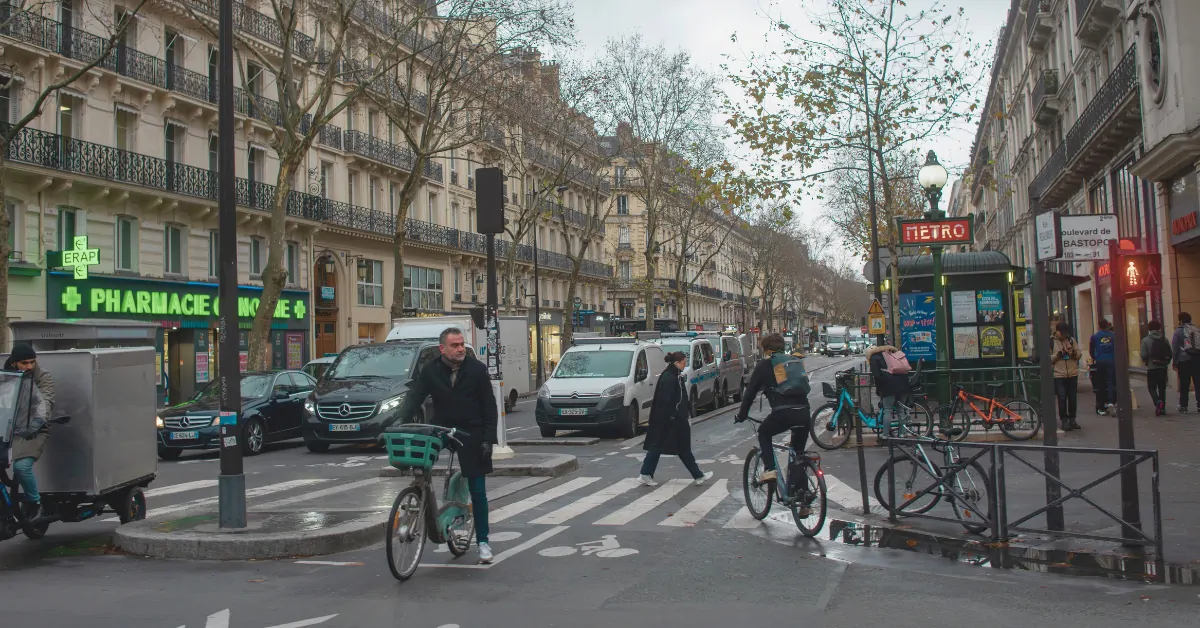
France continues to cut its greenhouse gas emissions, and the momentum is accelerating in 2026. According to the latest estimates from Citepa, published on October 13, emissions fell 4.1% in the first half of the year. An encouraging trend, driven in particular by a drop in fuel and natural gas consumption. But to meet its climate targets, the country will still need to accelerate.
Greenhouse gas emissions are falling faster in 2026
The curve continues to descend. And that’s good news for the climate. According to Citepa’s latest barometer, the agency responsible for tracking greenhouse gas emissions in France, French emissions fell 4.1% in the first half of 2026, compared with the same period in 2025, amounting to 7.7 million metric tons of CO2e avoided over six months.
Over the course of the year, however, the decrease is expected to be somewhat smaller. Citepa projects a 2.8% drop in 2026, versus 2.1% in 2025. If this trend holds, France would emit about 349.4 million metric tons of greenhouse gases this year, or 10 million metric tons less than in 2025.
Less gas for heating, less fuel on the roads
Behind this improvement, two sectors are playing a particularly important role: buildings and transport.
The building sector records the most dramatic decline, with emissions down 12% in the first half. This decrease is mainly due to lower consumption of natural gas used for heating, hot water, and cooking in homes and in commercial buildings.
Transport, France’s leading sector for greenhouse gas emissions, also shows encouraging progress. Emissions fell by 4.5% in the first six months of the year. Road transport contributes substantially to this decline. Diesel sales fell by 7.3% in the first half. Higher fuel prices have played a role in this trend, encouraging people to limit certain trips or reduce consumption. For 2026 as a whole, Citepa estimates that transport emissions could fall by 4.8%, or about 6 million metric tons of CO2e fewer.
Industry and agriculture are also contributing to the effort, with expected annual reductions of 1.8% and 1.3%, respectively.
Another benefit: potential improvement in air quality
The reduction in fossil fuel use can also have positive effects on air pollution. Citepa notes, in the first half of 2026, a 3.1% decrease in nitrogen oxide emissions, pollutants closely linked to combustion from traditional vehicles. Particulate matter PM2.5 emissions likewise fell by 5.8%, particularly thanks to lower heating emissions. These pollutants are different from CO2, but reducing them is an added benefit for the environment and public health. Burning less fuel often means both lower greenhouse gas emissions and less air pollution.
These results confirm a positive trend: French emissions keep falling year after year. That said, Citepa emphasizes that the current pace remains below what is needed to meet the country’s climate commitments. The National Low-Carbon Strategy indeed calls for indicative reductions of 5.7% in 2027 and 6.1% in 2028. France will have to cut its emissions almost twice as quickly as in 2026.
Another point of caution: part of the current progress is tied to lower energy consumption, especially in a context of expensive fuels. For these results to be durable, they must be accompanied by deeper transformations: energy-efficient renovations of homes, expansion of public transit, less-polluting vehicles, and greater use of decarbonized energy sources. The good news is that the emissions reductions continue. The challenge now is to make them lasting, so that they do not depend solely on energy prices or the economic cycle.
Read also
Do you really know what one metric ton of CO2 represents?