
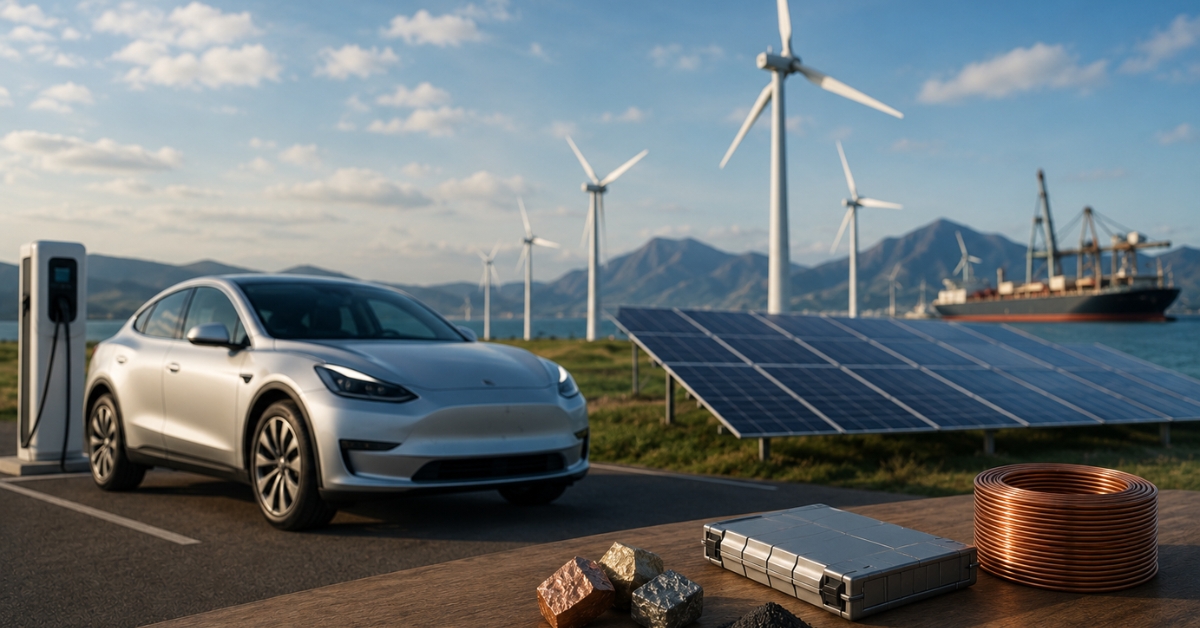
Lithium, cobalt, nickel, copper, graphite, rare earths… Long ignored in expert reports, critical minerals are now at the heart of industrial policies, the energy transition, and geopolitical rivalries. Not always scarce, but often hard to extract, process, or secure, they have become one of the material nerve centers of the 21st century.
They hide in the batteries of electric cars, the magnets of wind turbines, solar panels, the cables of power grids, semiconductors, satellites, smartphones, or military equipment. Without them, there is no large-scale energy transition, no accelerated digitization, no high-tech industries. But what are we actually talking about? A mineral or mineral raw material is deemed critical when it satisfies two conditions: it is essential to the economy or to a strategic sector, and its supply can be threatened.
Critical mineral does not mean rare
It is one of the most common misunderstandings. The “rare earths,” for example, are not necessarily rare in the Earth’s crust. What makes them strategic is their extraction, their chemical separation, their refining, and their industrial concentration. Likewise, a metal that is relatively abundant can become critical if its refining depends on a single country, if mines take twenty years to develop, or if no substitution is possible without sacrificing performance.
The French portal on non-energy mineral resources explains that criticality is traditionally assessed along two axes: supply risks and the economic importance of a substance. These risks can appear at every link in the chain: discovery of the deposit, extraction, transport, refining, transformation into a component, recycling at end of life. The problem is therefore not only “finding lithium” or copper. You also have to be able to extract it, purify it, transform it into an industrial-grade material, deliver it, finance it, gain local acceptance, and recycle it.
Why have these minerals become so strategic?
The energy transition is much more mineral-intensive than the fossil-based system it seeks to replace. A gas-fired power plant or a conventional car consumes mostly fuel over their lifetime. A wind turbine, a solar panel, or a battery requires more materials at the time of manufacture, but does not burn coal, oil, or gas thereafter.
This shift thus relocates part of the dependency: less imported hydrocarbons, but more metals and critical materials. Copper is essential for electrical grids. Lithium, graphite, nickel, manganese and sometimes cobalt are used in batteries. Rare earths like neodymium and dysprosium are used to manufacture permanent magnets employed in certain electric motors and some wind turbines. Silicon is central to photovoltaics and electronics. Gallium or germanium are used in advanced technologies, notably semiconductors.
According to the International Energy Agency, lithium demand rose by nearly 30% in 2024, while demand for nickel, cobalt, graphite and rare earths grew by 6 to 8%. For battery metals — lithium, nickel, cobalt and graphite — the energy sector accounted for 85% of the demand growth over the past two years.
A list that changes by country and era
There is no universal and definitive list of critical minerals. Each country or economic zone sets its own hierarchy according to its industrial needs, dependencies, and strategic priorities.
The European Union currently identifies 34 critical raw materials, including 17 strategic raw materials, deemed particularly important for the green transition, digital technologies, defense, and aerospace. Among them include lithium, cobalt, graphite, copper, battery-grade nickel, rare earths for magnets, gallium, germanium, tungsten, manganese, and metallic silicon.
The European Commission notes that its assessment rests in particular on economic importance, the risk of supply disruption, the concentration of production, dependence on imports, substitution possibilities, and recycling. Copper and nickel, although they do not meet all the conventional thresholds of criticality, were added to the European list because of their strategic character.
The real bottleneck: refining concentration
In the collective imagination, the minerals race is fought in mines. In reality, it is just as much — or more — played out in refining and processing plants. The IEA notes that geographic concentration has increased in recent years. Between 2020 and 2024, the average share of the top three refining countries for the main energy-transition minerals rose from about 82% to 86%. Over this period, roughly 90% of the growth in refined supply came from a single dominant supplier: Indonesia for nickel, China for cobalt, graphite, and rare earths.
The mine itself remains somewhat less concentrated than refining, but the imbalances are already significant: the Democratic Republic of Congo dominates cobalt, Indonesia dominates nickel, China dominates graphite and rare earths. For twenty minerals linked to energy and industry, the IEA estimates that China is the main refiner of 19 of them, with an average share of around 70%. This creates a paradox: even when geological resources exist in several regions of the world, the industrial chain can remain dependent on a few players.
Rising trade tensions
Critical minerals have also become instruments of power. Export restrictions, quotas, licenses, and technology controls are multiplying. The OECD estimates that export restrictions on critical commodities have been multiplied by a factor of five since 2009. Between 2022 and 2024, about 16% of global trade in these materials was subject to at least one export restriction. For cobalt and manganese, this share reaches about 70%; it is 47% for graphite and 45% for rare earths.
In this context, energy security no longer concerns only barrels of oil or cubic meters of gas. It extends to metals, powders, salts, magnets, cathodes, anodes, and the know-how of industries. The IEA warns that a durable shock to battery metals could raise the global average price of battery packs by 40 to 50%. Such shocks could slow the electrification of transport and reinforce the industrial edge of regions already dominant, particularly China.
Europe wants to reduce its dependence
The European Union has adopted the Critical Raw Materials Act to try to secure its supply. The 2030 targets are ambitious: extract on European soil at least 10% of its annual consumption of strategic raw materials, process at least 40%, recycle at least 25%, and not depend on more than 65% from a single third country for a given material.
The Commission notes, however, a strong dependency: Europe imports the majority of many critical materials, sometimes from a near-monopoly supplier. For example, it states that China provides 100% of Europe’s supply of heavy rare earths, that Turkey supplies 99% of boron, and that South Africa provides 71% of the platinum consumed by the EU.
Restarting European mining, developing refining, financing recycling, building strategic stockpiles, and forging partnerships with producing countries: this is now the roadmap. But it faces long timelines, massive investment needs, and local acceptance that is often fragile.