
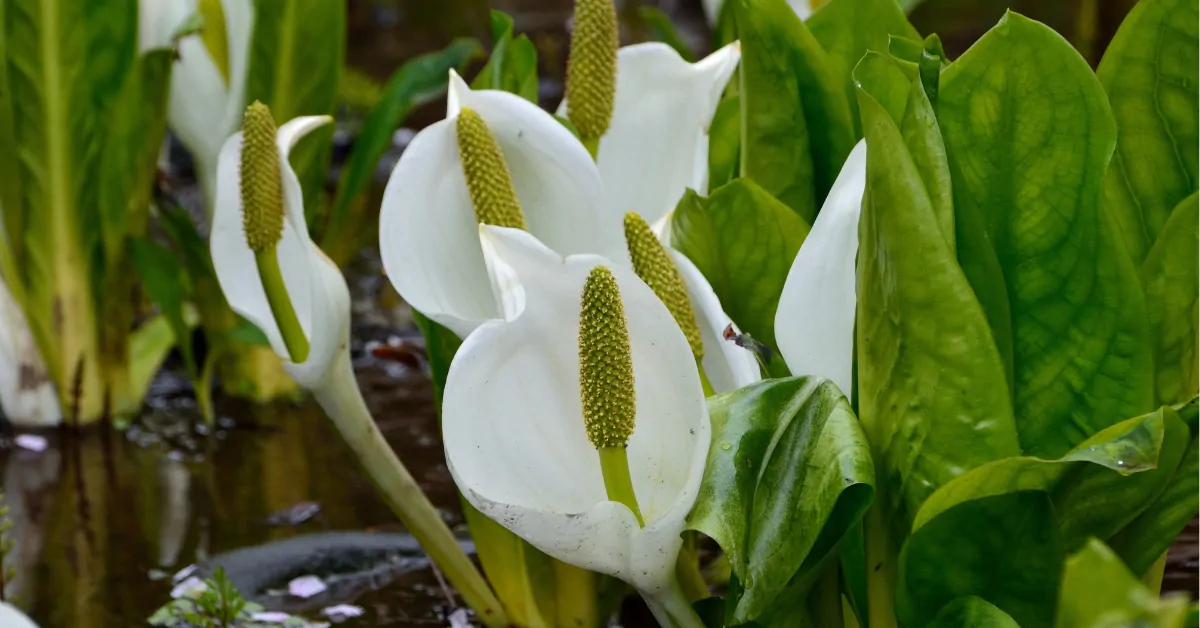
A new ecological threat weighs on the wetlands of Alsace: the appearance of the white Lysichiton (Lysichiton camtschatcensis), an emergent invasive plant species.
Exponential Reproduction Capacity
It was discovered in 2024 in Reipertswiller, in a marshy alder carr designated as Natura 2000. Facing the risk of rapid proliferation endangering local biodiversity, authorities launched a campaign of mass uprooting and total eradication over several years. Very hardy, the white Lysichiton tolerates temperatures down to -20 °C (−4 °F). It thrives in peat bogs, wetlands, and riverbanks where moisture remains constant. Its massive leaves, reaching up to about 1 meter (3.3 feet) in length, smother the local flora. As for its reproductive capacity, it is exponential: without intervention, a colony can grow from 200 to 1,000 plants in a single year.
To counter this invasion, the ONF Nord Alsace is implementing a real uprooting protocol before the plant seeds. Five forestry workers are mobilized to dig up not only the flowers and reproductive organs, but also all bulbs and deep roots. Indeed, the slightest fragment of tuber left in the damp soil is enough to trigger regrowth. Because young plants are more fragile, the teams plan to renew the operation each year for three to five years in order to exhaust the buried seed bank.
Yet Still on Sale
Elimination of extracted plant material will also be carried out with strict vigilance to prevent any accidental dispersal. Thus, bulbs, flowers, and roots collected will not simply be discarded, but fully destroyed through incineration and anaerobic digestion. Given the seriousness of the threat this plant poses to ecosystems, the state has chosen to fund the entire operation under its General Interest mission “Biodiversity and Landscape.”
Yet, paradoxically, unlike its cousin the yellow Lysichiton—which is banned—selling the white Lysichiton remains legal. This plant is available online or in garden centers for about fifteen euros (roughly $15), because its toxicity has not yet been officially recognized by law. In response to this situation, the ONF, the Botanical Conservatory, and the Regional Park of the Northern Vosges are joining forces to raise awareness among private pond owners, often responsible for introducing the plant, and to urge the public to exercise the greatest caution when purchasing it.