
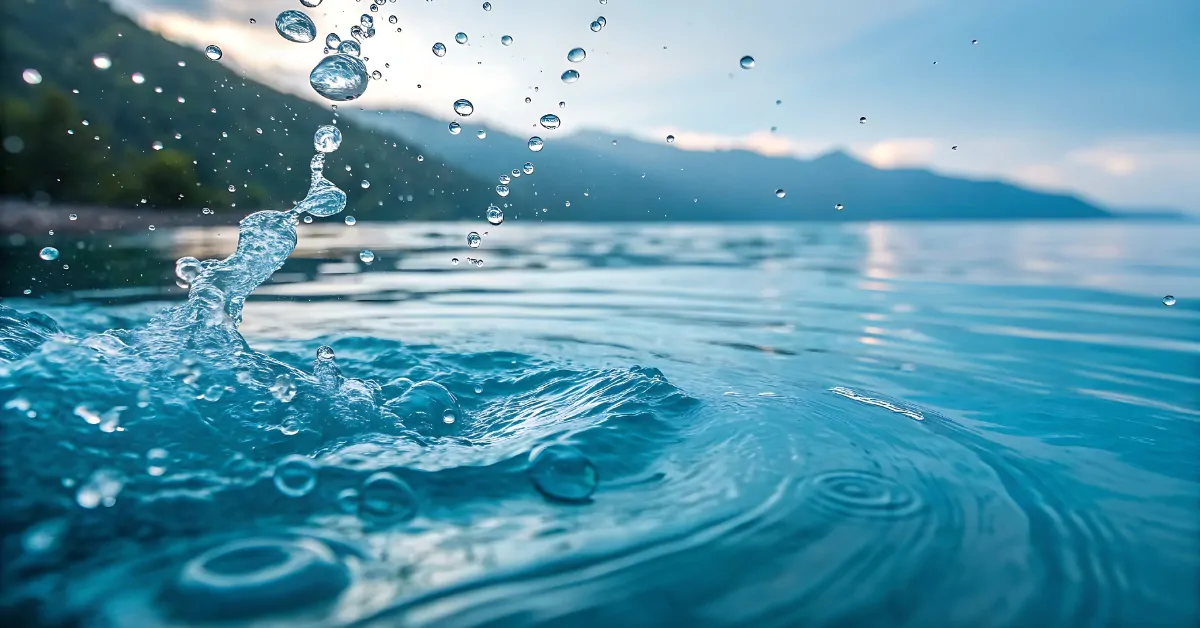
Imagine what a single drop of water reveals when viewed under a microscope…
At the Macro-Photographic Scale
How does one even conceptualize it when seeing it up close? Yet the meticulous examination of a single drop of seawater under the microscope reveals an astonishing agitation, turning what seems like an inert liquid into a thriving ecosystem. Photographer Angel Fitor has made it the subject of photo series whose beauty and mystery are simply breathtaking.
One must note that, at the macro-photographic scale, the water drop ceases to be invisible and becomes a genuine stage. Within it lies an immense biological crowd populated by a multitude of microscopic creatures that move, drift, and feed in a continuous rhythm.
A densely populated microcosm
Among the most remarkable inhabitants of this microcosm is the zooplankton. Composed of tiny animals and larvae of marine organisms, it spends its life actively filtering organic matter suspended and decomposing in the water. These small creatures play a fundamental role as the ocean’s cleaners and also form the base of the marine food chain.
Beyond the zooplankton, within a single drop of water the biological diversity intensifies dramatically with the presence of billions of unicellular microorganisms. By comparison, a single liter of seawater harbors tens of billions of these living entities, meaning that a simple glass of water potentially contains more individual organisms than there are people on planet Earth.
Phytoplankton and diatoms
Phytoplankton, or plant plankton, also shares this cramped space and flaunts geometric shapes so intricate that they resemble tiny extraterrestrial vessels. In truth, the impact of these microscopic plants extends far beyond their individual size: their global proliferation across the oceans is so massive that it can be observed and mapped from space by satellites.
Within this phytoplankton, the diatoms stand out for their unique cellular structure, which possesses the exceptional property of diffusing light optimally. This enables these microalgae to capture solar energy from every angle to maximize photosynthesis—a biological feat that currently inspires engineers in the development of new optical technologies. Ongoing scientific research continually broadens our understanding of this invisible universe. It is now estimated that there are more than 100,000 species of unicellular plankton and nearly 200,000 populations of marine viruses coexisting in the ocean.