
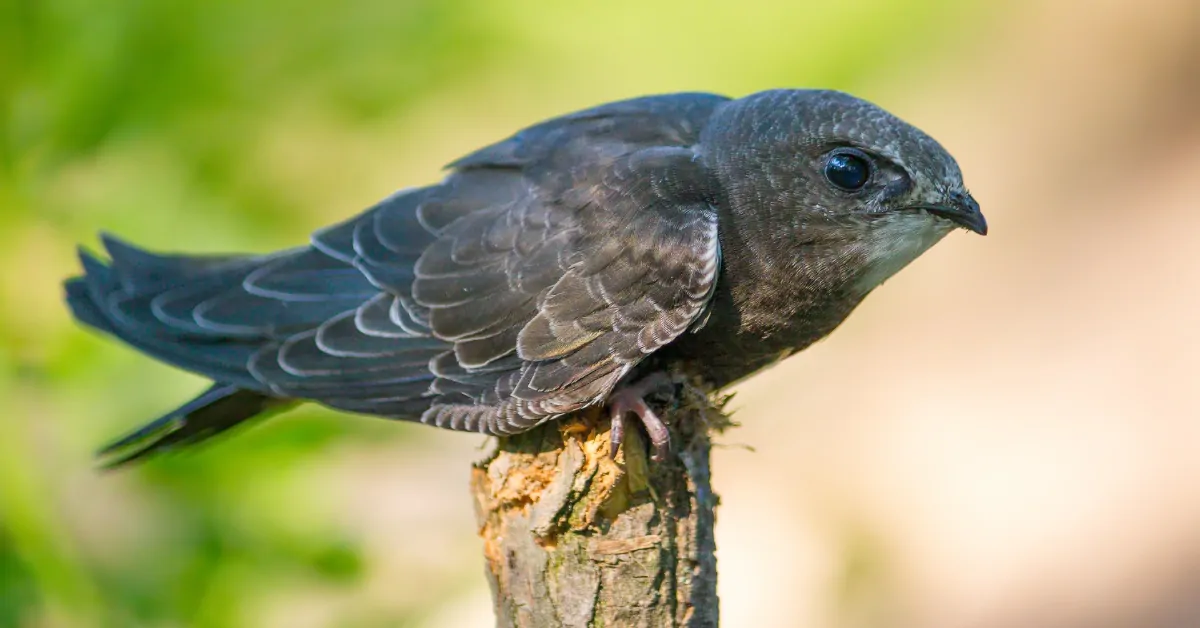
The Common Swift, or Apus apus, is often mistaken for the swallow. Yet this migratory bird belongs to a different family, the Apodidae. Its scientific name hints at its very short legs, because the swift spends most of its life in the air. It forages, mates, migrates, and can even sleep in flight.
The Common Swift, a bird built for the sky
Approximately 16 to 17 cm long (about 6.3–6.7 inches) and a wingspan of 42 to 48 cm (about 16.5–18.9 inches), the common swift is easy to distinguish from swallows when you take the time to observe it. Its long, slender, arched wings form a sickle-like silhouette. Its plumage appears almost entirely dark, with only a small pale patch under the throat.
Unlike swallows, it rarely perches on power lines. It spends most of its life in flight, except during nesting. It is, indeed, one of the most impressive birds to watch in cities, as it streaks between buildings while emitting its piercing calls.
The common swift feeds on insects captured in flight. Midge, mosquitoes, small beetles, and other aerial insects make up its diet. It thus plays a subtle but useful role in urban ecosystems.
Originally tied to cliffs and natural cavities, the common swift has adapted very well to buildings. It now nests often under roofs, in cracks, holes in walls, ledges or high-up crevices. However, it does not build a large visible nest like swallows. It instead makes use of an existing cavity.
Why is the Common Swift so remarkable?
The Common Swift is a flying champion. It can fly incredibly fast, execute tight turns, and thread through buildings with astonishing precision. Its fusiform body and long wings allow it to glide, accelerate, and abruptly change course.
Watching a common swift in flight can sometimes feel like it is about to hit a wall. Yet it slows at the last moment with spectacular control. Its arrivals near nesting sites are often impressive, especially in narrow urban streets where colonies are established.
Its legs, on the other hand, are very short. They are mainly useful for clinging to a wall or the entrance of a cavity. The ground is not its element. A swift found on the ground is almost always in trouble. It may be injured, exhausted, dehydrated, or too young to resume flight.
With young swifts, the first flight is decisive. Once they leave the nest, they can spend long stretches without landing. They typically return to a nesting site only as adults, after several years of aerial life.
Another fascinating feature: the common swift can sleep in flight. In the evening, it climbs to altitude and then glides for part of the night. This remarkable adaptation shows just how dependent this species is on the sky.
What you should remember
- The Common Swift is not a swallow.
- It spends almost all of its life in flight.
- It nests often in the cavities of buildings.
- A swift on the ground is usually a bird in distress.
- Its nesting sites are threatened by building renovations.
Is the Common Swift threatened?
The Common Swift remains listed as “Least Concern” worldwide. This means the species is not considered at immediate risk of extinction. However, the situation warrants monitoring. In several European countries, populations are declining, notably due to the disappearance of nesting cavities and the decline of insects.
In France, the swift is also affected by rapid changes in the built environment. Old walls, cornices, eaves, and cracks where it used to nest are disappearing. Yet this bird returns to the same nesting site year after year. When access is blocked, an entire colony may be unable to reproduce.
The threats facing the Common Swift
The loss of nesting sites
The main urban threat to the swift remains the loss of cavities. New constructions are often smooth, hermetic, and lacking in nooks and crannies. As for older buildings, they are frequently renovated, insulated, or repainted without a prior wildlife survey.
Energy-efficient renovations are essential to reduce energy use. But they must be planned with the building’s biodiversity in mind. Blocking a cavity used by swifts can erase a nesting site. It’s all the more regrettable given that simple solutions exist: keep useful openings, adjust the renovation schedule, or install swift nesting boxes.
In France, swifts are protected species. Do not destroy or obstruct their nesting sites without following regulations. If in doubt before work, it is best to contact a local naturalist association, the LPO, or the appropriate authorities.
The decline of insects
The Common Swift feeds almost exclusively on insects captured in flight. The reduction of insect populations therefore poses a serious threat. It can be linked to several factors: pesticides, land-use changes, the shrinking of flower-rich meadows, excessive nighttime lighting, or simplification of landscapes.
Fewer insects mean less food for both adults and nestlings. During the breeding season, parents must make more trips to feed the young. When resources dwindle, rearing the broods becomes increasingly difficult.
Heat waves and weather hazards
Heat waves can also push swifts into difficulty, especially young birds still at the nest. In the attic, heat can become suffocating. Some nestlings may fall to the ground while trying to escape overheating.
Weather conditions also influence the availability of insects. A long cold, rainy, or windy period can sharply reduce food resources. During migration, storms and heavy disturbances can complicate the journeys.
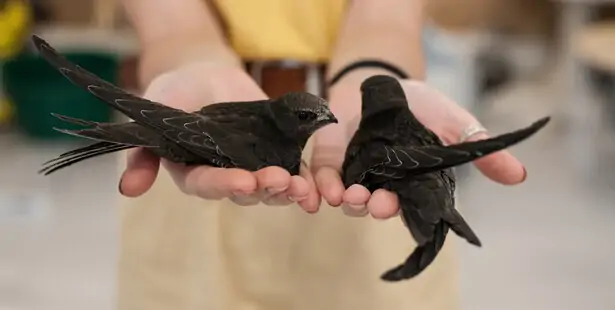
What to do if you find a swift on the ground?
A swift resting on the ground is not in a normal situation. Do not throw it into the air to “help” it take off. This action can worsen an injury or cause a fall.
The first step is to secure it. Gently place it in a closed, ventilated box lined with a clean cloth. Keep it calm, away from children, pets, and heat. Do not give it bread, milk, or seeds. Also avoid forcing it to drink, as that can be dangerous.
Then quickly contact a wildlife rehabilitation center, the LPO, SOS Martinets, or a local competent organization. These groups can tell you the appropriate steps based on the bird’s condition.
How to help Common Swifts near you?
The first aid is to protect their nesting sites. If swifts nest under a roof or in a facade, avoid construction work during the breeding period. This typically runs from spring through mid-summer, with regional and weather variations.
During renovations, it is possible to integrate specific nesting boxes into facades or under eaves. These boxes should be placed high with open access. The swift is faithful to its sites, and it may take time to adopt a new location. Patience is therefore essential.
In the garden or on a balcony, you can also favor insects. Plant nectar-rich flowers, banish pesticides, leave some wilder patches, and reduce unnecessary nighttime lighting. These actions benefit swifts, but also swallows, bats, pollinators, and other biodiversity allies.
As with any biodiversity effort, observation and outreach matter. Talk to children about swifts, report colonies, take part in naturalist inventories, and support wildlife protection groups.