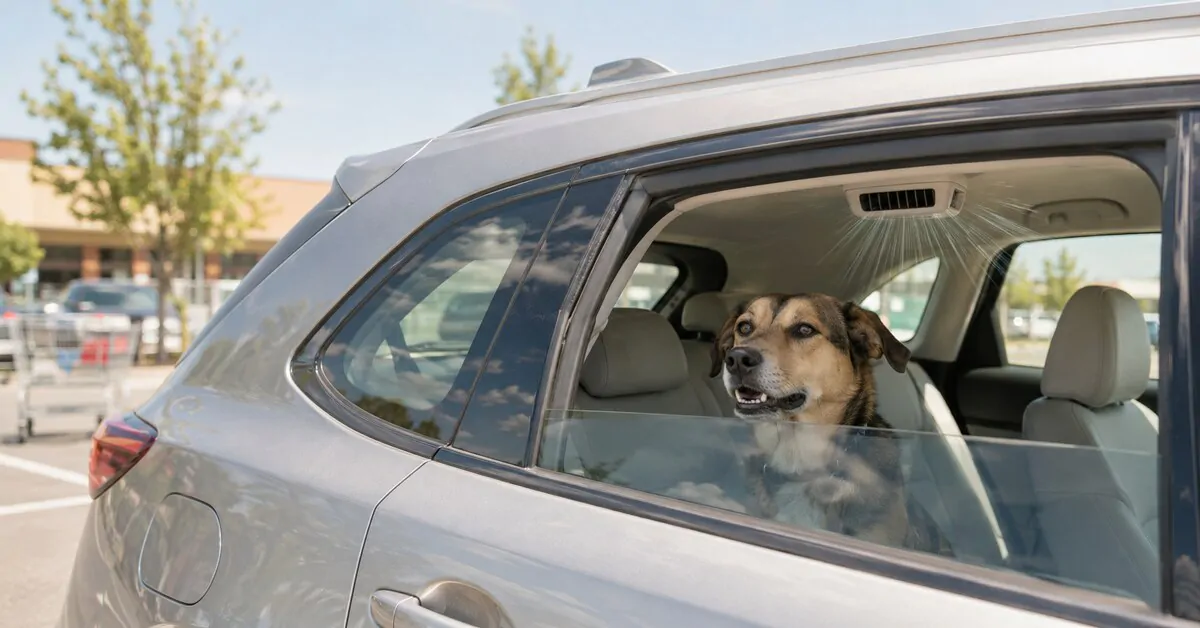
There is a growing concern among veterinarians about a false sense of security. Faced with real risks of mechanical failure and the speed with which a car left in the sun becomes a heat trap, animal health professionals now agree on a strict rule: never exceed a maximum of fifteen minutes.
The Air Conditioning Mirage
Air conditioning when the car is off gives an illusion of total protection that masks a critical biological reality. Dogs do not regulate their body temperature through sweating as humans do, but primarily through panting. A cooling mechanism that proves quickly ineffective if ambient conditions deteriorate. Entrusting your pet’s life to an air conditioning system that is running slowly in a parking lot is to rely entirely on a mechanical and electrical chain that could fail at any moment.
The main blind spot for drivers is the possibility of a sudden and invisible breakdown: an engine stalling, a compressor dying, a dead battery, or a glitch in the car’s “Dog Mode.” If the cooling system stops in the blazing sun, the effect is immediate and devastating. Without fresh air, the interior temperature can surge by more than 20°C in just a few minutes, easily climbing to around 122°F once the outside temperature tops roughly 77°F.
The 15-Minute Rule
Veterinarians set the critical threshold at 15 minutes—the limit not as a comfort margin but the average time beyond which a technical malfunction could irreversibly tip into tragedy. After this quarter-hour mark, the absence of direct supervision leaves the dog vulnerable to acute dehydration and heat stroke, with the animal unable to free itself from the vehicle or call for help.
Not all dogs are equally affected by a sudden temperature rise, and some profiles face even more immediate danger. This includes brachycephalic breeds (bulldogs, boxers and other pugs) whose facial anatomy greatly hinders breathing and accelerates suffocation. Likewise, puppies, elderly dogs, overweight animals, or those with dark coats—which absorb more of the sun’s rays—see their thermal resilience collapse in record time.
Signs of Distress
In the case of heat stroke, the animal’s system tips over quickly. Several hallmark symptoms should alert bystanders or the owner upon return. Abnormally heavy and persistent panting, excessive drooling, mucous membranes that appear bright red, an unsteady gait, or vomiting are the early warning signs of an imminent loss of consciousness. In such a life-threatening emergency, U.S. authorities, firefighters, or bystanders are generally allowed to break a window to free the distressed animal.
Beyond the trauma, the law punishes such negligence severely, equating confinement of a warm-blooded animal in heat with cruelty or mistreatment, with penalties that can include fines and jail time. To prevent this, veterinarians recommend safer alternatives: traveling with a companion so someone stays with the animal, or simply leaving your dog at home on cool tile when a trip is likely to be lengthy.
Also read
7 Eco-Friendly Habits to Adopt with Your Dog