
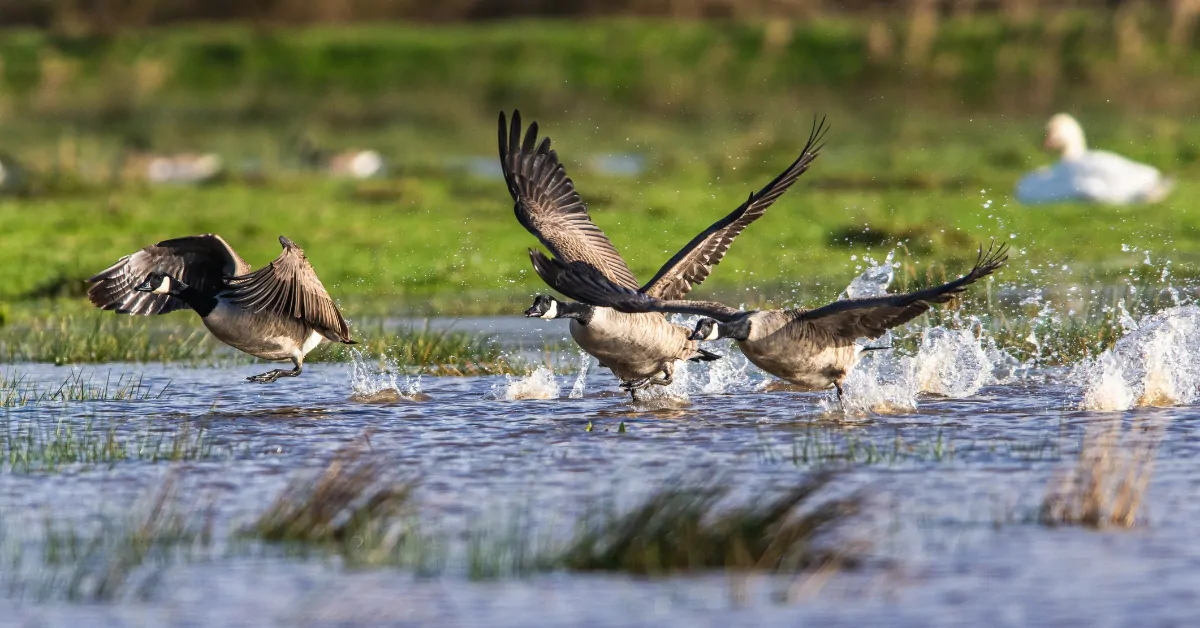
The LPO is calling for the early opening of waterfowl hunting to be postponed, currently set for Friday, August 21, 2026. The association wants to wait for the general opening on September 20, 2026, arguing that current conditions no longer allow birds to move normally between wetlands that are sufficiently nourished.
The LPO Calls for a Pause in Waterfowl Hunting
In the Pays de la Loire region, the warning takes on a particularly concrete dimension. Maine-et-Loire has been placed at “crisis” level for water uses. Behind the debate over the hunting calendar lies thus a broader question: what happens when ducks, waders, and protected species must share an ever-shrinking number of aquatic refuges?
The hydrological assessment stands at the center of the LPO’s push. According to the French Office for Biodiversity, about 43% of waterways are dry or have no flow. The association also characterizes the current episode as one of the most intense in a century. The meteorological context has developed over the summer: three heat waves have already hit France since the season began, on top of a heat spell that occurred early in May 2026.
This scarcity of water directly alters the distribution of wildlife. Rather than having a network of ponds, lakes, streams, and marshes where birds can spread out, they concentrate on the sectors that remain functional. The LPO sees a double risk there. First is the harvest pressure on populations gathered on reduced areas. Added to this is disruption: repeated takeoffs, forced movements, and the search for another resting place as retreat options are limited.
It is in this context that Allain Bougrain-Dubourg spoke of “a massacre and disruption without precedent,” said the president of the LPO. The phrase is deliberately strong. The association not only highlights mortality directly linked to shooting: it argues that the additional human activity imposed around the few water points could affect the entire bird community, including species that are not hunted.
Pays de la Loire: drought obliges, birds’ refuges under pressure
The situation is particularly sensitive in the Loire wetlands. Some areas are now completely dry, while those that retain water are hosting a growing share of the birds present. The LPO Pays de la Loire describes it as “a catastrophic situation for the region’s wetlands.”
For these birds, a water point is not just for drinking. Wetlands also provide feeding grounds and resting spaces, two essential functions as the first migrants begin to appear. The LPO notes that even protected areas are affected by the drying up and can no longer offer everywhere the usual tranquil conditions. A bird forced to move around to find food and water spends more energy, while heat and resource scarcity may already have weakened it.
The problem is all the more complex because species mix together. Alongside ducks and certain waders that can belong to the harvestable game are herons, egrets, white spoonbills, and some protected raptors. Storks are also among the protected birds found in these habitats. For the association, disturbance at a site does not stop at the species authorized for harvest.
Waterfowl Hunting: An Already Highly Regulated Calendar
The calendar, however, is not uniform, and several rules already govern harvests. On the maritime public domain, the opening began on August 1, 2026. The regional challenge focuses notably on the August 21, 2026 deadline outside the maritime public domain. The LPO Pays de la Loire is asking the prefects to exercise their intervention margin and hopes for a postponement until September 20, 2026.
From the hunters’ side, the regulations presented on the eve of the opening also stress the limitation of harvests. In Vendée, a cap of 15 birds per day per hunter, across all species involved, is set for several ducks and other waterfowl. The captures must be recorded at the moment of harvest on the ChassAdapt app or logged in a notebook provided for this purpose, according to the same federation.