
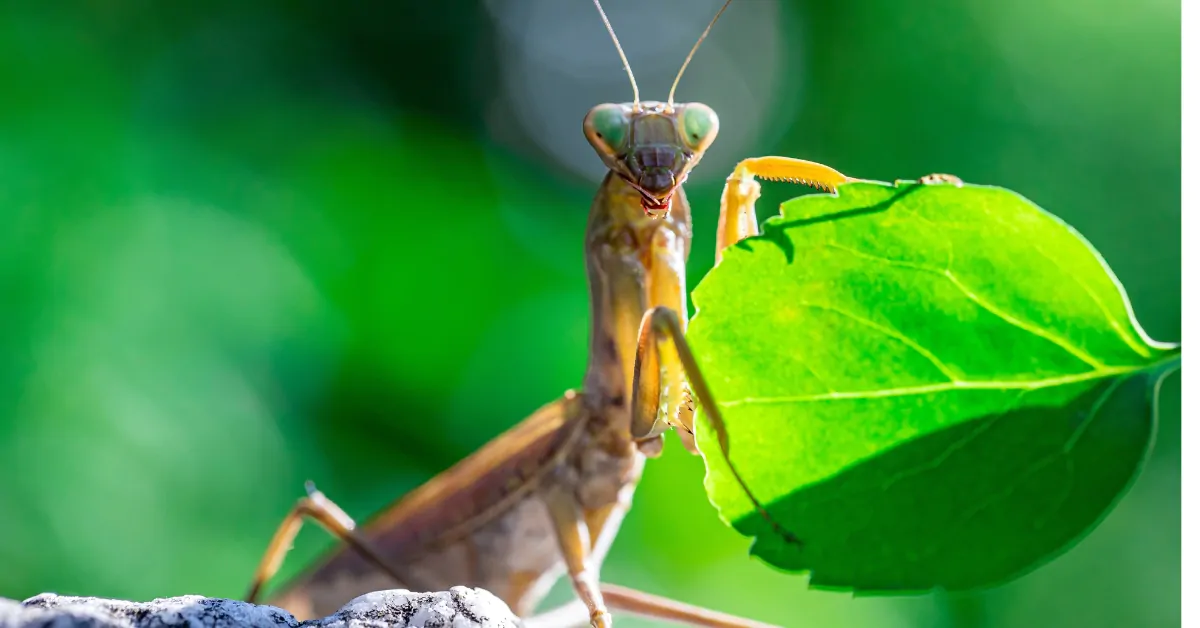
This is a species that favors sunny, dry habitats and loves warmth. The praying mantis “Mantid religiosa” is anything but a common grasshopper.
A Spectacular Colonization
Driven by successive waves of intense heat, the summer of 2026 records an unprecedented presence of the praying mantis (Mantis religiosa) in gardens and parks, notably in eastern France, but also in Switzerland and Germany. Native to Africa and established in the Mediterranean basin for ten millennia, this thermophilic species directly benefits from climate warming to extend its territory northward.
She is rightly regarded as one of the largest native insects in Europe: the praying mantis stands out with imposing dimensions. Females grow up to about 8 centimeters long. Its green or brown coloration, its highly mobile triangular head perched on a distinct neck, and its forelegs folded in prayer, hence the nickname, allow it to be instantly distinguished from ordinary grasshoppers.
An Explosion in Germany
In light of its ubiquity in gardens this summer, the German Nature Conservation Federation (NABU) has invited the public to report sightings on the online platform Naturgucker. Between early July and mid-August 2026, more than 15,000 photographic reports have already been recorded. This outpaces previous annual tallies with a remarkable accuracy rate estimated at 99.9%.
These data contribute to a broad research project aimed at tracking the species’ spread in the era of climate change. Particularly abundant in Baden-Württemberg after a mild spring, praying mantises are indeed colonizing new areas. Researchers are now studying whether populations in the southwest and east will eventually meet in northern regions that were once too cold.
A Harmless Predator for Humans
Despite its captivating appearance and piercing gaze, this imposing insect poses no danger to humans: it is venom-free and does not sting. Larvae and adults are ambush hunters that seize their prey—other insects and spiders—in a split second before devouring them alive. In this way, they play a key role in regulating their ecosystems.
The presence of praying mantises remains observable through October, the end of their annual biological cycle. Renowned for its sexual cannibalism, the species sees most males become meals for females after mating to provide the energy needed for egg-laying. Only the eggs will survive the rigors of winter to ensure the next generation.