
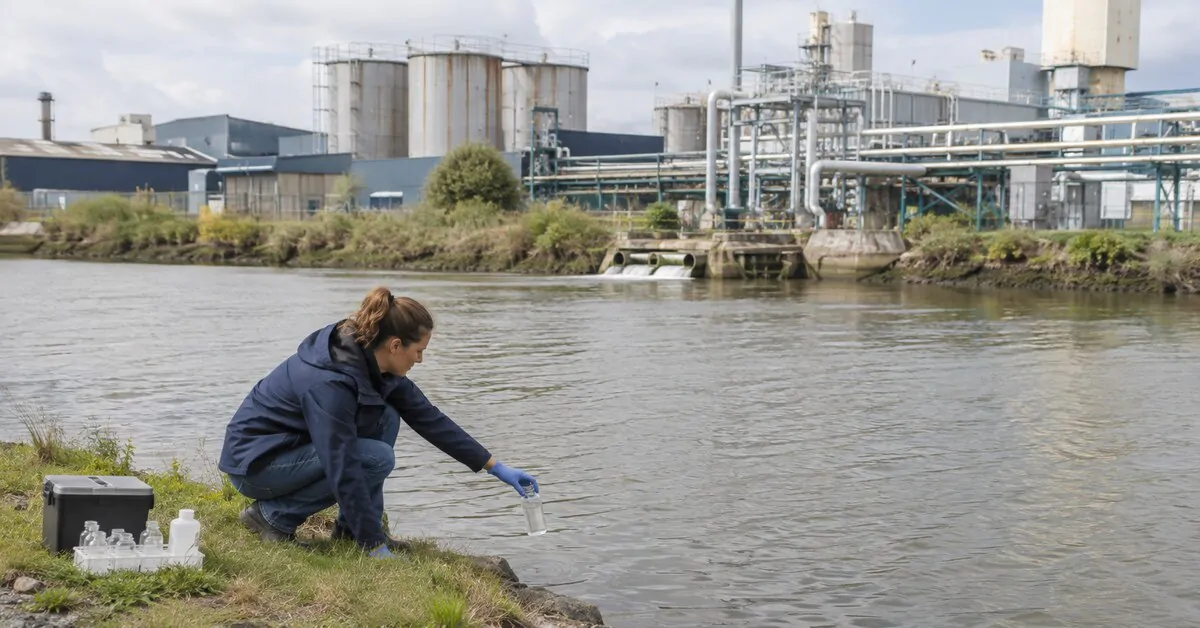
“Forever chemicals” — PFAS — these widely used industrial molecules often end up in waters near industrial sites. In parts of France, tap water usage has even been restricted, and expensive depollution systems are being installed to combat their presence.
A Cost of About $2.2 Billion per Year
That’s why, starting on September 1, the polluter-pays principle comes into effect to ensure that industries contribute to funding the cleanup. A measure whose rollout had been delayed many times. But now, at last, facilities that discharge PFAS into water will be charged a levy of $110 per 100 grams discharged. According to a recent report from France’s General Inspectorate of Finances on the costs of depolluting drinking-water networks contaminated by PFAS, this new tax is expected to yield only a limited return this year: about €10 million (roughly $11 million).
Yet, according to the same report, roughly €2 billion per year in the near term would be needed for a genuine depollution. A figure that raises questions about the actual effectiveness of this new polluter-pays rule. Not only were only 28 PFAS molecules chosen, but all PFAS emissions into the air were also excluded from consideration.
A Gift to Industry
Moreover, this measure “sets the obligation to monitor these discharges into water at once every five years for industries emitting less than 2 kg per year, i.e., the majority of cases”. The levy system took 19 months to come into force after the PFAS law was enacted, giving the main emitters time to implement solutions to curb their discharges. A good thing in principle, but not without consequences for the tax’s yield.
Furthermore, if companies install water-treatment systems, they can also benefit from an 80% deduction. A real boon to polluting industries that suggests everything has been arranged so that they end up paying as little as possible. Unlike municipalities and taxpayers confronted with these forever chemicals…
Read also
PFAS: The State Sued for Its Inaction on Forever Chemicals