
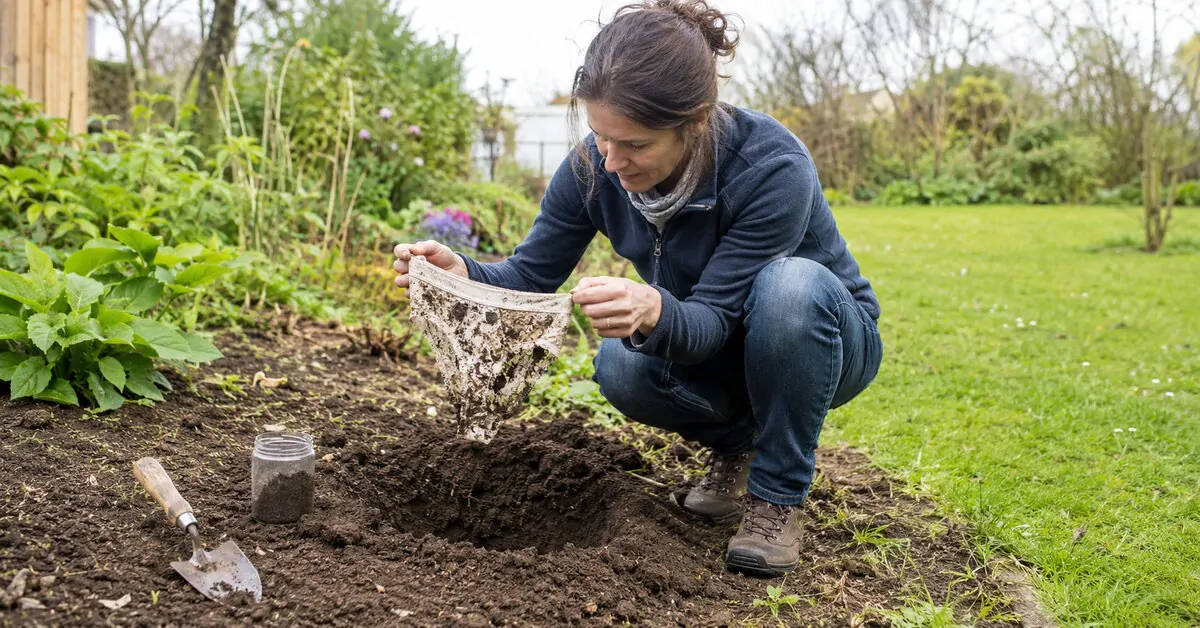
In Switzerland, researchers recruited 1,000 volunteers to bury more than 2,000 cotton underwear items. Behind this quirky experiment, a serious goal: to measure the biological activity of soils and raise public awareness about this essential, yet largely invisible, ecosystem.
At first glance, the image might evoke a smile: thousands of undergarments buried in gardens, fields, and meadows, then unearthed a few weeks later. Yet the experiment was not a whimsy.
The citizen-science project “Beweisstück Unterhose,” which could be translated as “The Evidence Item Underpants,” was launched in 2021. It was led by Agroscope and the University of Zurich. Its results were published in August 2026 in the scientific journal Plants, People, Planet.
This experiment aimed to answer a central ecological question: how can we make visible the biological activity of soil?
Cotton as a Revealer of Soil Life
The principle is fairly intuitive. Cotton is mainly composed of cellulose, an organic material that soil organisms can break down. The faster the fabric deteriorates, the higher the activity of bacteria, fungi, and the subterranean microfauna.
As part of this study, 1,000 citizens buried 2,000 organic cotton slips as well as 12,000 standardized tea bags. The trials were conducted on roughly 1,000 sites across Switzerland.
Participants followed a common protocol. They then unearthed the underwear, photographed them, and sent them to the laboratory along with soil samples.
After one month, about 10% of the cotton had decomposed. After two months, this rate averaged a little over 50%. Differences between sites, however, were substantial.
Gardens More Active Than Lawns
Private gardens recorded the fastest decomposition, with about 58% of the cotton gone after two months. Cultivated soils reached around 51%, compared with 47% for permanent meadows.
Lawns came in last, with an average decomposition of about 40%. According to the researchers, the land-use type was the factor that most influenced fabric degradation.
Gardens generally contained more organic matter. They offered favorable conditions for fungi, bacteria, and earthworms, the valuable laborers of the soil.
By contrast, a uniform, well-kept lawn can provide less food and fewer varied habitats for underground organisms.
A Heavily Degraded Underwear Does Not Necessarily Mean the Soil Is Healthy
Researchers caution against a rush to interpretation. A heavily decomposed underwear does not automatically indicate that a site is ecologically healthy.
The speed of decomposition depends on many factors: humidity, temperature, altitude, acidity, soil texture, organic matter, and nutrient concentrations.
The test therefore mainly informs about the intensity of decomposition and soil fertility. It does not, on its own, measure biodiversity, pollution, or the physical structure of the soil.
Gardens Sometimes Too Rich in Phosphorus
The analyses revealed elevated phosphorus concentrations in some private gardens. The average was 13.4 mg per kilogram of soil, versus 3.5 mg in cultivated fields. On a few sites, it exceeded 60 mg.
This richness can accelerate the decomposition of cotton without necessarily being beneficial. It may reflect excessive use of compost or fertilizers. The researchers note that pinpointing the exact source of these concentrations remains difficult.
Excess phosphorus that plants do not absorb can be carried into groundwater and waterways, potentially disturbing aquatic ecosystems.
Before regularly fertilizing your garden, it is best to consider the real needs of your plants. A natural input should not become a default. To nourish the soil with care, find our tips for successful home composting.
Soil, a Vast Ecosystem Under Our Feet
The study’s interest goes far beyond the performance of a single piece of cotton. More than half of the world’s biodiversity would live beneath the soil’s surface.
Bacteria, fungi, earthworms, mites, and springtails form a complex network. Together, these organisms participate in nutrient recycling, soil fertility, water retention, and carbon storage.
Yet soils remain often the great forgotten factor in biodiversity protection. They face sealing, compaction, erosion, pollution, and certain intensive agricultural practices.
At the scale of a garden, several actions can support this subterranean life: limit pesticides, diversify plantings, and avoid leaving soil exposed. Discover, in particular, why it’s better not to leave soil bare.
Mulching, fallen leaves, and measured additions of compost help preserve moisture and provide organic matter. These principles are central to methods for achieving fertile soil through permaculture.
Can You Reproduce the Slip Test in Your Garden?
You can try the home experiment to observe decomposition activity. Choose a white, 100% cotton undergarment, then bury it at a shallow depth. Mark the location well before retrieving it about two months later.
The seams and elastic, often made from synthetic material, will usually remain intact. They should be removed from the soil after the experiment.
Good to know
This at-home experiment is litmus-tested and indicative. To compare two plots, bury identical fabrics on the same day, at the same depth, then dig them up simultaneously.
More than a true diagnosis, this test is a fun way to discover what lies beneath our feet. The disappearance of cotton reminds us that soil is not just a surface to support things; it is a living environment on which a large part of our food depends.
Read also
This year, bury a slip in your garden!
- https://www.geo.fr/environnement/pourquoi-des-scientifiques-ont-ils-enterre-plus-de-2-000-sous-vetements-en-suisse-233420