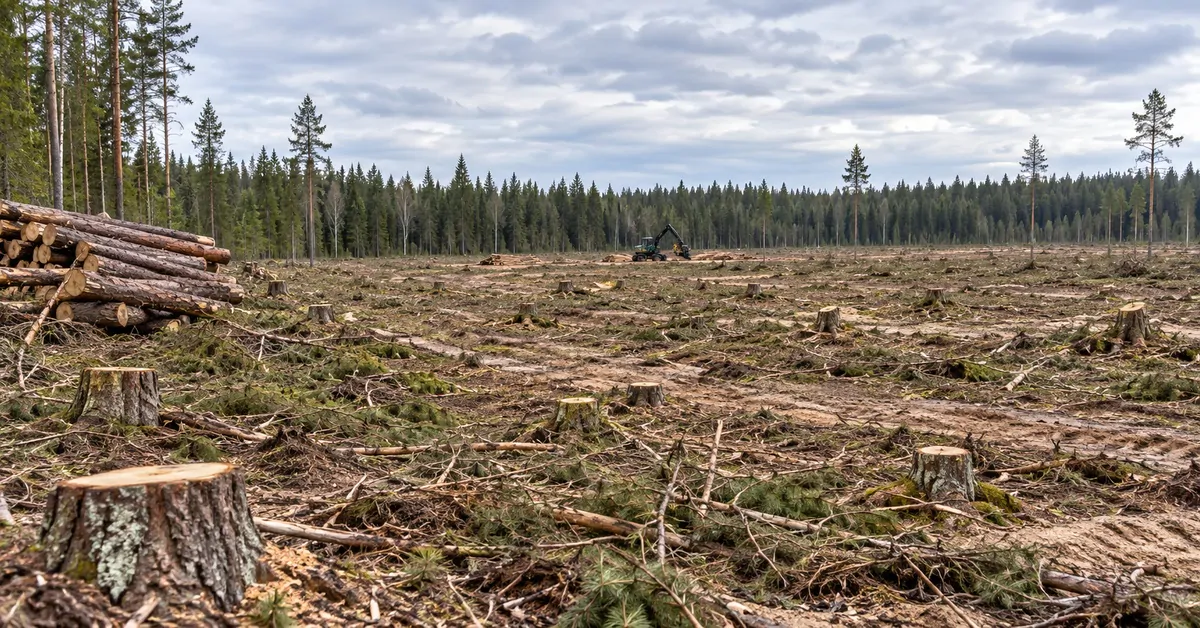
The Finnish authorities are now reviewing the legality of the work, while nature advocates are decrying the loss of areas considered crucial for biodiversity.
Google began clearing before the environmental assessment process had concluded
The scale of the clearing carried out by Google in Muhos, in northern Finland, is now hard to dispute. The company itself estimates the area felled at about 330 hectares (roughly 815 acres). Finnish regulations require an environmental assessment when permanent forest cover is removed from a continuous area exceeding 200 hectares (about 494 acres).
The controversy centers largely on timing. According to Wood Central, the felling began in March 2026. Tuike Finland, the contractor hired by Google, asked the authority in April whether the project could bypass a full environmental assessment. The administration indicated in May that the project would not receive an exemption. Yet, the clearings reportedly continued through August 2026.
That sequence of events lies at the heart of the case. An environmental assessment is not merely meant to inventory damage after land has been transformed. It is specifically intended to identify habitats, ecological corridors, sensitive species, and the impacts on water and landscape, and it can also lead to the imposition of avoidance measures. Clearing the forest before this analysis is completed can sharply reduce the procedure’s ability to prevent harm to nature.
The Finnish Association for Nature Conservation is calling for “the activities on this site to be suspended.” Google, for its part, argues that the forestry operations were carried out in compliance with the forest law. The company says it is awaiting further guidance from Finnish authorities.
A Muhos Forest Shortchanged on Areas Critical for Biodiversity
For environmental experts, the issue goes beyond the number of hectares lost. Suomen Luonto, a Finnish environmental news outlet, analyzed satellite imagery from Sentinel as well as locally shot footage. The analysis found that the bulk of the large-scale clear-cutting was executed rapidly in March and April 2026.
Four small zones identified as important for biodiversity were left intact in the middle of the cleared area. They were later felled in July 2026. The ecological study accompanying the planning had recommended preserving two of these zones from any land-use change, including logging. The other two should have been preserved as much as possible. The magazine also notes that these areas appeared in planning documents as places of particular ecological importance.
However, a legal nuance remains essential. The four areas were not nature reserves with formal protection status, Muhos technical director Mikko Kari told Suomen Luonto. “It isn’t really the town’s business if a private owner cuts trees,” he said. The magazine notes that the local documents nonetheless urged consideration of the natural values of these spaces.
From a forest conservation standpoint, the distinction between strict regulatory protection and ecological value remains decisive. A small wooded plot may not qualify as a reserve, yet it can serve as a biodiversity refuge, a breeding ground, or a corridor linking several habitats.
Google in Finland: €13 Billion in Investments and Forest Protection on the Line
This case unfolds against an extraordinary economic backdrop. Google plans to invest €13 billion in Finland over the next two years. It represents the company’s largest single investment in Europe. The expansion encompasses Muhos, Kajaani, Vaala, and Hamina, where Google already runs a data center.
In Muhos, the money fuels high expectations. The data centers are expected to bring jobs, economic activity, and new employment to a rural municipality.
Given these prospects, the environmental debate has shifted from the Muhos site alone. Finland has become a magnet for data-center operators thanks to its cold climate and a power supply largely backed by nuclear, wind, and hydropower.
But the growth of these facilities also raises questions about the electricity draw of data centers, grid capacity, and ecological impacts. A citizen initiative calling for stricter regulation collected more than 50,000 signatures in three days.