
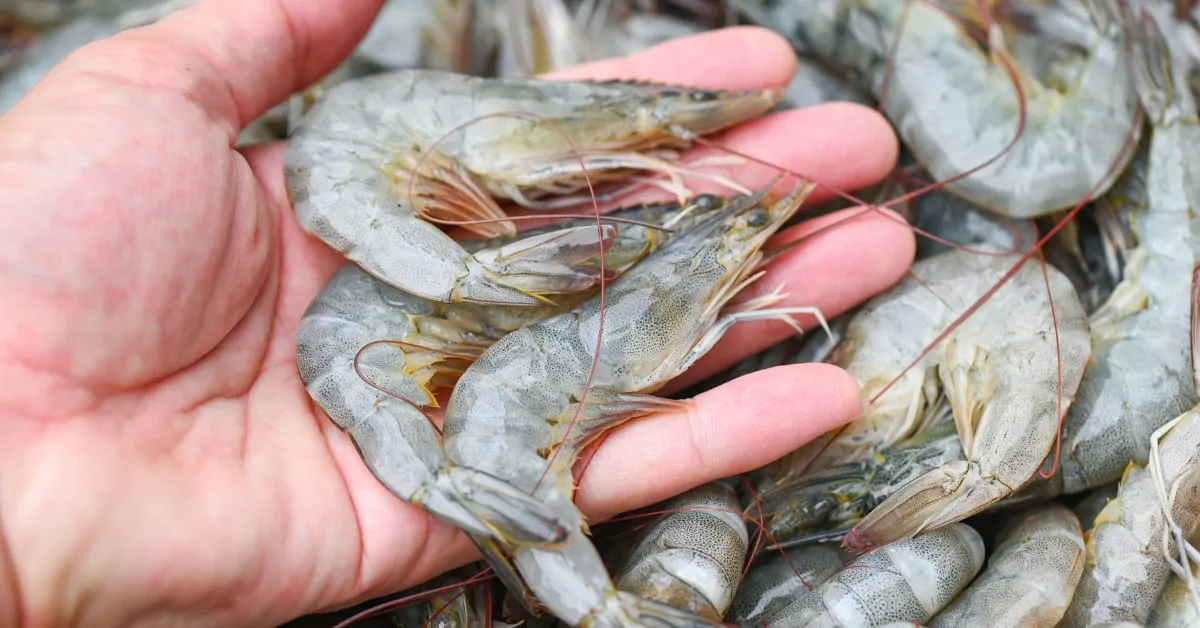
Each week, millions of French shoppers buy shrimp without realizing the suffering these animals endure. Eyestalk ablation, prolonged agony: the American NGO ICAW has published a damning report on intensive farming practices. In October 2026, the organization directly challenged France’s big retailers, which purchase between 6 and 9 billion shrimp per year, placing France at the forefront of European consumers.
What you don’t know about the shrimp you eat
Behind the seemingly harmless appearance of shrimp lie two practices deemed cruel by ICAW. The first, eyestalk ablation, involves mutilating the females to boost their egg production. The second concerns slaughter without prior stunning.
Eyestalk ablation involves severing one or two eyestalk peduncles from female shrimp without anesthesia, disrupting their hormonal system and increasing egg production. This method is widely used in hatcheries in Latin America and Asia, the main sources of shrimp sold in France.
Plunging live shrimp into ice is the standard slaughter method, supposed to cause a rapid death. But, according to ICAW, this process is ineffective under industrial conditions, resulting in prolonged agony or even pure suffocation. No electric stunning protocol is broadly in place.
440 billion shrimp slaughtered each year
Each year, 440 billion shrimp are slaughtered, making them the animals kept in captivity the most numerous, surpassing fish and chickens. Their fate remains largely ignored in animal-welfare debates, although since 2005 the European Food Safety Authority recognizes the crustaceans’ ability to feel pain.
France is the largest per capita consumer of shrimp in Europe, with 6 billion units eaten each year. Of these volumes, 70% come from intensive farming in Ecuador, Venezuela, India, and Madagascar. Each shrimp purchase helps sustain these practices.
Which retailers are really taking a stand?
Four retailers have taken concrete commitments to eliminate eyestalk ablation and to mandate electric stunning. Intermarché, U, Auchan and Aldi aim for 2030 for the first three and 2035 for Aldi. These commitments cover all of their offerings, sending a strong signal to producers.
Carrefour, Casino and Lidl ban eyestalk ablation but do not have a clear position on stunning. Carrefour is working to implement it by 2027 for its private-label brands, while Grand Frais sources 90% of its supply from suppliers avoiding eyestalk ablation, though it cites technical constraints.
E.Leclerc offers no commitments on eyestalk ablation or electric stunning. According to the ICAW report, 50% of the French market remains covered by retailers with no commitments or with partial commitments as of October 1, 2026.
Also read
Crustacean protection: Switzerland’s measures