
On October 22, 2026, the International Union for Conservation of Nature (IUCN) unveiled at the COP-17 Biodiversity Conference in Yerevan, Armenia, an unprecedented study that sends a chill down the spine: 96% of shallow-water coral reef ecosystems are now classified as “critically endangered.” This first global assessment, covering 127 tropical and subtropical ecoregions spanning 188,362 square kilometers of reefs across the planet, lays out a damning picture of the state of these jewels of marine biodiversity.
According to projections established by the international organization, if current trends persist, nearly all coral reefs could collapse by 2075, in barely half a century. This alarming outlook rests on the IPCC’s mid-range scenario forecasting a global temperature rise of 2.7°C by 2100.
Thermal stress threatens coral reefs
Dr. Grethel Aguilar, director-general of the IUCN, does not mince words in the official release: “Coral reefs are one of the most obvious indicators of ocean health. Their decline deprives countless species of food, shelter, and spawning grounds they rely on, while threatening the safety and livelihoods of coastal communities and undermining key economic sectors such as fishing, aquaculture, and coastal tourism.”
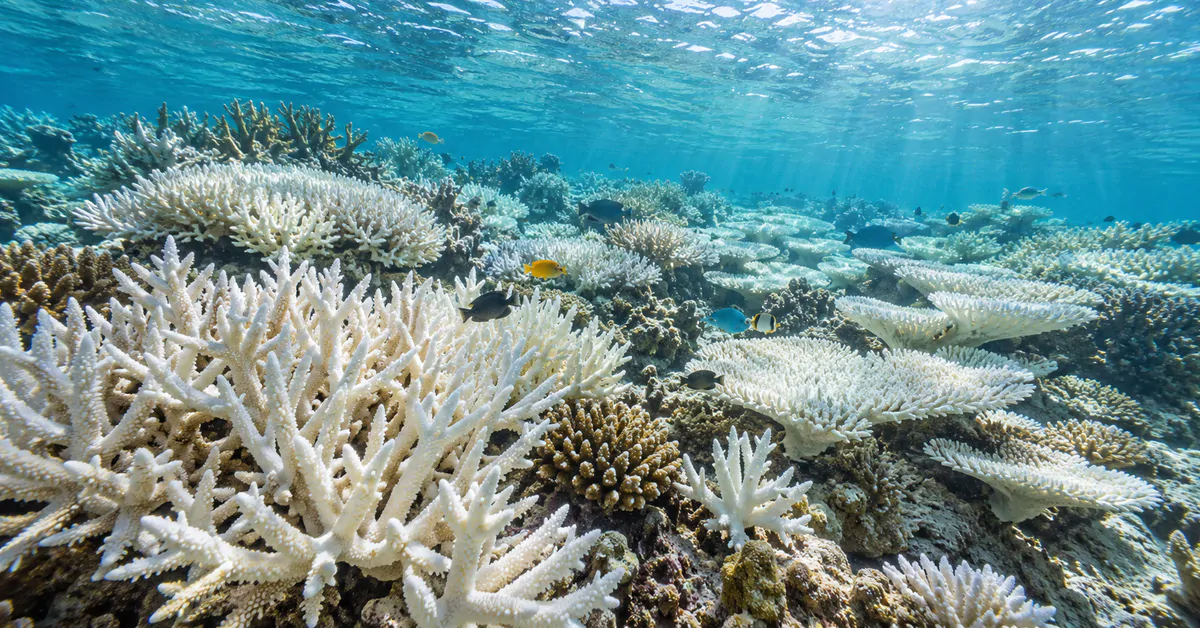
Thermal stress linked to climate change emerges as the most constant and devastating threat to these fragile ecosystems. Marine heatwaves, increasingly frequent and intense, trigger mass bleaching events that significantly weaken coral. The year 2026 has also seen the emergence of a “super” El Niño, a climatic phenomenon that further amplifies the risks facing these millennia-old living structures. Yet warming alone is not the sole culprit. The assessment also reveals that overfishing of fish essential to ecological balance, notably parrotfish and groupers, threatens 63% of coral ecosystems.
Marine heatwaves, increasingly frequent and intense, trigger episodes of mass coral bleaching that undermine these ecosystems.
Whole ecosystems on the brink
Among the victims of this crisis are the world’s most famous and richest sites. Australia’s Great Barrier Reef, visible from space and listed as a UNESCO World Heritage site, has joined the grim roster of ecosystems classified as critically endangered. The Coral Triangle, extending across Indonesia, Malaysia, the Philippines, Papua New Guinea, the Solomon Islands, and East Timor, considered the world’s epicenter of marine biodiversity with a quarter of all marine species recorded, is facing the same fate.
The Mesoamerican Barrier Reef, stretching over more than a thousand kilometers along the coasts of Mexico, Belize, Guatemala, and Honduras, as well as reefs in the Red Sea, renowned for their exceptional resistance to high temperatures, are also among the ecosystems at risk. The reefs of the western Galápagos Islands, which collapsed since the 1982-1983 El Niño episode, tragically illustrate what potentially awaits these formations if no action is taken.
The collapse of a coral ecosystem is characterized by the near-total disappearance of hard corals, replaced by algae, debris, and sponges. This radical transformation results in a drastic loss of biodiversity, dooming the fish, invertebrates, turtles, and sharks that rely on these complex habitats for survival.
Furthermore, the disappearance of coral reefs directly threatens more than eighty countries and territories whose coastal populations depend on these ecosystems for their livelihoods. Reefs provide vital ecosystem services: protection against coastal erosion, nurseries for commercial species, fisheries resources, and tourist attractions that generate substantial revenue. According to data compiled by the World Wide Fund for Nature (WWF), about 500 million people worldwide rely directly on coral reefs for their food and livelihoods. The annual economic value of reefs is estimated in the hundreds of billions of dollars, encompassing fishing, tourism, and coastal protection.
A narrow window for action
Despite the gravity of the diagnosis, scientists reject fatalism. Dr. Mishal Gudka, director of research at CORDIO East Africa and the scientific lead of the global assessment, emphasizes this point: “The risk of coral reef collapse is intensifying, but that must be seen as a wake-up call rather than a source of despair. Coral reefs have demonstrated a remarkable capacity to recover from devastating bleaching events.”
Reducing local pollutants is also part of the protective levers. Some UV filters found in sunscreens have raised concerns for coral environments.
This observed resilience, particularly in some parts of East Asia and the Red Sea, offers a glimmer of hope. Nevertheless, it cannot truly be realized unless environmental conditions allow. Dr. Aguilar drives home the necessity of action: “It isn’t too late to give coral reefs a chance to recover, but it requires decisive action to combat climate change and halt the warming of the oceans. We know what to do: ambitious emissions cuts, increased protection and restoration efforts, and sustained investment in resilient coastal ecosystems and in the communities that depend on them.”
Also read
Coral Bleaching: 84% of reefs affected, a staggering global record