
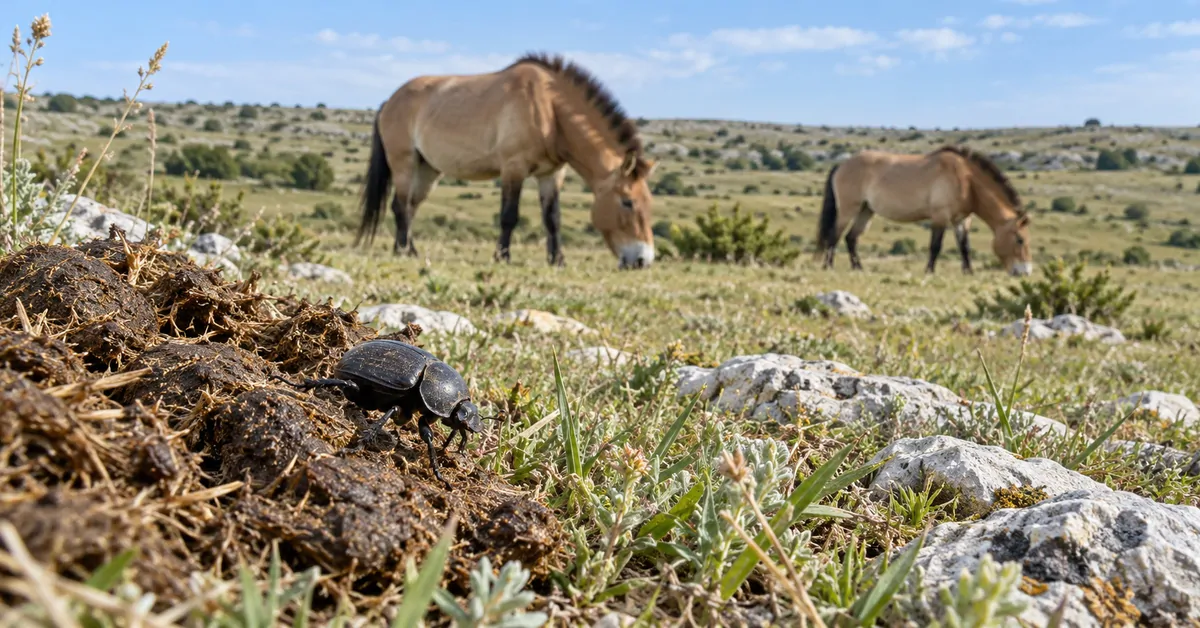
Since the rise of settled human civilization, domesticated grazing livestock have displaced wild fauna across Europe’s vast pastoral landscapes. This anthropogenic control over reproduction, care, and nutrition of herds has profoundly transformed ecosystem functioning. Today, the renewed interest in wild reseeding or the reintroduction of ancestral species raises fundamental questions: what is the real impact of this human management on the surrounding biodiversity?
A Unique Natural Laboratory
The Causse Méjean offers an exceptional testing ground by bringing together, within a single altitude band, three distinct modes of herbivore management. On one side, sheep have been grazing there for more than a millennium, representing a centuries-old form of pastoralism. On the other, domesticated horses are raised in a semi-extensive regime for endurance. Finally, since 1993, an autonomous population of Przewalski’s horses (or takhi), reintroduced by the Takh association, lives there in complete freedom—no supplemental feeding or veterinary care. This geographic coexistence allows direct measurement of ecological consequences caused by the very nature of the animal and by the way it is managed by humans.
To assess these effects, research has focused on dung beetles, coprophagous beetles that play an indispensable role in soil fertility and dynamics. These insects enable nutrient recycling and facilitate their uptake by the vegetation cover. Particularly sensitive to variations in pastoral pressure, to the nature of the herd, and to the frequency of care given to the animals, dung beetles constitute valuable biological indicators. Their feeding and breeding behaviors reflect, in a finely tuned way, the degree of disturbance or balance in a grazed environment.
Three Species, Three Profiles
Thanks to the double digestion typical of ruminants, sheep droppings contain less water and fiber but are noticeably richer in nitrogen, a nutrient highly sought after by beetles. In contrast, the droppings of domesticated horses contain far more undigested plant fibers. Surprisingly, the excrement of Przewalski horses sits midway between these two profiles. The takhi’s complete autonomy, coupled with a more varied gut microbiome due to the absence of antiparasitics and supplements, explains this nutritional peculiarity.
Beyond composition, the spatial-temporal distribution of droppings changes the accessibility of resources for the insects. While sheep cluster their feces after rest phases, creating highly localized zones, domestic horses spread them evenly throughout the day. Observations of insect populations reveal an unexpected phenomenon: a high volume of dung beetles does not guarantee faster decomposition of fecal matter.
Prioritizing Coexistence
Although more numerous in the pastures of domestic horses, the insects there degrade the droppings more slowly due to the high content of coarse elements. Conversely, the sheep dung, rich and easy to collect in pellet form, attracts species specialized in rapid transport and distant burial. For their part, the takhi dung piles favor species that lay eggs directly in the heart of the pile, ensuring localized but deep recycling.
While the overall composition of dung beetle species remains relatively stable and demonstrates notable plasticity, the farming management strongly modulates population density and the rate of organic matter recycling. These results invite us to move beyond the simplistic opposition between traditional farming and full wild reseeding. Rather than aiming for a single ideal of an ancestral ecosystem, it is better to prioritize the coexistence of diverse ungulates and management approaches.
Also read
Rewilding: How to give Nature a chance to restore balance