
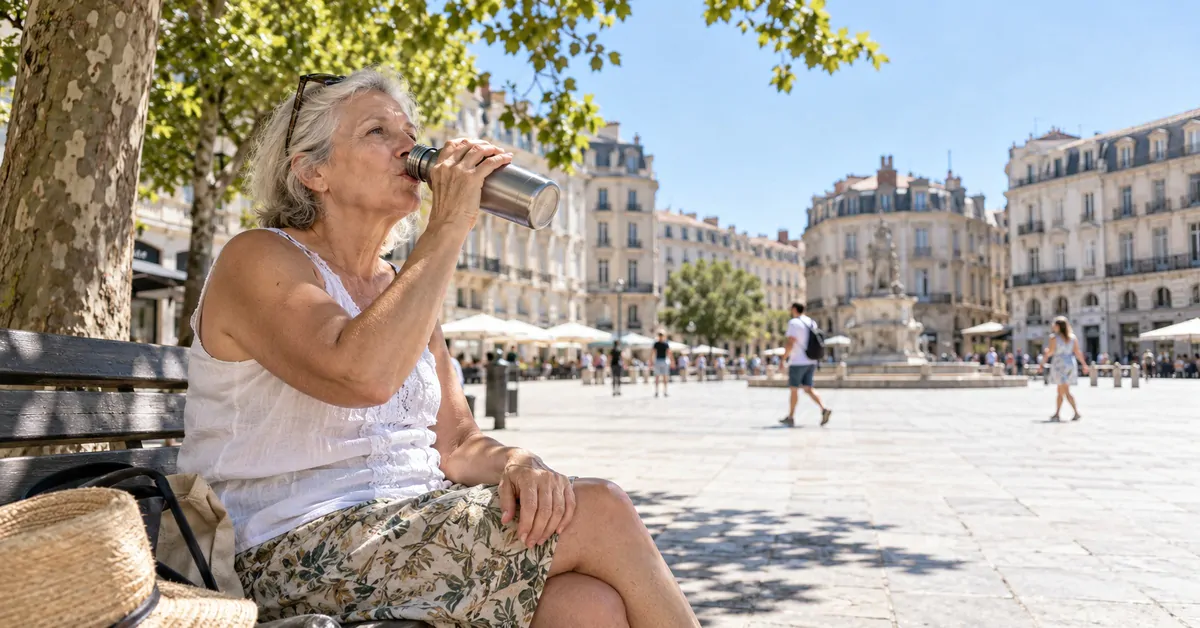
Behind this finding, the 2026 report describes a health crisis already tangible: deaths linked to extreme temperatures, compromised workdays, under-shaded cities, and infectious disease risks evolving with warming. But the data also show that lives can be saved.
Heat, a Health Hazard That Is Growing
The link between climate change and heatwaves is particularly clear. For the period 2021-2025, 80.6% of the heatwave days to which residents in France were exposed would not have occurred without human-caused warming, according to the tenth global Lancet Countdown report just released. The first victims of this trend are not affected in the same way. Children under one year and adults over 65 experienced, on average, nine additional heatwave days per year between 2016 and 2025. Compared with the 1986-2005 period, this corresponds to a 174% increase for infants and a 186% increase for seniors. Pregnant women and people with preexisting illnesses are also among the populations made more vulnerable by high temperatures.
Heat does not only threaten during the most dramatic episodes. Walking briskly or engaging in outdoor moderate physical activity now carries greater thermal stress. In France, time spent in conditions presenting at least a moderate risk increased by 76 hours per person per year between 2016 and 2025, compared with the 1990s. The ability to move, to engage in physical activity, or to work outdoors is therefore assessed through a public health prevention lens.
The warning goes far beyond France. worldwide, heat was linked to about 710,000 deaths in 2023. For that year, 71.5% of heat-related deaths are estimated to be attributable to human-caused climate change. The authors call for recognizing a global health emergency. “The harmful health effects of climate change are progressing faster than the global response to these effects,” laments Marina Romanello, executive director of the Lancet Countdown.
A Well-Documented Increase in Heat-Related Mortality
In cities, buildings, asphalt, and a lack of vegetation trap heat and slow nighttime cooling. The phenomenon affects a sizable population: 26.8 million people, about 40% of the French population, lived in 2023 within the 72 cities studied in the statistical perimeter of this analysis. Among them, 4.7 million were over 65 and 4.8 million were under 15. These figures describe a statistical definition of “city,” not the entire population living in urban spaces in the everyday sense.
Mortality reveals the scale of danger. In the French cities studied, the average annual heat-related death rate rose by 73 deaths per million inhabitants between the periods 1991-2000 and 2015-2024. Perpignan shows one of the most striking trends: from 10.7 to 139.2 deaths per million inhabitants per year between the two periods, a 1,184% increase. Martigues and Toulouse also show strong relative increases, at 965% and 919% respectively. These variations do not represent the total number of deaths recorded in these municipalities in a given year.
Another indicator measures the direct heat surplus of cities relative to neighboring rural areas. Between 2003 and 2020, Chambéry experienced an average of 90 days per summer when this gap exceeded 1.5°C. Annecy logged 78 and Nancy 75, compared with 12 days on average in the studied French cities. Repeated gaps like these contribute to prolonging exposure to heat, particularly for residents in poorly adapted housing.
Shade is also in short supply. In 2020, trees covered on average 9.2% of the surface of the studied French cities. The United Nations Economic Commission for Europe recommends at least 30% tree canopy. Only Fréjus and Besançon met or exceeded this threshold. The Île-de-France metropolitan region had 19,500 hectares of trees, but they represented only 8.9% of its area; in La Rochelle, the canopy was recorded as 8.6 hectares, or 0.2%. In Dunkirk, tree cover grew by 33% between 2000 and 2020.
Planting trees is not a cure-all, but it can also shield daily commutes. Between 2018 and 2020, only 14% of cycling routes and pedestrian shared paths in France enjoyed tree shade. Belfort and Besançon reached 28.9% and 26.6% respectively among cities exposed to moderate or high heat stress. Its chart also shows 20.5% in Paris, versus 10.6% in Marseille and Toulouse. The report also notes a decline in urban surfaces that reflect heat.
Climate Change: In France, Infectious Diseases Are Changing Terrain
The thermometer also influences the transmission conditions of certain pathogens. Along the French coast, warming water favors bacteria of the Vibrio genus, which can cause human infections. The average length of coast climatically suitable for their transmission rose by 21% between 2016-2025 and the reference period 1982-1991, reaching 89.9 km. This figure measures environmental suitability, not a permanent contamination of the entire concerned coastline.
The document estimates an average annual of 2,569 Vibrio cases in France between 2016 and 2025, i.e., an 81.5% increase compared with 1982-1991. A precaution is essential: these are cases estimated by the scientific indicator, not necessarily diagnosed each year by the health care system. This distinction between modeled risk and observed disease is crucial for interpreting the warning correctly.
The mosquito vectors of malaria provide another signal. For the parasite Plasmodium vivax, the average duration of favorable climatic conditions for transmission reached about one month per year in France between 2016 and 2025, a 29% increase from 1981-1990. This does not mean that malaria is currently transmitted everywhere in France for a month, nor that a resurgence of locally acquired cases has been observed. The report instead advocates for surveillance that blends climate, environmental, and health data to detect evolving risks before foci take hold.
Transports, Pollution and Energy in the Face of Rising Temperatures
The picture is not uniformly negative. In France, low-carbon sources accounted for 90% of electricity production in 2023, but only 46.7% of total energy supply. The contrast is even starker on the roads: fossil fuels provided 92% of the energy for road transport and electricity just 0.5%. For households, fossil liquid fuels and gas still accounted for 36.5% of energy uses, with an additional 18.7% from biomass deemed harmful to health. “Low carbon” does not mean exclusively renewable: nuclear power is included in this category.
At the urban scale, several trends are moving in the right direction. Greenhouse gas emissions per capita fell by 42.6% between 2000 and 2024 in the tracked French cities. The drop reaches 68% in the energy sector. For this indicator, the French portion of the Annemasse-Genève metropolitan area shows a 100% decrease, ahead of Grenoble at 92.4% and Le Havre at 91.9%. The authors mention the phase-out of coal and the energy transition as possible explanations, without attributing a single cause to each city.
The reduction in air pollution represents a tangible health benefit. Between 2000 and 2023, mortality attributable to PM2.5 from electricity production declined by 82% in French cities. Mortality linked to pollution from harmful fuels, across all sectors, fell by 52%. In Paris, PM2.5 from these fuels was associated with 86 premature deaths per 100,000 people in 2023, with transportation accounting for 38% of this attributable mortality. Béziers, meanwhile, recorded a 69.2% drop in this indicator from 2000 to 2023.
There remains substantial room for improvement. The average annual French concentration of PM2.5 was estimated at 10 micrograms per cubic meter, roughly twice the WHO guideline of 5 micrograms per cubic meter. Globally, at least 323,000 deaths per year would have been avoided in 77 countries where pollution from fossil-fuel energy decreased.
To read also
Vegetation: How to Turn Your Condo Into a Cooling Island