
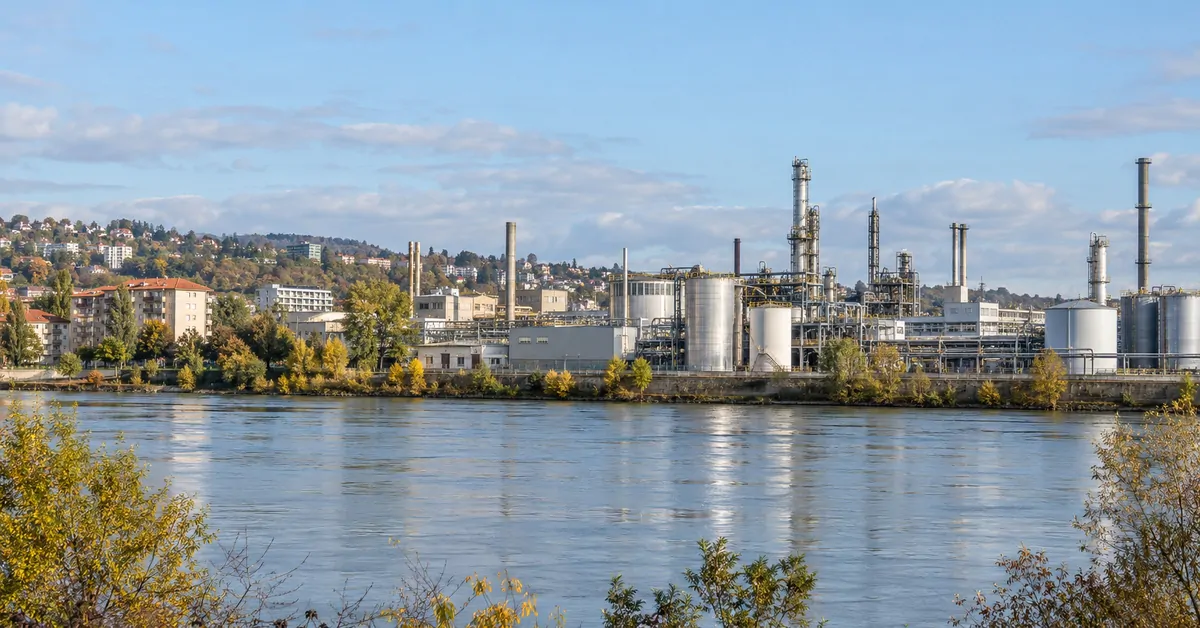
Four associations filed an appeal to overturn this authorization, arguing that health and environmental risk assessments in the Chemistry Valley—already heavily contaminated—are insufficient.
R-1234yf Gas: Environmental groups condemn a modification to the industrial process without an environmental impact study
Four associations — Bien Vivre à Pierre-Bénite, Notre Affaire à Tous – Lyon, Eau Bien Commun Lyon-Métropole, and the Ligue des droits de l’Homme Lyon Confluences — filed an appeal with the Lyon Administrative Court of Appeal on September 28, 2026, joined by Rhône-Alpes Ecologists for Savoie and the PFAS Against Earth collective in support. In a statement released on October 28, 2026, they announced seeking the annulment of the prefectural order issued on July 24, 2026, which authorizes Daikin Chemical France to use R-1234yf at its Oullins-Pierre-Bénite facility in the Rhône region.
Beyond this new legal battle, the central question is how authorities assess PFAS-related risks. The petitioners accuse the prefecture of authorizing a modification to the industrial process without a full environmental impact study. Daikin, for its part, defends a complete regulatory procedure, backed by a health study it considers reassuring. Two opposing readings of the same project in a region that has been shaped since 2022 by revelations about the scale of PFAS pollution.
PFAS and R-1234yf: what Daikin intends to change at its plant
Contrary to what its presentation as a “new PFAS” might imply, R-1234yf is not a newly discovered molecule. This fluorinated gas is already used as a refrigerant in automotive air conditioning systems. Its introduction into Daikin Chemical France’s manufacturing processes, however, constitutes the novelty. The company plans to use it starting in 2028 to produce materials intended, among other things, for the automotive industry.
At its Pierre-Bénite site, the Japanese chemical company aims to manufacture a new range of fluorinated polymers, materials prized for their resistance to demanding industrial conditions. R-1234yf is expected to partially replace hexafluoropropylene, or HFP, currently used in production. This shift, according to the company, also aims to improve the environmental performance of the process.
Daikin highlights an anticipated reduction in emissions of certain PFAS into the water and the atmosphere. The prefectural order relies on these projections to justify the plant’s evolution. The administration considers that the new process does not constitute a substantial modification of the existing activity. This qualification allowed avoiding a new full environmental permit procedure.
The industrial interest of R-1234yf is not enough to dispel the concerns. This substance belongs to the broad PFAS family, whose characteristics and hazards vary from molecule to molecule. While some PFAS exhibit very high environmental persistence, others can transform into degradation products that are themselves persistent. R-1234yf falls into the latter category: the associations are more worried about the fate of its potential atmospheric emissions than about its mere presence in the plant.
This distinction is essential. A process may lower emissions of several fluorinated substances while introducing new environmental risks. For the petitioners, the gains touted by Daikin must therefore be examined alongside the potential consequences of using the new gas, especially its degradation into trifluoroacetic acid (TFA).
Chemistry Valley: An authorization contested for its environmental assessment
The main dispute centers on the scope of the studies conducted before the signing of the prefectural order. In May 2026, Daikin presented its project to the administration. The prefecture subsequently ruled that the proposed modification did not justify a full environmental assessment. The associations now challenge that decision before the administrative court.
The lack of an impact study does not mean that no health analysis was conducted. Daikin Chemical France asserts that it voluntarily provided a health risk study conducted according to the methodology of the National Institute for Industrial Environment and Risks, INERIS. In its response, the company states that this assessment concluded “no health risks from the project.” According to the company, the prefecture deemed its impact acceptable on the basis of this dossier.
Nevertheless, the associations contest the scope of this evaluation. They argue, in particular, that it does not sufficiently examine the consequences of the formation of TFA in the atmosphere. They also regret that the health documents and project risks were not the subject of genuine public consultation. The question, therefore, is not merely whether Daikin produced a study, but whether it enables a comprehensive appraisal of all possible environmental and public health effects.
For Jeanne Fleury, president of Notre Affaire à Tous – Lyon, this approach is especially troubling given the region’s industrial history. “It is incomprehensible and concerning that the precautionary principle is not more strongly applied,” she said in the association’s October 28, 2026 release. She is calling for a risk assessment that is thorough enough to determine the protective measures needed for nearby residents.
The consultation method is also up for debate. In July 2026, the president of Daikin Chemical France had proposed a meeting with several local organizations. The PFAS Against Earth collective had agreed to this exchange, while stressing the need to address environmental health issues, working conditions, and job protection. The participants, however, felt the meeting mainly served as a platform for the company to present its decisions rather than to discuss project directions.
This challenge comes in a long-standing mobilization context. Since the initial 2022 revelations about contamination around Daikin and Arkema facilities in the southern Lyon area, associations have pursued efforts to curb emissions and improve knowledge of health impacts. For them, every new industrial authorization must now take into account this historical exposure rather than being evaluated in isolation.
PFAS and R-1234yf: degradation into TFA at the heart of concerns
The central scientific alert concerns trifluoroacetic acid, known by the acronym TFA. This compound is also part of the PFAS family. It is highly persistent and mobile, capable of circulating through the environment via rainwater, soils, and bodies of water. Its origin is not limited to a single industrial activity: it can also result from the degradation of various fluorinated substances. In their October 28, 2026 statement, the associations rely in particular on explanations by climate PFAS expert Hans Peter Arp: his work highlights the atmospheric transformation of R-1234yf into TFA. This reaction lies at the core of concerns about potential discharges from the new process.
The problem lies with the properties of the degradation product. Unlike the initial gas, TFA can persist in the environment long after deposition. The associations thus worry about a possible additional contribution to water and soil contamination. They also note that the European Chemicals Agency (ECHA) began a 2026 process to recognize the reproductive toxicity of TFA. This is a hazard evaluation, which on its own does not quantify the health risk associated with future emissions from the plant.
The issue is even more critical given that the Chemistry Valley houses several historic fluorinated compound production and transformation facilities. Pre-existing PFAS contamination complicates exposure analysis. A new potential source of TFA would raise questions about its added contribution to an already contaminated environment, even if the extent remains to be established.
Daikin counters these concerns with its emissions-control measures. In its response published by Lyon Capitale on October 28, 2026, the company stated that its treatment station can retain “more than 99.99%” of PFAS contained in the site’s aqueous discharges. The company also highlights more than 95% reduction of atmospheric HFP emissions thanks to activated carbon filters.
Regarding dust potentially containing bisphenol AF, Daikin also claims a capture rate of 99.995%. If confirmed in real-world operating conditions, these performances would demonstrate the effectiveness of certain existing equipment. However, they do not, by themselves, measure future R-1234yf emissions or the amounts of TFA that could form after atmospheric dispersion.
That very uncertainty is what the associations want to see examined. In an interview with 20 Minutes, Jeanne Fleury notes that no filtration device can guarantee the complete elimination of all emissions, particularly in the event of a leak or uncontrolled discharge. The association is calling for regular performance checks of the facilities and a reevaluation of the risks associated with the new process.
Chemistry Valley: accident risks, storage, and a legal precedent
Beyond chronic pollution, the appeal raises another issue: industrial safety. R-1234yf is a flammable gas, and its pressurized storage requires special precautions. The associations warn about the risk of BLEVE, a phenomenon that can occur when a tank containing a liquefied gas is heated, potentially with violent consequences.
The prefectural order sets a maximum quantity of 18 tonnes of R-1234yf that may be present on the site. This figure corresponds to a storage ceiling, not an annual usage or discharge amount. Jeanne Fleury mentions a figure of 15 tonnes stored, a number that does not represent the total capacity of the installation.
The authorization also provides for additional fire and explosion prevention measures, including water spray systems, water curtains, and water rings. These devices aim to limit the consequences of heating and the accident risks associated with storing the new gas.
The administration acknowledges, however, that the project introduces two additional hazardous phenomena that could have external consequences. It specifies, however, that the areas likely to be affected lie within the danger zones already identified around the existing installations. In other words, no new population would be exposed to these scenarios.
This analysis has drawn strong opposition. For Lucas Miguel, a member of the PFAS Against Earth collective, the fact that residents are already exposed to industrial risks does not justify introducing further exposure. “We are demanding more guarantees,” he insisted in the association’s statement, calling for a genuine environmental impact study.
The petitioners also rely on a judicial precedent involving Daikin. In June 2024, the Lyon Administrative Court suspended a previously approved expansion project. In that case, the court took into account the plant’s location in a densely populated area already exposed for decades to PFAS emissions and concluded that the project should have undergone an environmental permit and corresponding assessment. The ruling strengthens the associations’ argument, though it does not predict the outcome of the current appeal. The installations involved, project specifics, and administrative decisions differ. This time, the court will particularly scrutinize the relevance of the prefecture’s non-substantial modification qualification for the new process.
Daikin Chemical France asserts that it has complied with regulatory requirements and defends its efforts to reduce emissions. The company emphasizes the thoroughness of the administrative review and the safety measures built into the project. It intends to continue investing in its treatment facilities.
For the associations, the key issue remains the consideration of all risks, especially those related to atmospheric emissions and their fate after dispersion. Their action concerns an administrative authorization, not a pollution event already measured after the commissioning of the new process. The use of R-1234yf is planned to begin in 2028. The timeline thus leaves room to examine environmental guarantees and contested prescriptions, while the associations do not rule out further legal actions to oppose the project.
Also read
the polluter pays principle applied to PFAS discharges