The small black gnats fluttering above pots are almost always fungus gnats, also called soil gnats. These insects belong mainly to the genera Bradysia, Lycoriella, and Sciara in the Sciaridae family.
They hatch in the pot itself, where the female lays her eggs in the substrate. They are found in moist potting mixes, especially indoor plants and seedling flats. Their larvae live in the potting mix and feed on decomposing organic matter, fungi, and sometimes young roots.
Fungus Gnat or Vinegar Fly
Confusion with the vinegar fly, the tiny fruit fly, is common. The vinegar fly is stout, beige to orange, with red eyes. You find it around a fruit bowl, the kitchen compost bin, or opened bottles.
The fungus gnat tends to stay near pots, even in a room without food. INRAE describes adults of 1 to 5 mm, gray-black, with long beaded antennae, with fairly long legs and wings with clearly visible veins. Most species measure about 3 to 4 mm.
Their behavior also helps identify them. Adults often run on the surface of the potting mix or fly slowly around the plants, and take off when you water or move the pot.
By scratching the surface of a water-soaked substrate, you can find larvae, legless, translucent with a black head. They measure 5 to 12 mm long depending on their instar. The larvae cluster under a slice of raw potato placed on top of the soil, which helps confirm their presence.
A Potting Mix That Stays Wet
These gnats can breed year‑round indoors. Their return in autumn is due to several changes that happen at once. Plants that spent the summer on the balcony are brought indoors with their root balls, and sometimes with eggs or larvae.
With less light, growth slows and the plant drinks less. Yet, watering often stays at its summer pace. The potting mix remains surface-wet for days, giving the females the perfect place to lay eggs.
The Plant Health Bulletin from Horticulture/PEPI notes that these insects proliferate in moist, organic-rich substrate. Heat then speeds up their development. For Bradysia paupera, the most commonly encountered species, INRAE provides the following durations:
| Temperature | Egg-to-Adult Duration |
|---|---|
| 15 °C (59 °F) | about 6 weeks |
| 20–24 °C (68–75 °F) | about 3 weeks |
The adult lives about 1 week. It feeds hardly at all and mainly exists to lay eggs. In the temperature of a heated living room, several generations can follow one another through a winter if the soil remains damp. Open bags of potting mix left open and newly purchased plants can also bring larvae.
The damage depends on the plant. Adults do not harm plants, and a well-established plant is unlikely to suffer from the larvae. INRAE Ephytia biocontrol fact sheets note a higher risk for cuttings and young plants.
In these cases, the larvae attack the roots. These damages appear mainly on weak plants or when the substrate is too moist. A gnat flight most often indicates potting soil that is overwatered.
Drying the Surface
The first step is to let the top layer of the potting mix dry out between waterings. Fungus gnats are often more numerous in a substrate that stays wet. Letting it dry reduces their numbers, provided the plant can tolerate it.
A finger pressed into the soil is enough to know whether you should water. If the surface still sticks, wait.
This method doesn’t work for plants that require consistently fresh substrate, such as carnivorous plants and some ferns. For them, you move on to traps and biocontrol.
Watering through the saucer does this as well. The water climbs up the root ball by capillarity and the roots moisten, while the first few centimeters of soil stay dry, where the females lay eggs. You must empty the water that wasn’t absorbed, because a saucer or cachepot that’s always full maintains high humidity at the base of the pot.
A layer of sand or fine gravel laid on top of the potting mix yields a similar result. It dries quickly after watering and prevents the females from reaching the substrate to lay eggs.
Trap, Repot, Treat
Yellow sticky traps placed in the pot or nearby capture the adults, attracted by the color. They are recommended when gnats become a nuisance. They limit egg-laying and show how the infestation evolves from week to week. They do not affect larvae already present in the soil. When used alone, they do not solve the problem.
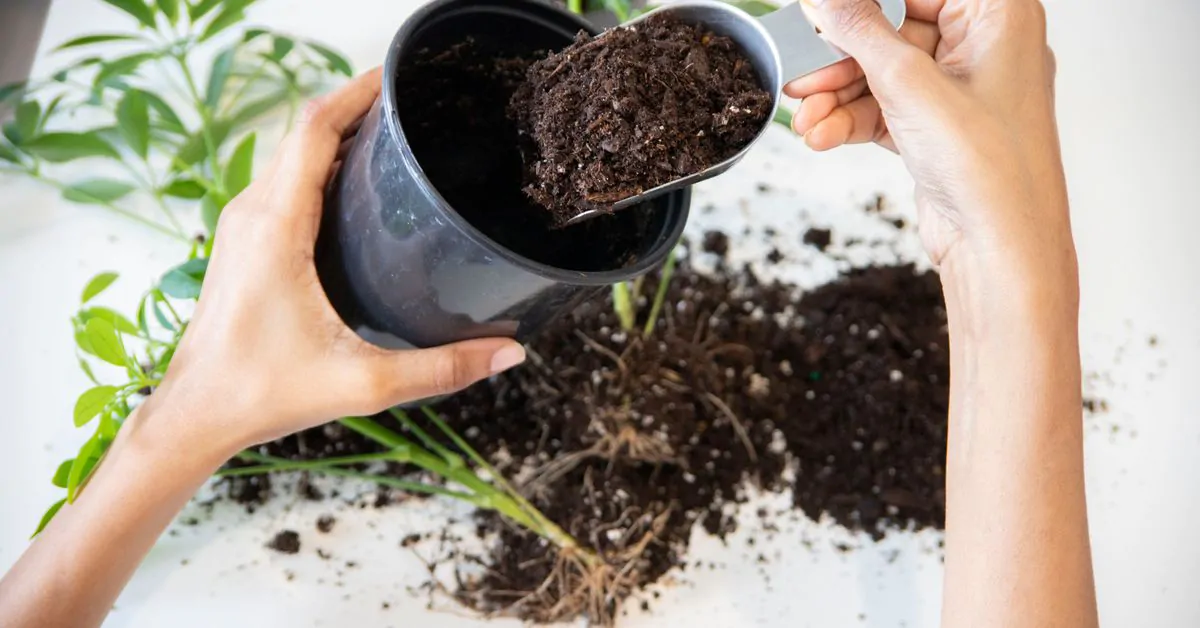
When larvae are very numerous, it is faster to repot. Remove the old substrate around the roots, clean the pot, and refill with fresh potting mix. Prefer a mix formulated for indoor plants, which helps prevent outbreaks. Home compost, rich in living organic matter, has no place in house pots. Keep the opened bag sealed.
Two biocontrol options sold at garden centers directly target the larvae.
The first are nematodes, tiny parasitic worms that enter the larvae and kill them. INRAE notes that the species Steinernema feltiae has been used against fungus gnats since 1984. It works best in moist soil around 15 °C (59 °F) and is sensitive to UV. It is diluted in the watering solution and applied in the evening, directly onto the potting mix.
The second option is Bacillus thuringiensis israelensis (Bti), a bacterium that produces a crystalline protein toxic to fly larvae when ingested. It is applied with the watering and only affects larvae.
These two treatments require a moist substrate to act, which runs counter to the dry-surface approach. You therefore apply them first, then return to spaced watering. The egg-to-adult cycle lasts about 3 weeks at room temperature. Keep the combination of yellow traps and a dry surface for at least 3 weeks to eliminate adults from eggs laid at the time of the first treatment.
Sources: ephytia.inra.fr | ncbi.nlm.nih.gov | rdf.codex.cati.inrae.fr