
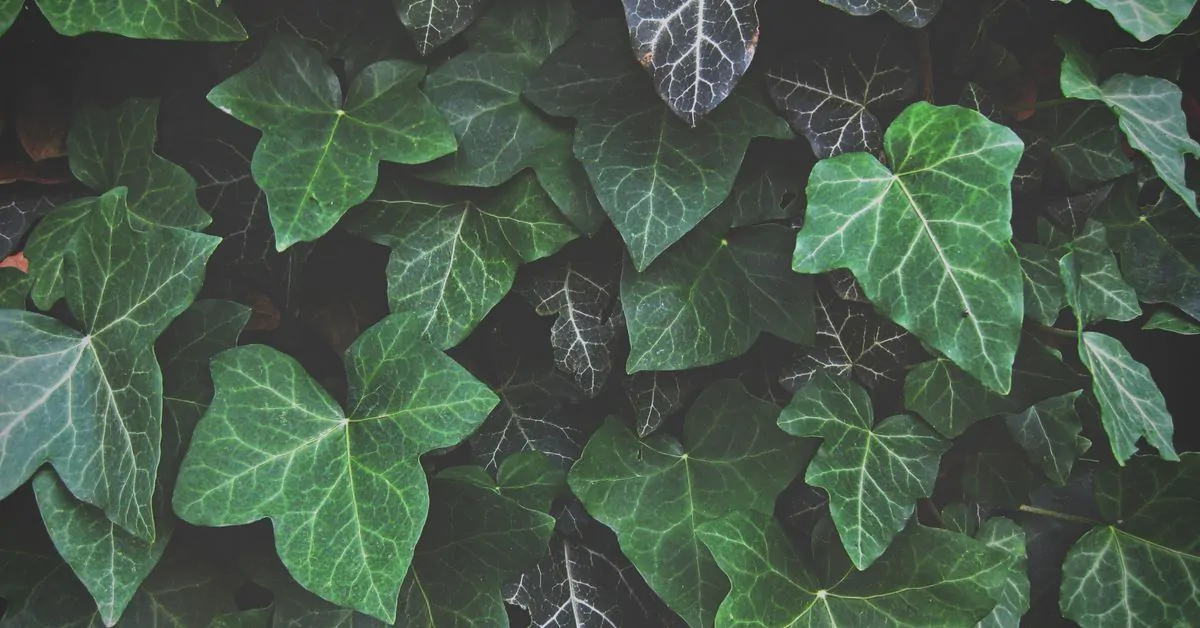
A decoction of climbing ivy leaves properly cleans lightly soiled laundry: clothes worn for a day, sheets, towels, and colors you want to protect. This washing power comes from the saponins contained in the leaf, molecules that foam and detach part of the dirt. It remains weak against blood, egg, grass, and greasy collars; it does not whiten, does not disinfect, and doesn’t store well.
It is a seasonal preparation, because ivy (Hedera helix) is evergreen. Its leaves can be picked in mid-winter, which makes this laundry one of the rare “homemade” preparations whose raw material can be gathered in November.
Saponins that wash, with limited strength
Fresh ivy leaves contain pentacyclic triterpenoid saponins (hederasaponin C) and other derivatives of oleanolic acid, hederagenin, and bayogenin. Each of these molecules combines a water-loving part (sugars) with a part that binds oils and greases.
It behaves like a surfactant, i.e., a agent that lowers the surface tension of water, wets fibers better, and keeps soils suspended until rinsing. It’s the same principle as commercial detergents, but at a much lower concentration and with more variability.
Concentration depends on the amount of leaves, their maturity, and the maceration time. Recipes therefore recommend doubling the amounts compared with a conventional detergent.
The abundant foam formed during cooking does not indicate the washing strength. The result is acceptable for clothes worn briefly and to refresh textiles, and the preparation adds neither fragrance nor synthetic dye.
Blood, grease and white laundry stay out of its reach
A store-bought detergent combines several families of ingredients. It contains surfactants and enzymes. Proteases break down blood, egg, or sweat; amylases act on starch in sauces; and lipases target fats. The powders also contain an oxidizing whitening agent.
The ivy decoction has neither enzymes nor bleaching agent. On a stain of protein or fat, it does little better than hot water, and hot water fixes the blood into the fiber.
The whites turn gray for lack of whitening. To compensate, it is common to add 1–2 tablespoons of sodium percarbonate to the wash, and to wash at 40 °C (104 °F) or higher. Stubborn stains are pretreated by rubbing with Marseille soap or black soap. Blood should be rinsed out with cold water first.
The resulting liquid is green to brown, with a mildly vegetal odor: testing on a pale, inexpensive textile helps avoid unpleasant surprises. No recipe claims to disinfect the laundry. For clothing belonging to a patient, the program temperature is what matters.
| Ivy Laundry | Commercial Detergent | Marseille Soap | |
|---|---|---|---|
| Cleaning agent | Plant saponins, low concentration | Surfactants formulated and stable | Saponified fats (soap) |
| Enzymes | None | Yes, depending on formula | None |
| Grease stains | Weak | Good | Good, especially in pretreatment |
| Blood, egg, sweat | Weak | Good (proteases) | Medium |
| White laundry | Grayish, no percarbonate | Bleaching agent in powders | Gray with hard water |
| Dose per load | 100 to 150 ml | Label dose | Variable by recipe |
| Preservation | 2–4 weeks refrigerated | Several months | Long shelf life |
Marseille soap degreases better than ivy and is mainly used for stain removal by rubbing a collar or a stain. In liquid detergent, and in hard water, it reacts with lime and forms an insoluble deposit that dulls fabric. Commercial detergent remains the most complete option for very dirty laundry. The ivy decoction has a place for routine washes, with pretreatment of stains.
A simple recipe, a toxic product to label
The circulating proportions vary from about fifty to a hundred leaves per liter of water. It is climbing ivy with tough leaves, not to be confused with ground ivy (Glechoma hederacea), a small creeping plant from the mint family. The usual steps are as follows:
- put on gloves, rinse the leaves, then cut or bruise them;
- submerge them in 1 liter of water, cover, bring to a boil, then simmer for 15 minutes;
- turn off the heat and let macerate for 24 hours, still covered;
- straining by pressing the leaves, pour into a bottle and note the date;
- dose about 100 to 150 ml per load, in the detergent compartment or directly in the drum.
Without a preservative, the preparation ferments. The advised durations range from 2 weeks to 1 month in a cool, dark place. If the detergent changes appearance or odor, it’s a sign that fermentation has occurred and it should be discarded.
To avoid waste, you can prepare small quantities or freeze the laundry in ice cube trays, one cube per wash. A dedicated pot reserved for this purpose helps prevent mixing with kitchenware.
The ivy is not harmless. Leaves and berries contain saponosides and falcarinol, the main allergen responsible for dermatitis. Trimming and handling repeatedly with bare hands can cause irritant or allergic dermatitis, hence gloves for picking and cutting. People with sensitive skin should test a first wash on a few garments.
Ingested, ivy can irritate the mouth, cause excessive salivation, nausea, vomiting, or diarrhea. Berries are the most dangerous, and in children they can be toxic from as few as 2–3 berries.
A brown liquid in a bottle may pass as iced tea. The bottle should therefore carry an explicit label (“ivy laundry, do not drink”), is never a former beverage bottle, and should be kept out of reach of children.
In case of an accident, ANSES advises that if a child has placed leaves or berries in the mouth, rinse the inside of the mouth with a damp cloth, wash the hands, and call a poison center. In the United States, poison control centers offer free medical consultations, 24/7. In case of severe trouble, such as trouble breathing or loss of consciousness, call 911. For the U.S. context, you can dial Poison Help at 1-800-222-1222 to reach your local poison control center.
Sources: enquetes.anses.fr