
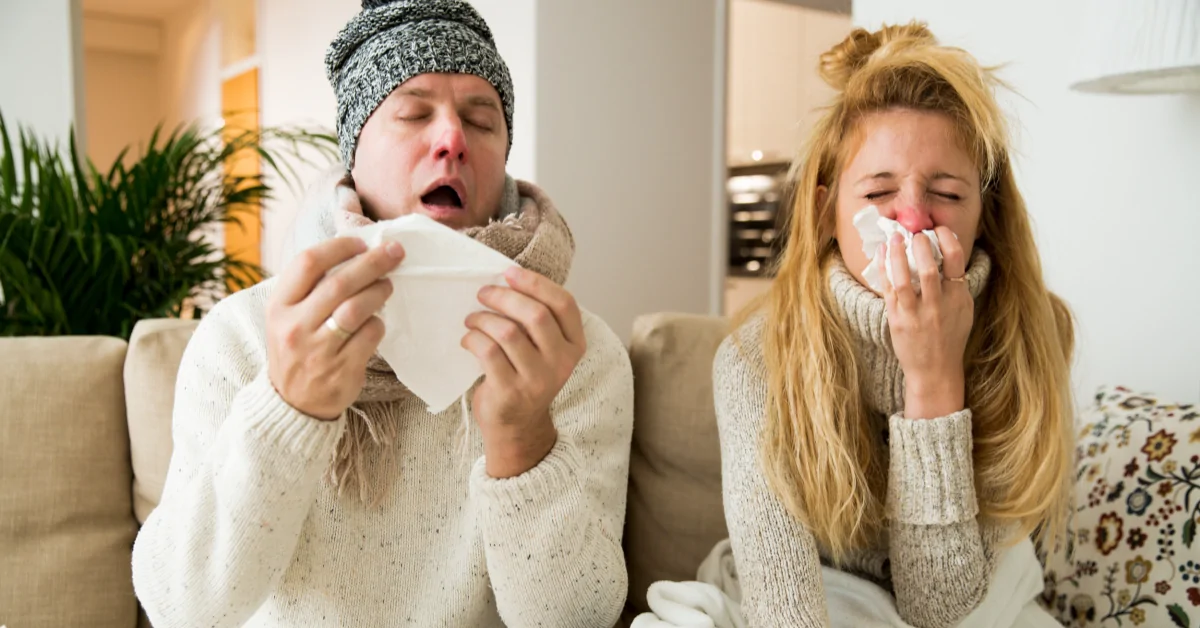
The thermometer reads temperatures below 50°F, and the same admonitions start again. “Put on your scarf, you’ll catch a cold!“, “But you don’t have a coat? You’ll get sick!” So, once and for all, let’s debunk this myth: catching a cold does not make you sick. At least not directly.
That doesn’t mean cold weather is harmless, and directly or indirectly, it can be a danger factor.
The Myth: Catching Cold Would Make You Sick
There is indeed a widespread myth in France and in many French-speaking countries. And for good reason—the language carries it: in popular speech, people say they can “catch cold” or “take a cold.”
Perhaps the most surprising part is how we express this in English: “You can catch a cold.” Which translates to “you can catch a cold,” but here the concept is illness, not cold itself.
In France in particular, a sizable number of people firmly believe that cold weather makes you sick, which elicits laughter in many other countries. The situation, in fact, is a bit more complex.
Catching Cold Isn’t Real
Technically, cold weather isn’t what makes you fall ill. If in everyday speech we say we catch cold, the cooling of the body isn’t what triggers winter illnesses. The culprits are most often viruses, and even predominantly rhinoviruses.
There are also bacteria. The vast majority of winter illnesses people attribute to “catching cold” are actually rhinitis or rhino-pharyngitis, sometimes tonsillitis, laryngitis, tracheitis or bronchitis, sometimes a flu-like syndrome, and more rarely whooping cough.
Most of these illnesses disappear in a few days, unless a treatment is required—specifically in cases of a bacterial infection. In any event, the nose runs, the throat hurts, but cold weather is not directly responsible. Saying we “catch cold” is therefore technically inaccurate.
Cold Weather Isn’t Completely Innocent
Humans remain sensitive to cold, and small discomforts or bigger problems can appear. At first, cold air weakens the body: it irritates the nasal passages and the bronchi.
That’s how cold weather can pave the way for infections of the upper respiratory tract (URIs).
Moreover, cold doesn’t kill viruses—at least not at typical outdoor temperatures. An American study showed that the flu virus can survive even longer at 5°C than at 20°C, especially when humidity is low. Outdoor temperature has a non-negligible influence on virus development. This is how the flu virus and some others form a protective envelope to shield themselves from the cold. That envelope disappears once the virus enters a warmer host, hence researchers argue, more winter epidemics.
Cold Weather Can Be Dangerous for Humans
Don’t underestimate the cold! Cold weather is bad for the heart, and it’s been tied to an uptick in cardiovascular events in winter: +2% for every 1°C drop in temperature.
Similarly, the risk of a heart attack increases by about 2%, as another 2019 study shows. In short, any physical activity in winter places extra strain on the heart.

Not to mention risks of hypothermia, carbon monoxide poisoning deaths, and significant impacts on existing conditions like asthma, hypertension, and other respiratory diseases. It’s estimated that around 300,000 deaths are more or less directly linked to winter—much higher than during heat waves today.
Protect Yourself From the Cold!
In theory, anyone can suffer the consequences of cold, especially if unprepared. It’s wise to protect yourself even more if you have a chronic illness, work outdoors, or if your home insulation isn’t optimal.
Older adults and young children are also more exposed, as their bodies adapt less well to temperature changes. Since the body doesn’t protect itself from the cold as effectively, simple tips can help.
The best approach is to dress appropriately, including indoors, and you can layer clothing to better adapt to temperature shifts and to trap warmth with air.
Scarves are recommended for a good reason: most heat loss occurs through the head, and they help maintain a warmer breathing zone.
Generally, avoid abrupt temperature changes that stress the body, and they’re further amplified by air pollution.
However, don’t overheat living spaces: ADEME’s guidelines translate to roughly 68–72°F (20–22°C) in living areas, and about 64–66°F (18°C) in bedrooms. Finally, remember to ventilate your home even in winter.
Also read
Natural remedies to treat a cold
Article republished October 2026
- Sirimi, Natalia, et al. « Respiratory syncytial virus activity and climate parameters during a 12-year period. » Journal of medical virology 88.6 (2016) : 931-937.
- Jarraya, Mounir. « Froid hivernal et fréquence de la grippe à Sfax (Centre-Est de la Tunisie). » Territoire en mouvement Revue de géographie et aménagement. Territory in movement Journal of geography and planning 38 (2018).
- Postnikov, Eugene B. « Dynamical prediction of flu seasonality driven by ambient temperature : influenza vs. common cold. » The European Physical Journal B 89.1 (2016) : 13.
- Sartini, Claudio, et al. « Effect of cold spells and their modifiers on cardiovascular disease events : evidence from two prospective studies. » International journal of cardiology 218 (2016) : 275-283.
- Stewart, Simon, et al. « Winter Peaks in Heart Failure : An Inevitable or Preventable Consequence of Seasonal Vulnerability ?. » Cardiac failure review 5.2 (2019) : 83.
- Carreras, Hebe, Antonella Zanobetti, and Petros Koutrakis. « Effect of daily temperature range on respiratory health in Argentina and its modification by impaired socio-economic conditions and PM10 exposures. » Environmental pollution 206 (2015) : 175-182.