
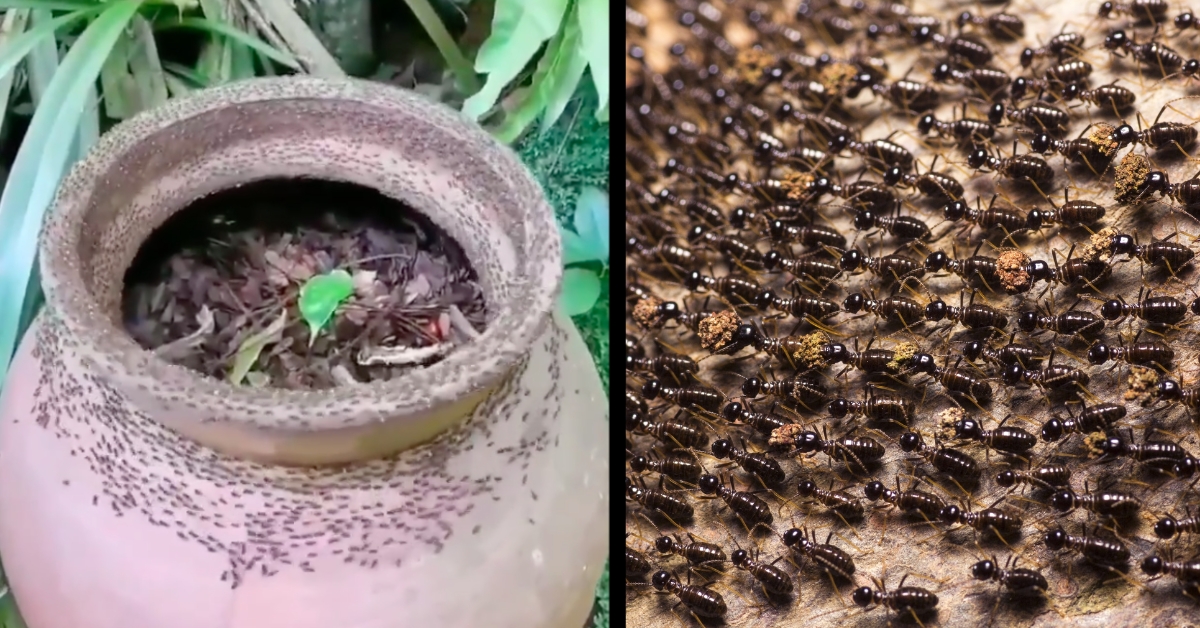
They spin in circles until death follows. What could drive certain insect species to such collective suicide?
A Natural Vortex Phenomenon
This isn’t exactly a new finding: the death spiral phenomenon affecting certain insects, namely termites and ants, has been observed as far back as the early 20th century. Yet it remains as rare to observe and as difficult to understand today.
This vortex phenomenon has in fact also been observed in other species, from caterpillars to bats, and even some fish. On social media, one can encounter images and videos of these insects circling until they die. A death by exhaustion—a true collective suicide that raises questions.
This behavior is all the more puzzling since it does not arise from a conscious will to die. It is rather an escalation of collective behavior: a biological mechanism perfectly adapted to life in a colony, but which, under certain conditions, can go awry.
When the Path Becomes a Loop
But what explains these death spirals, especially among ants? For these insects, the path laid down by pheromones plays a huge role. These chemical substances they leave on the ground help them orient themselves and follow a route as they march in a column. Instinctively, ants will follow the most scented path, the one where the pheromones are strongest, which typically leads them toward food as well as toward the nest.
But if the path turns into a loop, what happens? The ants, disoriented, can then start turning in circles. An endless circular motion that will lead them to die of exhaustion, so to speak, because of a simple GPS error… Likewise, a lost, bewildered ant may start circling, until others follow, joining it in this deadly vortex.
This phenomenon is amplified by a formidable mechanism: the more a trail is used, the stronger it becomes. As a result, an initial error can quickly become a real chemical highway… that leads nowhere. Each individual, by following the trace, involuntarily contributes to reinforcing the collective error.
The death spiral 🌀
To navigate, each soldier ant follows by scent the one in front of it, but when they lose the trail of their swarm, they start circling each other in search of a pheromone trail, until they die of exhaustion. pic.twitter.com/11Fdx1KdRT
— ATOME ⚛ (@ATOMEE__) August 29, 2021
Termites as Well
The size of these death spirals can vary enormously, just as the size of ant colonies does. The largest ever observed, gathering thousands of army ants, was simply gigantic: no less than 365 meters in circumference.
This phenomenon has also been observed in termites, who also circle until they die of exhaustion. A dead-end trap for species living in vast colonies, highly organized and so dependent on the group that a single individual’s reaction rarely breaks the loop.
More broadly, these behaviors illustrate a fascinating limit of the animal world: collective intelligence, so effective for survival, can also become a trap. When no individual steps back, the group can trap itself in a fatal loop.
In some species, this kind of disorientation can also be worsened by external disturbances: environmental changes, unusual obstacles, heat, drought, or human activities that blur chemical cues. A simple change of terrain can sometimes be enough to turn a logical trajectory into a deadly trap.