
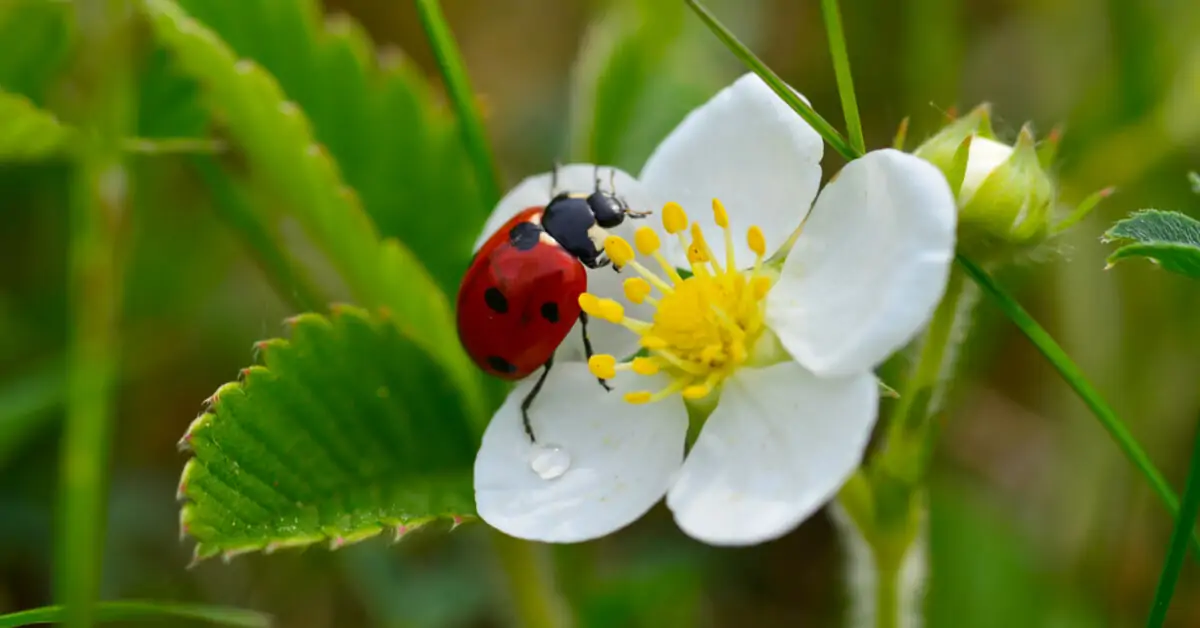
A ladybug is one of the few insects that naturally evokes sympathy. Its round silhouette and colorful dress please children as well as gardeners. Yet the famous “ladybird” remains surrounded by conventional wisdom. Its spots, in particular, do not reveal its age. They contribute rather to its identification and its defense.
The Ladybug: A Valuable Ally for Gardeners
The ladybug belongs to the family Coccinellidae, within the order of beetles. Like all beetles, it possesses two rigid elytra that cover and protect its wings.
Many species are remarkable garden helpers. Their larvae and adults feed on aphids, but also on scale insects, mites and other small invertebrates.
A ladybug can thus devour several hundred aphids over the course of its life. The number varies, however, depending on the species, the temperature, the developmental stage, and the available food.
Not all ladybugs share the same menu. Some feed on microscopic fungi, such as powdery mildew. Others mainly feed on plants. The family is therefore much more diverse than the classic red seven-spotted ladybug suggests.
Do Ladybug Spots Indicate Age?
No, the number of spots has no relation to the insect’s age. A seven-spot ladybug is therefore not seven years old, just as a two-spot ladybug isn’t two years old.
This belief probably persists because ladybugs are often used to teach children how to count. Yet the pattern on the elytra is determined by the species’ characteristics and its genetic makeup.
Adult ladybugs typically live from a few months to a few years, depending on the species and living conditions. Some spend the winter in shelter, then become active again when spring returns.
What Are Ladybug Spots Really For?
A Clue for Identifying Species
The color, the number of spots, and their arrangement provide useful clues for identifying a ladybug. There are about 6,000 species worldwide and more than 130 in France.
The seven-spotted ladybug, Coccinella septempunctata, remains one of the most familiar in our gardens. There are also yellow, orange, brown or black ladybugs. Their markings can be red, black, yellow, or cream.
However, the number of spots does not always determine the species. Some ladybugs exhibit several forms. Their color and the number of spots can vary significantly from one individual to another.
The Asian lady beetle, Harmonia axyridis, perfectly illustrates this diversity. Its elytra can be yellow, orange, red, or black, with a highly variable number of spots.
Contrary to another old belief, ladybugs do not choose their mate by counting spots. Reproduction occurs between compatible individuals of the same species, even when their coloration differs.
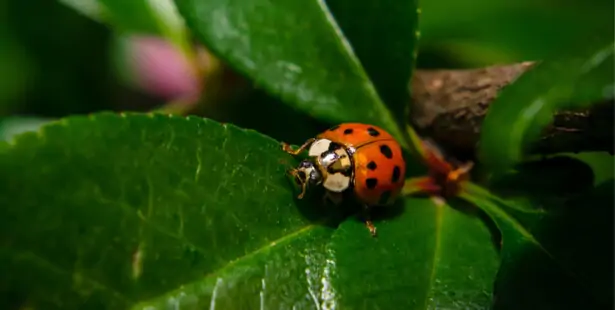
Colors That Warn Predators
The red, orange, or yellow outfits paired with black also serve as a warning to predators. In nature, these highly visible colors often indicate that an animal tastes bad or has a defense mechanism.
This principle, called aposematic coloration, is found in other garden dwellers as well, such as the firebug.
When threatened, the ladybug can release from the joints of its legs a few drops of a yellowish liquid. This is its hemolymph, the equivalent of blood in insects.
This liquid contains alkaloids. Its bitter taste and odor deter many predators. The ladybug is therefore not aggressive: this “reflex bleeding” is simply one of its defense strategies.
Did you know?
When a ladybug emerges from its pupa, its elytra are still soft and very pale. Their color and markings gradually appear as they harden.
How to Welcome Ladybugs to Your Garden?
To benefit from their help, it’s best to provide a living garden rather than trying to release them artificially. A small population of aphids provides the essential food for both adults and larvae.
Avoid insecticides, including products marketed as natural when they do not target only the pests. They can also affect ladybugs, hoverflies, lacewings and other beneficial insects.
You can also encourage their presence with a few simple steps:
- preserve areas of spontaneous vegetation;
- cultivate plants with varied flowering times;
- leave some fallen leaves and hollow stems over winter;
- install a small, diverse hedge;
- tolerate a few aphids rather than treating immediately.
An insect hotel can complement these measures if it stays dry, well anchored, and protected from prevailing winds. However, a hedge, a pile of leaves, or an old log often offers more natural refuges.
Why Is It Called the “Good God” Bug?
The ladybug has long been associated with luck. The exact origin of its nickname remains uncertain, but several medieval legends tell of it saving a prisoner unjustly accused.
One ladybug allegedly perched on his neck at the moment of execution. Despite multiple attempts, the insect would return to the same spot. The king saw divine intervention and spared the man.
The tale leans into myth. Yet the practical value of the ladybug in the garden readily explains its good reputation. By naturally protecting crops, it indeed brings gardeners a touch of luck.
Also read
Learn about ordinary biodiversity to better protect it.