

After several weeks without rain, the soil can become hard, compacted and almost impermeable. Water then runs off without penetrating. To rejuvenate a dry soil, there’s no need to drown it or turn it over abruptly. A gradual rehydration, compost, gentle decompaction and a cover crop can restart its natural fertility.
What to remember
- Rehydrate the soil in several passes.
- Decompact it only when it is slightly damp.
- Apply mature compost on the surface.
- Sow a cover crop suited to the season.
- Mulch to prevent further drying out.
Why does dry soil end up repelling water?
Under heat, the water present in the top few inches of soil evaporates. The surface contracts, hardens and sometimes forms a crust.
Some soils also become hydrophobic. Organic compounds can coat soil particles and slow their rewetting. Water then remains in droplets or runs off to the lower areas. (1)
To test your soil, drop a few droplets of water on a dry patch. If they sit on the surface for several minutes, the soil absorbs water poorly.
However, a “cooked” soil is not dead. Living organisms often slow down their activity while waiting for favorable conditions to return.
Slowly rehydrating the soil, without wasting water
Pouring a large amount of water all at once is counterproductive. A big portion will either run off or evaporate.
Start by lightly scratching the crust for one or two inches. Use a claw tool or a small rake. Do not work very dry soil deeply.
Then water in two or three passes spaced a few minutes apart. The first pass moistens the surface. The following passes gradually penetrate deeper.
You can also create small basins around plants. They hold water near the roots. A soaker hose or drip irrigation makes slow, even diffusion easier.
Water early in the morning or in the evening. First, check for any watering restrictions in your area.
Loosening the soil without turning over the entire bed
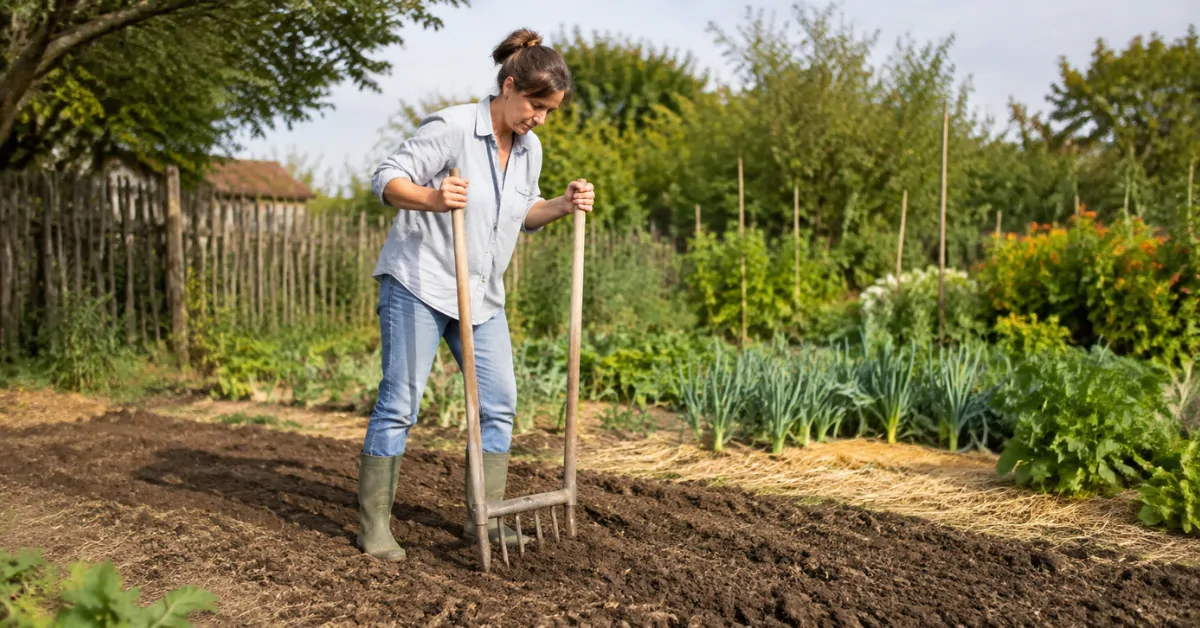
Once the soil is slightly moistened, use a broadfork or a garden fork. Push the tool in vertically, then make a light back-and-forth motion.
The goal is to create cracks and channels for water. Do not overturn the different soil layers.
This method preserves more roots, worm galleries and natural pores. These passages then ease water infiltration. Studies on hydrophobic soils show the importance of these biopores. (2)
Avoid trampling the planting boards. Place a board on the ground if you need to work on a patch that is still fragile.
Restarting soil life with mature compost
Spread one to two centimeters of mature compost on the damp soil. Do not bury it deeply. A light surface raking is enough.
Compost provides organic matter. It gradually improves soil structure and its ability to retain moisture.
Choose a dark, crumbly compost with no unpleasant odor. Compost that is still hot or poorly decomposed can disrupt young seedlings.
Compost tea or leachate is not essential. Its effects vary depending on its preparation and quality. Some mixtures enriched with sugar can even promote unwanted bacteria. (3)
If you want to use it, choose only perfectly mature compost. Prefer a fresh brew, with no sugar or manure. Pour it onto the soil, never onto crops ready to harvest.
Which cover crop to sow at the end of summer?
An uncovered soil dries out, compacts and erodes more easily. Green manures cover the soil while producing roots.
Depending on your region and the sowing date, you can choose:
- phacelia, which grows quickly and produces many roots;
- mustard, effective at quickly covering a free patch;
- crimson clover, a legume suited for early sowings;
- vetch, often paired with oats or rye;
- rye, hardy and suitable for later sowings.
Avoid mustard before a future crop of cabbage, radish or turnips. These plants belong to the same botanical family.
Sow after rehydrating and loosening the surface. Then keep the soil cool and moist until germination.
Mow the cover crop before it sets seed. Leave the plant material to dry on the surface to act as mulch.
Finish with a structuring mulch
Cover the unsown areas with five to eight centimeters (two to three inches) of plant material. Use fallen leaves, straw, wood chips or clippings that have been dried beforehand.
Mulching reduces evaporation and protects the surface from the impact of heavy rains. It also gradually feeds soil organisms. Some guidelines recommend a light compost top-dress before mulching.
Avoid laying down a thick layer on soil that is completely dry. Always rehydrate the soil first. Otherwise, the mulch could slow the infiltration of light rains.
In a few weeks, the soil will regain a better structure. Autumn rains will then infiltrate rather than run off.
Read also
Drought: our tips to use less water in the garden
- https://swr.agriculturejournals.cz/artkey/swr-200810-0009_a-brief-overview-of-the-causes-impacts-and-amelioration-of-soil-water-repellency-a-review.php
- https://www.csiro.au/en/research/plants/crops/farming-systems/water-repellent-soils
- https://soiltesting.cahnr.uconn.edu/compost_compost_tea_and_manure/