Inexpensive, lightweight, and easy to install, emergency blankets have become a popular solution for limiting heat in homes. But their effectiveness largely depends on placement, window exposure, and how they are installed.
With the rise of heat waves, Americans are seeking simple ways to shield their homes from the sun. According to data provided to RMC by Decathlon France, 102,895 emergency blankets were sold between July 1 and July 12, 2026, marking a surge of more than 80% compared to the previous year. Individuals, but also schools and healthcare facilities, turned to them when air conditioning equipment was unavailable.
How does an emergency blanket block heat?
An emergency blanket is made of a very thin plastic film, usually PET, coated with a metallic layer, often aluminum. Its shiny surface reflects a substantial portion of solar radiation.
Placed in front of a sun-exposed window, it thus reduces the amount of energy entering the room and warming the floor, walls, or furniture. It does not create cold and does not replace an air conditioner: its role is primarily to slow the temperature rise of the home.
To optimize your entire home against heat waves, it’s also useful to adopt good habits to keep your house cool during one of these heat spells.
Its effectiveness will naturally be more noticeable on a bay window or a south- or west-facing window. On a north-facing façade or one that is already shaded, its benefit remains limited.
An outdoor installation is preferable
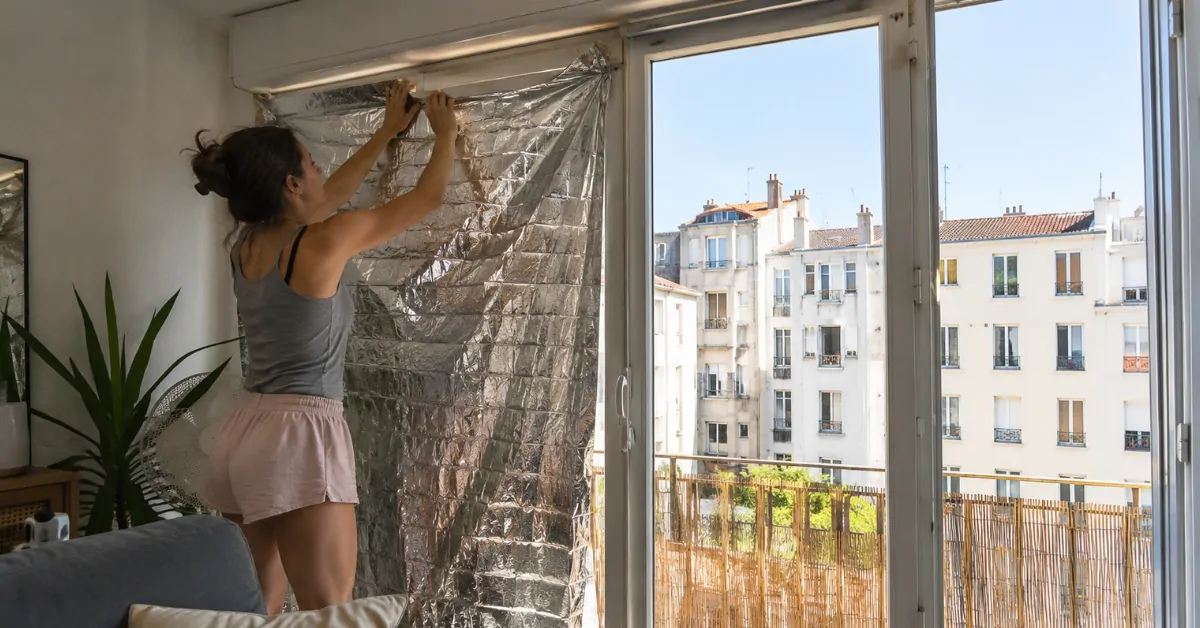
To achieve the best result, the blanket should be placed outside the glazing, with the metallic (silver) side facing the sun. The radiation is thus reflected before it passes through the glass and heats the interior.
Indoor installation can nonetheless provide partial protection when access to the exterior façade is not possible. It will simply be less effective, as the sun will have already passed through and heated the glazing.
It is best to fix the blanket to the window frame or to a removable support, without sticking it directly and partially to the glass. A significant temperature difference between multiple zones of a pane can, in some configurations, create thermal stresses.
The mounting should also be sturdy enough to withstand wind. In case of a storm or strong gusts, it’s better to temporarily remove the setup rather than trying to handle it from the outside.
Can you really gain several degrees?
Some users report a drop of 5 to 8 °C in rooms that are very exposed. However, these results are difficult to generalize.
The gain depends on many factors: the orientation of the home, window size, type of glazing, insulation level, nighttime ventilation, and outdoor temperature. An emergency blanket is generally more useful in a room that is heavily sunny and lacks shutters than in a home that is already well protected. If you want to go further and consider long-term solutions, learn how to achieve ecological thermal insulation for your home to maintain comfort in winter and summer.
Contrary to a common belief, its effect does not automatically vanish above 30 °C. Even during a severe heat wave, limiting solar radiation entry remains useful. However, the blanket cannot prevent heat from passing through walls, the roof, or outdoor air.
The emergency blanket: an affordable but temporary solution
The emergency blanket is an accessible heat-reduction hack, especially for renters or homes without shutters. It, however, has several limits: it is fragile, not very durable, and it considerably reduces natural light.
For permanent protection, blinds, exterior shutters, awnings, and good insulation remain more effective. Ventilating the home during cooler hours, then closing windows and solar protections as the temperature rises, complements the setup.
The emergency blanket should therefore be considered a stopgap: when well installed, it can reduce solar gains and improve indoor comfort, without replacing equipment designed to protect the building from heat in the long term.