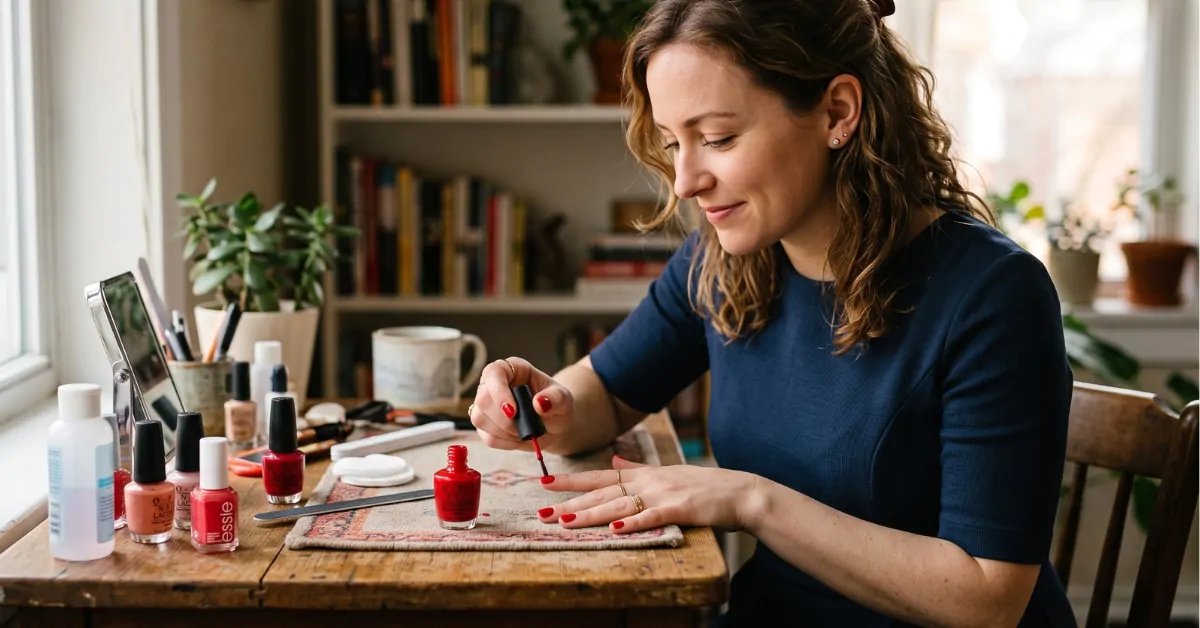
Nail polish is making a big comeback on our toes as the sunny days arrive. However, it is not harmless: here is our breakdown.
Even though this adornment has existed for more than 3,000 years, it was the composition of car paints that inspired today’s nail polish makers. Needless to say, the substances that make it up aren’t very natural… We’ve decoded for you the labels on standard nail polishes.
The nail polish, a toxic product?
Nail polishes must have several properties: long-lasting wear, shine, and easy application. To achieve this, manufacturers use several types of substances:
- to form a film on the nail, a film-forming agent, most often nitrocellulose, flammable;
- resins that provide gloss and adhesion;
- plasticizers to make the material flexible;
- for color, mineral or organic pigments and natural or synthetic pearlescent pigments;
- to spread the polish, a rheological agent that gels as soon as it is applied to the nail.
- solvents to facilitate the application of the polish.
The dangerous substances contained in nail polish
In most nail polishes, you’ll find dangerous substances. This is the case for formaldehyde, a hardener that is part of endocrine disruptors and classified as a “carcinogenic substance“.
There’s also toluene, used as a solvent and irritating to the skin, eyes, and respiratory system. Dibutyl phthalate (DBP) is used to increase the smoothness of the polish. It is also classified in the category of endocrine disruptors.
Nail polishes can also contain parabens (preservatives, endocrine disruptors), xylene and rosin, irritants, or camphor, which can trigger headaches.
Are there non-toxic nail polishes?
The top three ingredients (toluene, formaldehyde, and DBP) are the ones most commonly found in polishes. However, some manufacturers offer “3-free” formulas that do not contain these three substances. There are even “5-free” or “7-free” polishes that contain fewer ingredients considered dangerous.
And organic/natural nail polish? In 2011, the first organic nail polishes were pulled from the market, deemed negatively by consumers. Today it’s hard to navigate between “bio” polishes and natural polishes.
Three brands to note, however: the Avril brand, which offers organic-certified nail polishes (Ecocert), the Kure Bazaar polishes with an 85% natural composition and “3-free,” and those from the Couleur Caramel brand, free of parabens, formaldehyde, toluene, and rosin.
A caveat: UFC-Que Choisir, a French consumer group, tested these products in 2016 and found that some of the so-called “natural” products also contained certain endocrine disruptors. No nail polish is therefore free from potentially toxic substances!
So what should one do? If one is absolutely determined to wear nail polish, follow these guidelines:
- Apply it outdoors to avoid inhaling toxic fumes;
- Avoid spilling onto the surrounding skin to limit diffusion;
- Do not keep polish on for more than a week at a time to minimize toxin exposure;
- Use a natural, less-toxic remover.

Ethan Hartwell
I break down everyday products to understand what they truly contain and what they imply. My goal is simple: make information clear and useful so people can make more responsible choices without complexity or unnecessary noise.