
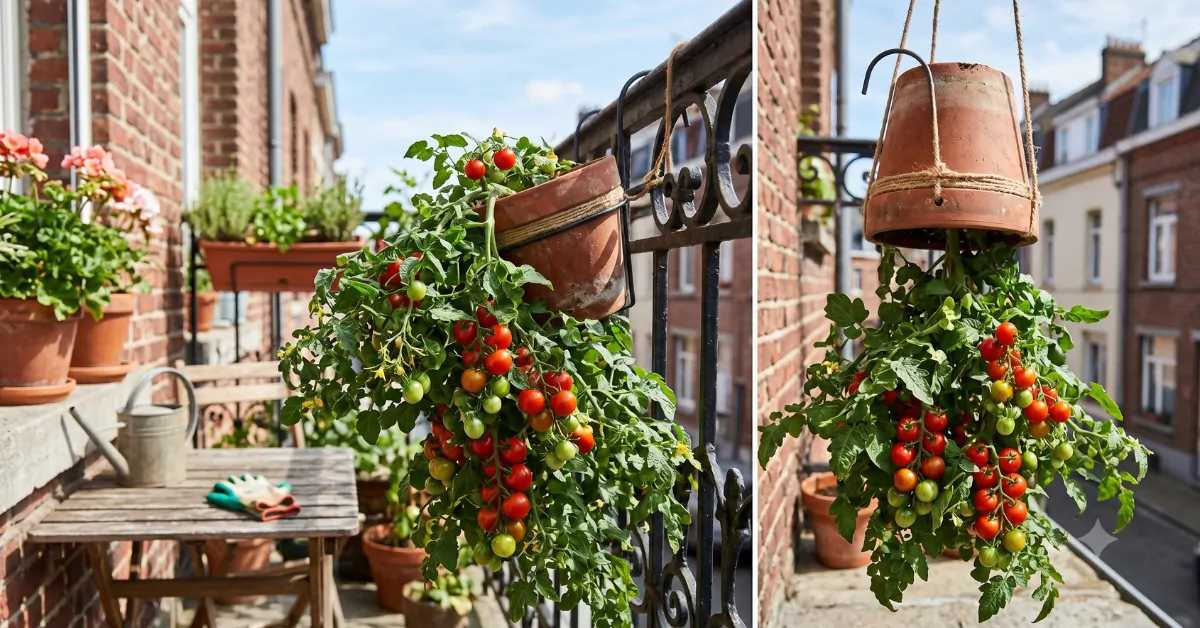
Who hasn’t dreamed of having their own tomatoes within reach? While growing these water-rich fruits requires some know-how, you don’t necessarily need a garden to enjoy them. Tomato plants can also grow in pots and window boxes on a balcony or patio. It is also possible to grow hanging tomatoes! Steps to follow and a close look at the advantages and drawbacks of this growing method.
Growing Hanging Tomatoes: Why Do It?
As the name suggests, the hanging tomato plant is a tomato plant that grows upside down, in a pot hung up. It’s a fairly easy idea to implement, even for gardening beginners. Hanging tomatoes arranged upside down are also highly decorative on a balcony or patio, but one question arises right away: why choose this method?
To start with, growing tomato plants in an upside-down hanging pot takes up far less space than in a traditional vegetable bed, since you only need a small area that allows a pot to hang. There are also several other benefits:
- Hanging tomatoes in a pot are not exposed to weed growth.
- Soil-dwelling pests that harm them, such as wireworms, can’t reach them.
- Plants grown in upside-down pots are also more resistant to tomato diseases.
- In case of frost or extreme heat, you can quickly bring them indoors.
- Since the plant will grow downward, it won’t need a stake or tomato cage to stay upright.
Upside-down pots are perfect for growing cherry tomatoes
All tomato varieties can be grown in an upside-down pot, but the smaller ones, such as cherry tomatoes, are probably the best fit due to their compact size. It’s also important to remember that an upside-down hanging pot will be fairly heavy once filled with soil and especially when the soil is saturated with water. This is why growing cherry tomatoes in small hanging pots makes sense, since their roots require less space.
Still, at the end of the day, these are roughly the same advantages as growing tomatoes in a regular pot. In short, growing tomatoes upside down in a hanging pot is mainly an aesthetic choice, though this growing method does offer a handy space-saving benefit on small balconies, for example.
How to Grow Tomatoes Upside Down?
Want to grow tomatoes upside down? You don’t need to invest in hanging pots for a tomato plant; you can make your own. Here’s how to do it:
1 – Choose a container wide and deep enough so the roots can develop properly and the substrate doesn’t dry out too quickly. For cherry tomato varieties (or small tomatoes), we recommend pots about 12 inches wide and tall. Remember that the taller the plant will grow, the larger the container should be. The container should have hooks or handles for hanging.
2 – Once you’ve chosen the pot, make a hole in the bottom. This will let water drain and also allow your tomato plant to grow downward. The hole should be generous but not too large, so that the plant remains supported. For a pot about 12 inches in width and height, we suggest a hole about 3 inches (8 cm) in diameter.
3 – Place newspaper at the bottom of the pot, which you’ll also need to pierce in its center. You can also use burlap or disposable coffee filters.
4 – Carefully insert the tomato plant from the top of the pot, through the opening designed for this purpose. Part of the stem and of course the roots should stay contained in the pot, while the rest of the stem should extend outside the pot, hanging down toward the ground.
5 – Fill everything back with soil, packing it down before watering generously to thoroughly moisten the substrate. You can then mulch the top of the pot to protect the plant’s roots.
6 – You’ll just have to hang your pot in a sunny spot and water the pots regularly to keep the soil moist.
Growing Tomatoes in an Upside-Down Hanging Pot Isn’t All Pros
While upside-down tomato growing has its benefits, it also comes with drawbacks:
- It can be tricky to install the plant in an inverted pot and the stem may break. You’ll need to handle the plant with particular care during installation.
- Once filled, the container can be quite heavy, so the hooks or handle—and the support it’s attached to—must be sturdy.
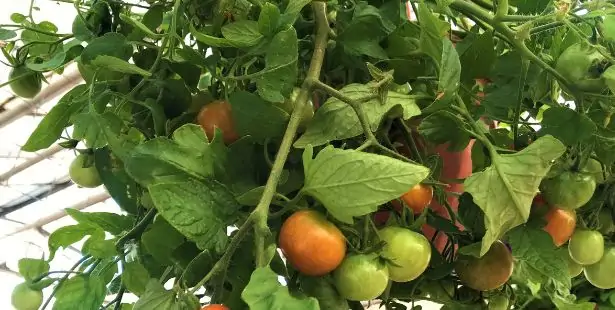
- When grown upside down in a pot, tomato plants generally produce fewer flowers and thus fewer fruits than those grown in the ground. This method can be less productive. Why? The hormones that promote flowering tend to accumulate in the upward-growing stems rather than those pointing toward the ground. Flowers tend to form more on stems that manage to straighten, but once loaded, the stem will droop back down.
- The plant hanging at the bottom of a pot will receive less sunlight than a plant in an upright pot, since the rays don’t hit it directly.
- Watering can also be a bit less effective, because in an upside-down hanging pot, you tend to add less water to avoid it running onto the fruits or dirtying the soil.
Despite all that, growing tomatoes upside down remains feasible for those who want to try it, especially for those who don’t have a lot of space. It’s also a fun activity to do with kids, who can watch the plant grow downward!