
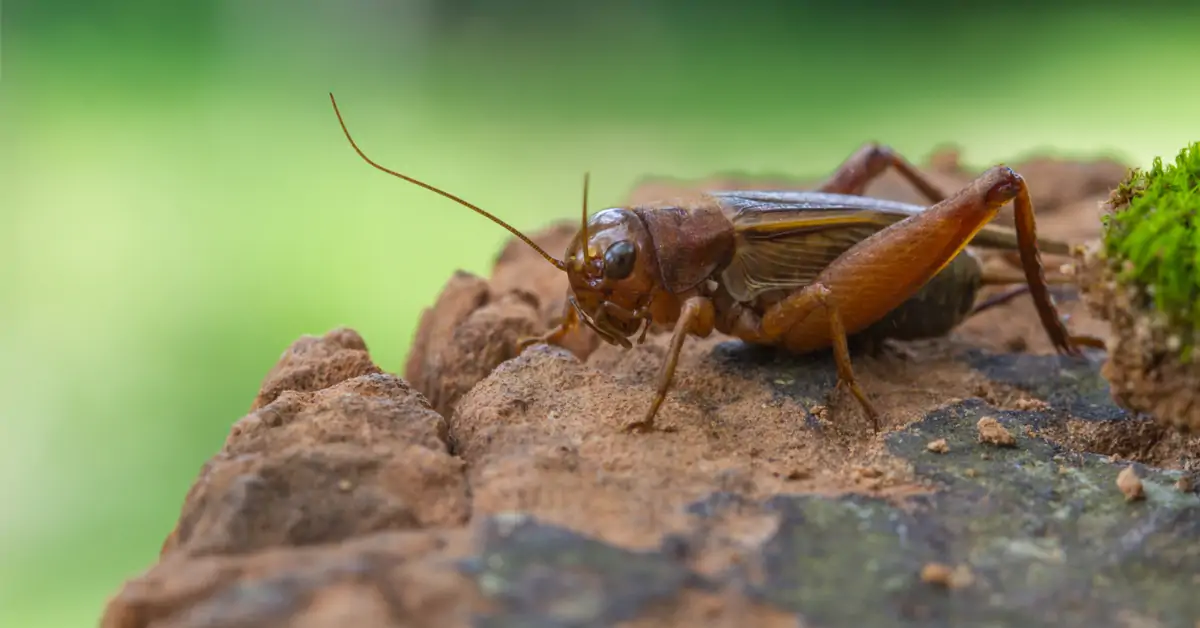
The cricket belongs to the large family of orthopteran insects, like grasshoppers and katydids. Under the term “cricket,” however, one groups very different species. In mainland France, there are today nearly thirty species of crickets in the broad sense. In other words, saying “crickets” is a bit like saying “birds” to refer to anything with feathers.
Hidden, often heard before seen, the cricket is part of this ordinary biodiversity that we forget all too quickly. Yet its song accompanies our warm evenings, our gardens, sunlit embankments, and meadows. So let’s take the time to better know this familiar, harmless insect that is precious to ecosystems.
What to remember
- The cricket is an orthopteran insect, closely related to grasshoppers and katydids.
- Metropolitan France is home to about 29 species of crickets in the broad sense.
- The cricket’s song is produced by males, who rub their forewings.
- Crickets are not dangerous to humans and play a role in the food chain.
- Their future mainly depends on preserving meadows, embankments, hedgerows and pesticide-free gardens.
The cricket, the insect that stridulates in warm evenings
Like all insects, the cricket has six legs. Its hind legs are powerful and adapted for jumping. Its long antennae allow it to explore its environment, detect obstacles and communicate.
Most crickets prefer warm, dry, or exposed environments. They are found in natural lawns, sparse meadows, embankments, roadside verges, fallow land, and some gardens.
The field cricket, or Gryllus campestris, is one of the best known. Adults are most visible in spring and early summer. Males often sing at the entrance of their burrows, especially when temperatures are mild.
In some species, crickets dig tunnels in the soil. They serve as shelters, overwintering sites, or singing posts. In the field cricket, the burrow can reach several centimeters in depth.
The female lays eggs in the soil using a long organ called the ovipositor. In the field cricket, laying can reach several hundred eggs. This number compensates for high natural predation.
For the cricket is also an important prey. Birds, amphibians, lizards, spiders and small insectivorous mammals feed on it. In its own way, it participates in the balance of life.
Why does the cricket sing?
The cricket’s song is called stridulation. Contrary to a common belief, it does not sing with its mouth. The male produces the sound by rubbing its forewings, also called elytra.
This “xsss xsss xsss” regular trill mainly serves to attract females. It can also play a role in defending a territory or in interactions between males.
In some species, the sounds are highly coded. Intensity, rhythm, and frequency can vary depending on the message. For us, it’s just a summer noise. For the cricket, it’s a real communication tool.
The cricket’s wings have therefore acquired an astonishing function. In many species, they are used less for flying than for producing sounds. Some species fly little, or not at all, which limits their ability to disperse.
Cricket, grasshopper, katydid: how to tell them apart?
It’s easy to confuse these three insects. They all belong to the Orthoptera group, but several clues help distinguish them.
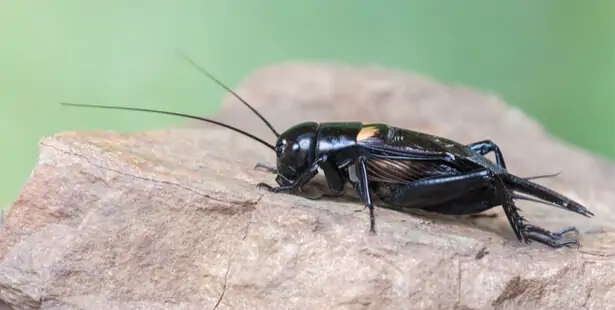
- The cricket often has a stout, dark and flattened body, with long antennae.
- The grasshopper has shorter antennae and usually lives in open habitats.
- The katydid has long antennae and a body that is often more elongated.
Another useful difference: the cricket is often quieter and harder to spot. You hear it before you see it. The grasshopper, by contrast, tends to leap more readily in the grasses when you walk in a meadow.
Is the cricket dangerous?
No, the cricket is not dangerous to humans. It does not bite or sting under normal circumstances and does not transmit diseases known in our gardens.
In a house, an isolated cricket may simply surprise with its song. It is usually seeking warmth, shelter, or food. It’s best to gently capture it with a glass and release it outside.
In the garden, there’s no need to regard it as a pest. Some occasional damage may occur on young shoots, depending on species and context. But in a balanced garden, the cricket remains mainly a living part of the ecosystem.
Threats facing crickets
Cricket populations do not fare the same across the board. Some species remain common. Others depend on very particular habitats and become vulnerable when these habitats disappear.
Regional data on orthopterans show a troubling reality. In Île-de-France, for example, nearly a quarter of the assessed species of grasshoppers, crickets, and katydids are considered threatened or regionally extinct.
The disappearance of meadows and living soils
The first threat remains habitat destruction. Soil artificialization, roads, housing developments, commercial zones, and intensive agriculture reduce habitats favorable to crickets.
Natural meadows, grassy embankments, dry lawns, and fallow land are often seen as “useless” zones. Yet, these environments host a remarkably rich fauna, including many insects.
France has set a goal of net-zero soil artificialization by 2050. But on the ground, preserving small ordinary habitats remains a daily challenge.
Landscape fragmentation
Crickets often have a limited capacity to disperse. When they fly little or not at all, they depend heavily on the continuity of habitats.
An embankment isolated in the middle of a large field, a meadow cut by a road, or a garden surrounded by concrete surfaces quickly become islands. Populations end up separated from one another.
In the long term, this fragmentation reduces gene flow between individuals. It also makes populations more fragile in the face of drought, farming work, or changes in management.
Pesticides and mowing too often
Pesticides don’t only affect targeted pests. They also impact many non-target insects. Crickets can be exposed directly or indirectly.
Mowing lawns too short poses another problem. A very short lawn offers little shelter, little food, and few breeding sites. For a cricket, it is almost a desert.
How to help crickets in your garden?
Good news: helping crickets doesn’t require expensive equipment or major work. It often just means leaving a little space for the wild.
In a garden, on a vegetated balcony, or in a courtyard, several simple actions can support crickets and other insects.
- Mow less often and keep a patch of tall grasses.
- Leave a small embankment, a border, or a dry corner without intervention.
- Avoid pesticides and broad-spectrum insecticides.
- Leave a few fallen leaves, stones or pieces of wood on the ground.
- Plant a varied hedge with native species.
- Limit outdoor lighting at night, especially in summer.
- Avoid turning over the soil deeply every season.
These actions also benefit wild bees, butterflies, spiders, hedgehogs and birds. A living garden is not a neglected garden. It’s a better-shared space.
A DIY mini cricket haven
To create a welcoming corner, choose a quiet, well-exposed area with little foot traffic. Let the grass grow taller there than on the rest of the lawn.
Add a few flat stones, a small pile of dead wood, and a patch of bare earth. Don’t water too much. Crickets often favor warm, dry, and structured environments.
Then, observe. In the evening or on mild days, listen. If a cricket settles in, you’ll probably hear it before you see it.
Observing crickets, a gateway to ordinary biodiversity
Crickets deserve to be better known. It’s always easier to let a species disappear when we don’t know it exists.
To observe them, you don’t need to capture them. Move slowly through a grassy area, listen to their song, then spot the entrance of a burrow. With a bit of patience, you may sometimes see the male singing at the entrance.
You can also participate in citizen science. Naturalist platforms and specialized associations help map where species occur.
To go further, you can approach organizations specializing in entomofauna, such as the Office for Insects and Their Environment. They can support curious individuals, teachers, local authorities, and gardeners who want to take action in the field.
Your move: the next time you hear a cricket, don’t hear it as just a summer sound. Hear it as a subtle signal of biodiversity.