
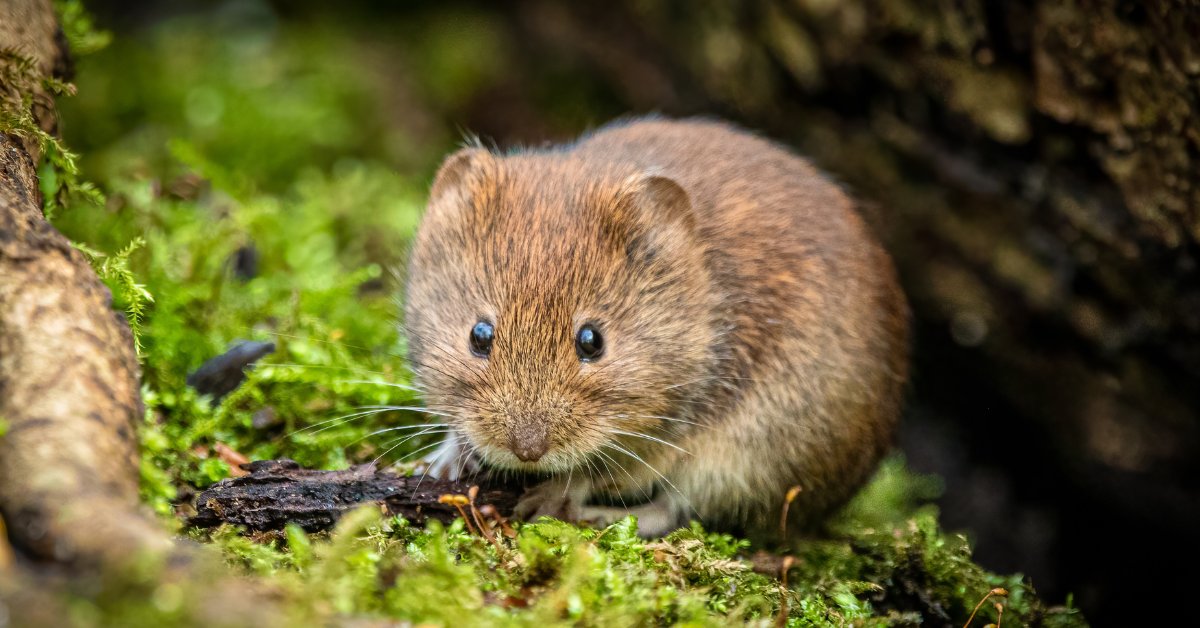
Ordinary biodiversity also includes those animals we know are there, that we know are thriving, and that we believe or hope have many good days ahead. Each species has its own place, and here we speak of an iconic creature of our countryside, so iconic that its name is partly given to it—the field vole.
The Field Vole, a Rodent That’s a Real Menace in Rural Areas!
Voles, grouped in the subfamily Arvicolinae, are rodents that have managed to conquer a wide range of habitats—from grasslands to aquatic environments. And within the great tribe of voles, the field vole stands out as one of the most formidable at staking its claim!
Digging small mounds that are easy to mistake for molehills, these mounds can be so numerous in fields that they limit the amount of grass produced.
Measuring 12 to 22 cm in length and weighing up to 180 g, the field vole is a herbivore that consumes roughly its own body weight in roots or bulbs over its 6 to 8 months of life.
Our small rodent is capable of creating a network of underground galleries up to 60 m long and depths ranging from 20 cm to 1 m, where it also has its nesting chambers where females can have 5 to 6 litters per year, each containing 2 to 8 young.

Traits of the Field Vole
The field vole’s breeding pattern and frequency are such that there can be years of extraordinary population booms, somewhat akin to their high-latitude cousin, the lemming.
These population booms occur in cycles every 5 or 6 years, and they are the result of a confluence of several factors such as climate, predator presence, disease, parasites, and more.
To better understand this extraordinary phenomenon, consider that a single pair of field voles can produce, on its own, as many as 114 descendants in a year, which can lead to population densities approaching about 1,000 voles per hectare!
If we translate that into their food needs, the daily requirement per hectare would then be around 180 kg… Not easily sustainable in itself, and even less so when the vole shares its land with humans.
Threats Looming Over the Field Vole
Chemical Control
While mechanical control methods (trapping) can yield fairly good results, the approach is labor-intensive and requires a broader restructuring of the predator pool.
In this regard, the use of chemical compounds, notably bromadiolone, is among the most effective means of reducing the damage caused by the field vole.
This method of control, however, has no future, neither environmentally nor economically, since bromadiolone, to a degree similar to ferramol for slugs (the blue granules even labeled “bio”), remains in the bodies of killed animals and can be consumed by predators that die from it or develop serious pathologies.
Disappearance of Its Predators
The dynamics of field vole populations make them a key element of the food chain.
It would be a long list to enumerate all the animals that prey on them, but to name just one predator, namely the tawny owl, imagine that a single pair with offspring can consume up to 2,600 field voles in a single season!

Or, with habitat fragmentation, the disappearance of hedgerows or field trees, the rise of monoculture, and a general decline in landscape richness, the field voles’ natural predators are themselves vanishing.
They boom more intensely and, above all, maintain higher population levels, which increases the need for human intervention. When these interventions rely on bromadiolone, the chemical is then consumed by the predators that survive, which in the end amplifies the problem and contributes to biodiversity collapse as well as to aggravating the original issue.
How to Help the Field Vole
As with all biodiversity, ordinary or otherwise, we should contribute to its observation, share knowledge especially with younger audiences, and support wildlife protection groups and all organizations working to preserve ecosystems.
In the case of field voles, and given that their biggest threat is humans in the most direct sense, it means both staying informed about the various management options to keep damage from becoming excessive (for example, discouraging fox shooting, installing perches for birds of prey, ensuring hedgerows are replanted, etc.) and promoting them to people who either don’t care or aren’t aware of them.
Don’t hesitate to reach out to mammalogical societies or associations sometimes housed in regional Natural History Museums, and keep an eye on the issue from the agricultural sector’s perspective, such as the FREDON groups.