
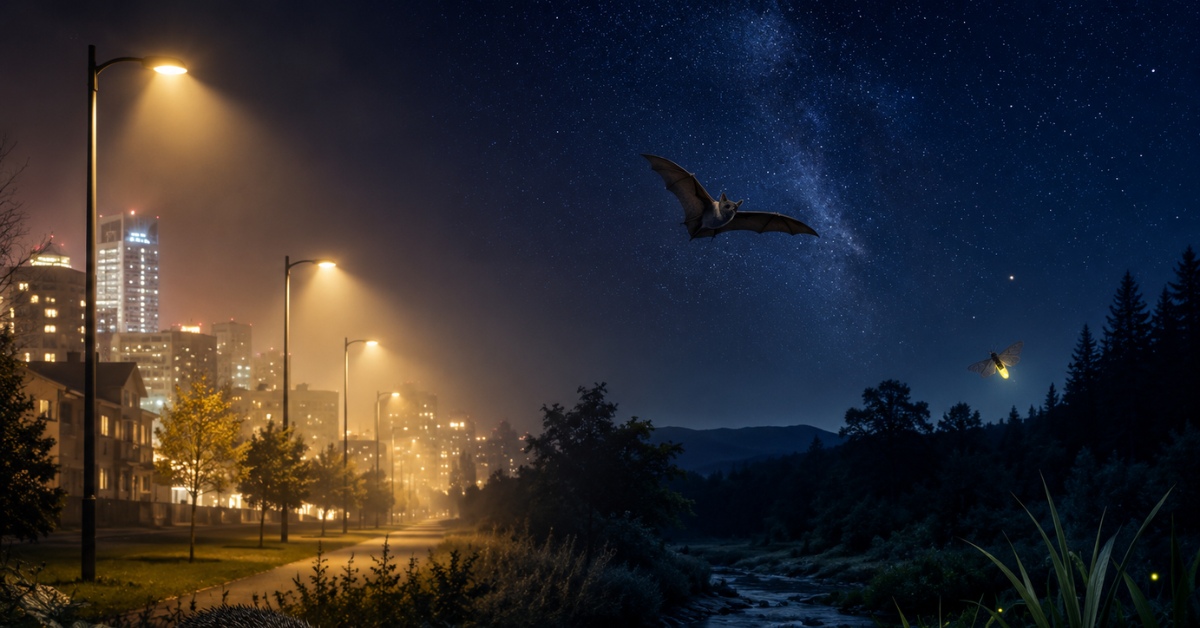
According to the French Office for Biodiversity, cited in the Regional Biodiversity Strategy for Nouvelle‑Aquitaine, 85 percent of the metropolitan territory was exposed to high levels of light pollution in 2020. This nighttime artificialization disrupts animal movements, fragments natural habitats, and also affects human sleep. In response to this growing pressure, territories are progressively developing dark networks, an instrument now integrated into ecological connectivity policies.
Light pollution and biodiversity: why the dark network is essential
Light pollution is no longer confined to urban centers. Streetlights, commercial signs, decorative lighting, or private gardens now create a near-permanent halo. Yet a large portion of life depends directly on darkness. According to the official Trame verte et bleue portal, nocturnal artificial light exerts an effect of “attraction or repulsion” on many species. Insects, certain birds, or hatchling sea turtles can be drawn toward and trapped by light sources, while bats, terrestrial mammals, or fireflies avoid lit areas, according to the state-run Trame verte et bleue site. This light pollution then acts as an invisible barrier. It fragments habitats and cuts the nocturnal corridors used by wildlife. The guide “Dark Network – Methods for its development and tools for implementation,” published by the French Office for Biodiversity in March 2021, stresses the need to “preserve and restore nocturnal ecological continuities.” According to this official document, the dark network is specifically aimed at restoring spaces dark enough to enable movement, feeding, or reproduction of nocturnal species.
Numbers illustrate the scale of the phenomenon. According to data shared by the French Office for Biodiversity, more than one-third of French municipalities were already practicing partial extinguishment of public lighting at night in 2024. This shift reflects a growing awareness of the impacts of light pollution on biodiversity, but also on energy costs. In Nouvelle‑Aquitaine, AREC and the region’s energy unions estimate, for example, that public spending related to lighting reaches about €70 million per year for one million light points, according to the Regional Strategy for Biodiversity published in 2023. Regulation is also evolving. The DREAL Grand Est recalls that the dark network was officially defined in the Official Journal of August 4, 2022 as “a network formed of sites where the light footprint is heavily limited, if not zero, and of nocturnal ecological corridors.” This definition underscores the objective of reducing habitat fragmentation caused by light pollution to protect biodiversity while promoting rest for diurnal species.
What concrete impacts on living beings?
The consequences of light pollution affect virtually all groups of species. Nocturnal insects are among the first to be affected. According to several scientific studies compiled in official resources on the dark network, artificial light disorients nocturnal pollinators and disrupts their feeding and reproductive behaviors. Some studies cited in institutional documents indicate a 62% decrease in flower visits in illuminated areas compared with dark areas. Bats are also strongly affected by this light pollution. Some species that are termed lucifugous completely avoid lit spaces, reducing their hunting grounds and movements. In its methodological guide, the French Office for Biodiversity explains that certain light corridors become “impenetrable” for several nocturnal mammals. This phenomenon reduces genetic exchanges between populations and weakens their long-term survival.
Among humans, light pollution also affects biological rhythms. Urban light halos disrupt melatonin production and alter circadian cycles. The Nouvelle-Aquitaine strategic document explicitly notes the “impacts on human health (circadian rhythm).” In addition, according to analyses shared by the National Association for the Protection of the Night Sky and the Nocturnal Environment, excessive lighting contributes to the progressive disappearance of the natural night in many French regions. Jurisdictions are now testing several concrete solutions. Turning off public lighting in the heart of the night is rapidly expanding. The webinar organized by the French Office for Biodiversity on April 29, 2026 reminded attendees that this measure does not lead to a general increase in crime.
How to reduce light pollution at home to help biodiversity?
The Dark Network is not only a concern for municipalities. Individuals can also limit light pollution in their gardens or around their homes. Recommendations published by specialized agencies converge on several simple principles: reduce lighting intensity, limit lighting durations, and avoid lights directed toward the sky or toward hedges. The French Office for Biodiversity specifically recommends adjusting lighting schedules and prioritizing truly useful lighting. Experts also advocate using warm-color temperature bulbs, which are less disruptive to biodiversity. Motion-sensor lighting can further reduce constant illumination. These adjustments simultaneously lower energy consumption and ecological disruption.
Some communities go much further. Bordeaux Métropole has launched specific studies to integrate a dark network into its Biodiver’Cité 2021-2026 strategy, according to the Nouvelle‑Aquitaine regional biodiversity strategy. Other territories develop “starry villages” to preserve the quality of the night sky and promote astronomy-related tourism. Light pollution thus becomes a central topic in land use planning. Between energy savings, biodiversity protection, and public health, restoring darkness is emerging as a major environmental lever. Long considered merely a modern convenience, artificial light is today seen as an ecological pressure in its own right.