
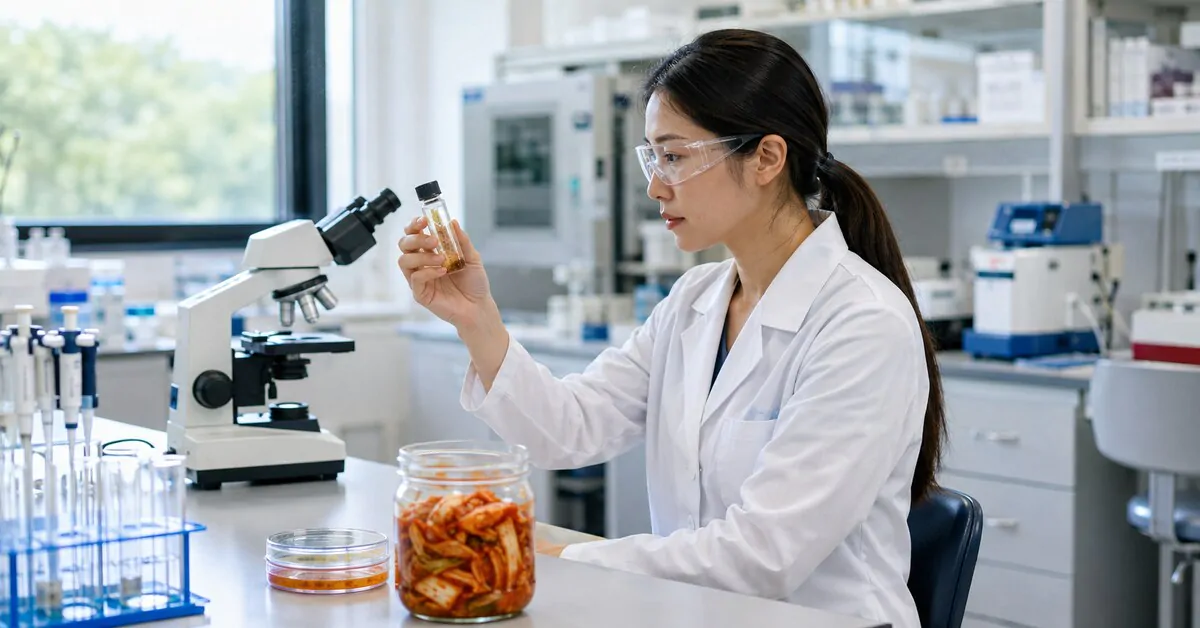
A study published in the scientific journal Bioresource Technology focuses on microplastics and their potential elimination by certain bacteria derived from fermented foods. Microplastics are increasingly worrying the scientific community, as they have been detected in blood, lungs, brain, and kidneys. In this context, any solution capable of reducing their presence in the body naturally attracts researchers’ attention.
Why Kimchi Intrigues Researchers
For several years, researchers have focused on fermented foods for their effects on the gut microbiome. Kimchi, made from fermented vegetables and rich in lactic acid bacteria, is among the products that have been most studied. However, according to the 2026 study published in Bioresource Technology, some of these bacteria could interact directly with microplastics present in the digestive tract.
Researchers at the World Institute of Kimchi studied in particular a strain named Leuconostoc mesenteroides CBA3656. According to the results published in Bioresource Technology in 2026, this bacterium demonstrated an absorption capacity for nanoplastics reaching 87% under laboratory conditions. Even in an environment simulating the human gut, it retained notable effectiveness. According to the study authors, reported by ScienceDaily on May 18, 2026, this property could help trap a portion of microplastics before they spread through the body.
Encouraging Animal Results
Researchers did not limit themselves to laboratory experiments. To measure the real impact of this bacterium on microplastics, they also conducted tests in mice. The results drew the attention of several international science outlets. According to the World Institute of Kimchi, cited by Phys.org on March 21, 2026, mice that received the CBA3656 strain showed more than twice as many nanoplastics in their feces as the control group animals. The bacterium would facilitate the evacuation of plastic particles via stool rather than their accumulation in tissues. Phys.org also reports that “a lactic bacterium isolated from kimchi could promote the elimination of nanoplastics from the body by binding to them in the intestine.”
These results align with other work published in 2025 in Nature Communications. That study evaluated 784 different bacterial strains to identify those capable of acting on microplastics. Researchers observed a 34% increase in the excretion of plastic particles in animals treated with certain probiotic strains, as well as a 67% reduction of residues present in the gut. According to the authors, this strategy could constitute an innovative approach to the rising microplastic contamination.
Microplastics: A Promising Discovery, but Still Incomplete
Despite the excitement generated by these studies, scientists urge caution. The data currently available are mainly based on laboratory experiments and animal models. No large-scale clinical study has yet demonstrated that regular kimchi consumption actually increases the elimination of microplastics in humans.
This caveat is evident in several analyses published in recent weeks. According to ScienceDaily on May 18, 2026, researchers consider the results robust enough to justify human trials but insufficient to make medical recommendations. Meanwhile, Bloomberg Opinion, cited by Channel News Asia on June 1, 2026, stresses that kimchi is not a miracle solution to global plastic pollution. The outlet notes that reducing microplastics must primarily involve cutting their production and dispersion in the environment.
Nevertheless, researcher Se Hee Lee highlighted the potential of this approach. “Plastic pollution is increasingly recognized not only as an environmental issue but also as a public health challenge,” the scientist said in remarks reported by Delish on March 24, 2026. He added: “Our results suggest that microorganisms from traditional fermented foods could represent a new biological approach to address this emerging challenge.”