
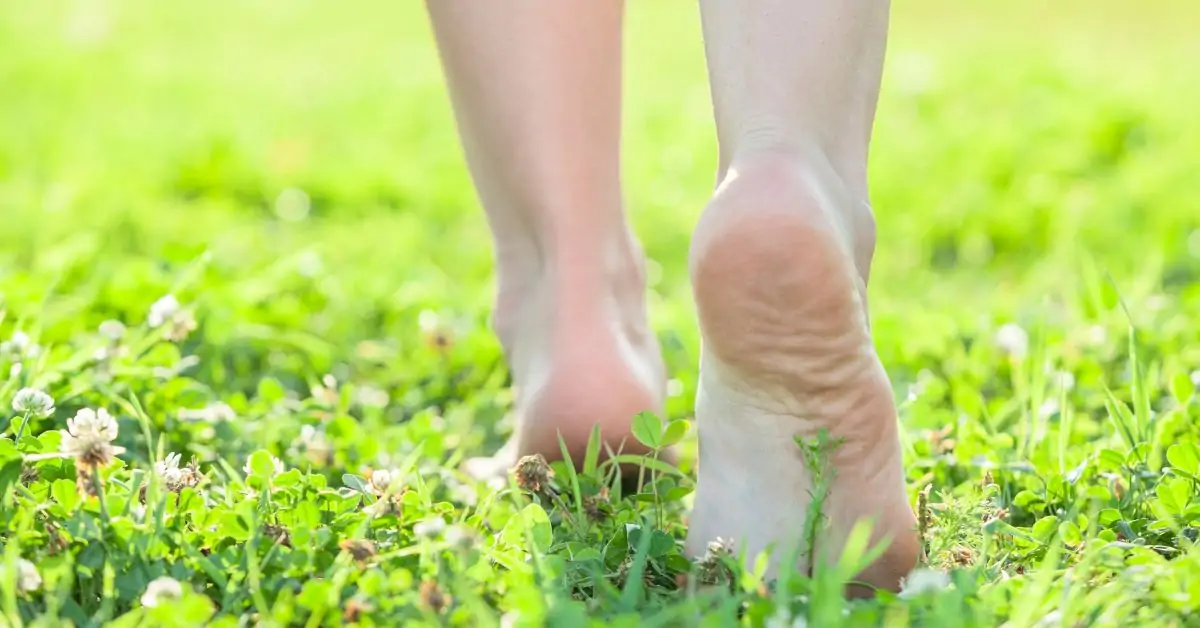
When we walk, the sole of the foot is the part of the body that makes contact with the ground, bears our weight, and lets us feel the terrain. Without the protection of shoes, this highly sensitive area is exposed to the elements: walking barefoot becomes a kind of massage, with beneficial effects that stimulate the reflex points and zones directly linked to the body’s organs, systems, and glands, according to foot reflexology. Thus, the soles of the feet form the foundation of the body’s reflex zones and of optimal health. Let’s pamper them.
Principles of plantar reflexology
plantar reflexology rests on the idea that the feet contain reflex zones corresponding to different parts of the body, and that stimulating these zones can improve health and overall well-being.
The feet are divided into reflex zones that correspond to different organs, glands and parts of the body. For example, the tips of the toes are believed to correspond to the head, while the area around the heel corresponds to the hips and legs.
By applying specific pressure to these zones, the reflexologist aims to clear energetic blockages and restore balance to bodily functions.
Plantar reflexology is often based on the theory that the body contains a vital energy that flows along specific pathways. Blockages or imbalances in this energy can contribute to disease or discomfort.
Walking barefoot to stimulate the reflex points and weight-bearing zones of the sole
The reflex points and weight-bearing zones are the parts of the foot that support the body’s weight when standing or walking. Ideally, body weight should be distributed evenly between the forefoot and the rearfoot. The surface that bears weight is cushioned to protect the bones.
During walking, a typical foot bears weight in the following sequence:
- the heel of the foot,
- the metatarsals (the cushioned area under the base of the toes),
- the pads of the five toes.
When the footprint is not flat or hollow, it is a normal foot, and the imprint will show an inward curve of about 2 cm.
Key benefits of walking barefoot
On flat ground
Walking barefoot on flat terrain sensitizes and activates the reflex zones located at the foot’s weight-bearing points.
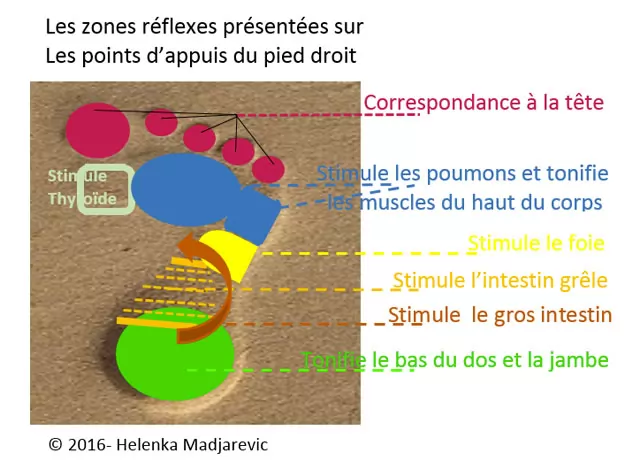
- tones the muscles of the foot, the lower back, the muscles of the right leg, the knee and hip joints on the right side;
- reduces pain in the right leg up to the right hip;
- stimulates the function of parts of the large intestine and the small intestine, improving digestion;
- stimulates liver function;
- tones the function of the respiratory organs;
- reduces muscle fatigue in the shoulders, neck and arms;
- makes the thyroid gland more efficient;
- activates and supports the proper functioning of the eyes, sinuses, ears, cranial nerves, via the toe-head correspondence.
On uneven ground
Walking barefoot on uneven terrain heightens perception and stimulates the entire surface of the soles as well as the apex of the arch—an area that is highly innervated and, for most people, the most sensitive part of the body.
In addition, each step on irregular terrain requires you to counterbalance the irregularities of the ground, which activates all the reflex zones of the soles.
Beyond the reflex zones activated by barefoot walking on flat ground, walking on uneven ground stimulates additional areas. The extra benefits include better functioning of:
- the large intestine and transit;
- the small intestine and nutrient absorption;
- the spleen, a key organ for an effective immune system;
- the pancreas, to support good digestion;
- the kidneys, which handle toxin elimination;
- the heart (left foot only);
- the spine, for greater flexibility from the sacrum up to the cervical vertebrae.
In general, walking barefoot improves blood and lymphatic circulation. It also promotes reduced stress and better sleep. It also raises awareness of the environment and the difference between walking on concrete and asphalt, on sand or on grass.
Walking barefoot is becoming a popular trend. Ideally, try to walk as often as possible with bare feet on soil, sand, earth, or grass. An alternative is to massage the soles with a spiky ball by rolling it under the foot.
Plantar reflexology: a wellness practice above all
Plantar reflexology relies on a traditional map that associates different zones of the foot with parts of the body. The pressure and massage of the sole can produce a sense of relaxation and help some people release tension.
However, the available scientific data do not demonstrate that foot pressure can directly affect the liver, kidneys, thyroid, or heart.
Warning Reflexology does not replace medical diagnosis or treatment prescribed by a health professional. Persistent pain should always be evaluated.
How to start walking barefoot without getting hurt?
After years in shoes, the muscles, tendons, and skin need an adaptation period. It is therefore best to begin with a few minutes on a clean, relatively soft surface.
- Start at home, on clean wood flooring or a clean mat.
- Proceed on a manicured lawn or on compacted sand.
- Survey the ground to avoid sharp stones, glass, and debris.
- Gradually increase the duration of your walk.
- Stop if you experience sharp or persistent pain.
A slight muscular fatigue may appear at first. However, pain in the heel, under the toes, or in the Achilles tendon should not be ignored.
When should you avoid barefoot walking?
This practice is not suitable for everyone. It’s wise to seek medical advice in case of:
- diabetes or neuropathy;
- poor circulation;
- loss of sensation in the feet;
- wounds, blisters, cracks, or infections;
- significant balance issues;
- plantar fasciitis or chronic pain.
A person who experiences pain may not notice a cut, burn, or foreign object. The injury could worsen before it’s detected.
Be mindful of hot surfaces and public places
In summer, sand, pavers, and pavement can become hot enough to burn. Always test the ground temperature with your hand before walking barefoot.
In pools, communal showers, and locker rooms, it’s better to wear sandals. These damp spaces can foster the transmission of fungi and plantar warts.
Three simple exercises to wake up your feet
Roll a ball under the sole
Place a soft ball under your foot and roll it slowly for one to two minutes. The pressure should be comfortable and should never cause pain.
Spread the toes
Place your feet on the floor and try gently spreading the five toes apart. Hold the position for a few seconds, then release. Repeat the exercise five times.
Rise onto your tiptoes
With the help of a chair for balance, slowly rise onto the tips of your toes, then lower back down. Do five to ten repetitions depending on your ability.
After the walk: inspect and hydrate your feet
After walking barefoot, rinse your feet with lukewarm water and thoroughly dry the spaces between the toes. Check for any cuts, redness, splinters, or blisters.
You can apply a moisturizer to the heels and dry areas. However, avoid applying it between the toes, where excess moisture can promote maceration.