
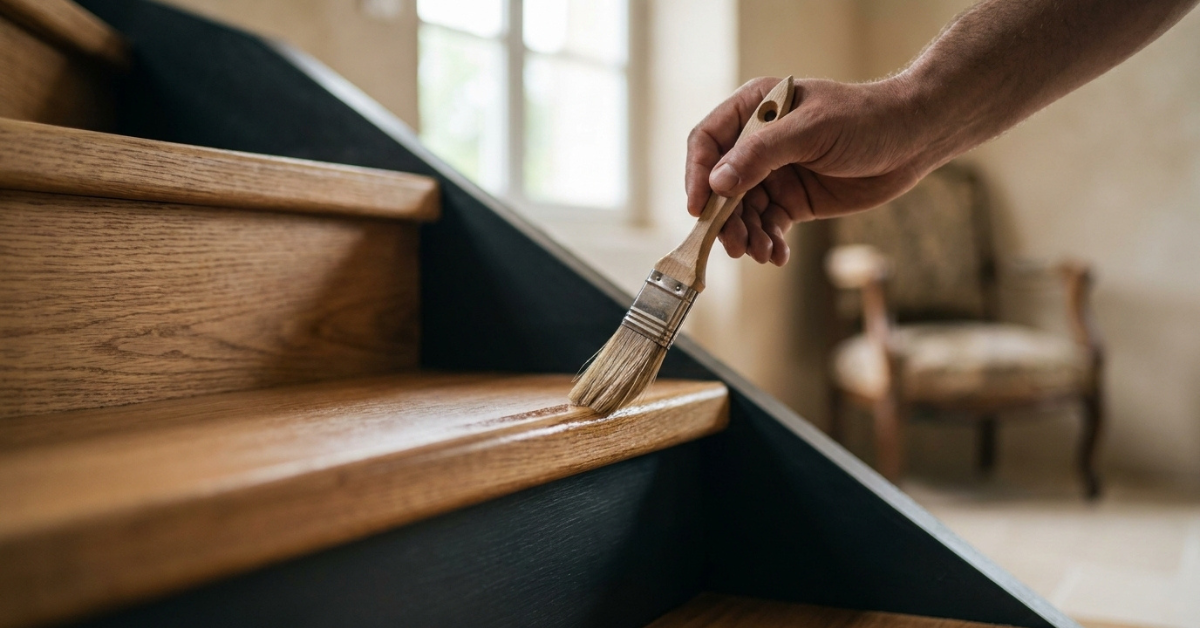
Renovating a staircase rarely costs as much as you expect, not because materials are expensive, but because the upfront assessment is often underestimated. You must not ignore the condition of the stringers before any installation, or you risk doom on the project to immediate cost overruns.
The Secrets of a Successful Stair Renovation
Two factors largely determine the final result: the quality of the substrate preparation and the relevance of the material chosen. One without the other compromises the whole project.
Site Preparation
It’s essential to prepare the site properly to ensure excellent adhesion. To do this, follow this sequence:
- A thorough cleaning and degreasing to remove wax, grease, or dust that create an invisible barrier between the substrate and the finish.
- Protecting surrounding areas: walls, adjacent risers, and the handrail to prevent glue or varnish splatters that would be hard to correct after drying.
- A 120-grit sanding to slightly open the wood pores without weakening it, which increases mechanical bonding points for the finish.
- A 3 mm expansion joint around the perimeter to compensate for natural wood movement due to humidity. Without this gap, the finish swells and lifts.
- A final visual check of treated areas to confirm substrate uniformity before any application.
Choosing Materials
The lifespan of your renovated staircase largely depends on the material chosen. Solid wood absorbs shocks and can be refinished after years of use. Laminate is cheaper upfront but tolerates moisture poorly. Stone does not age in the same way; it patinas gracefully.
The finishes play an equally decisive role. A two-component polyurethane varnish forms a hard film that resists everyday scratches. Epoxy paint, applied to risers or landings, withstands heavy traffic without chipping.
As for price, budget roughly between $3 and $5 per square foot, depending on the surface area and the required preparation. This rate varies with the condition of the substrate and the number of coats needed.
Projects like Escal Concept demonstrate concretely how these material and finish combinations transform an ordinary staircase into a durable architectural feature.
The Surefire Ways to Save
Doing it yourself can cut costs by up to 75% compared to installing a brand-new staircase if you choose the right finishing products. An average budget of about $150 is enough to transform an aging staircase, provided you make smart choices from the start. The recommendations are to:
- Favor ready-made covering solutions: self-adhesive treads, decals, or kit coverings install without complex cutting.
- Shop around for materials before buying: the same product can vary by up to 30% depending on the distributor.
- Choose durable materials from the first purchase: a cheap coating that wears out in two years ends up costing more than a mid-range product installed once.
- Calculate the exact area to cover to avoid unnecessary leftovers or urgent, costly extra purchases.
- Test substrate compatibility before applying any adhesive product: poor adhesion forces you to start over, erasing the initial savings.
Renovating a staircase does not require demolition or a large budget. The right materials, careful stripping, and a suitable finish are enough.
Frequently Asked Questions
Can you renovate a staircase without sanding it all the way down?
A light sanding with 120-grit is sufficient on a sound finish. A degreaser followed by a bonding primer ensures adhesion. Full sanding is only necessary on severely degraded or saturated woods.
What finish should you choose for a high-traffic staircase?
At minimum, an AC4-rated laminate or a two-component polyurethane varnish offers the best abrasion resistance. For safety, check the slip-resistance rating—aim for a high rating suitable for stairs.
How long before you can walk on a freshly treated staircase?
Touch-dry occurs in about 4 hours for water-based finishes. Curing through the wood takes 48 hours to 7 days depending on the product. Plan ahead to avoid blocking access to the upper floors.