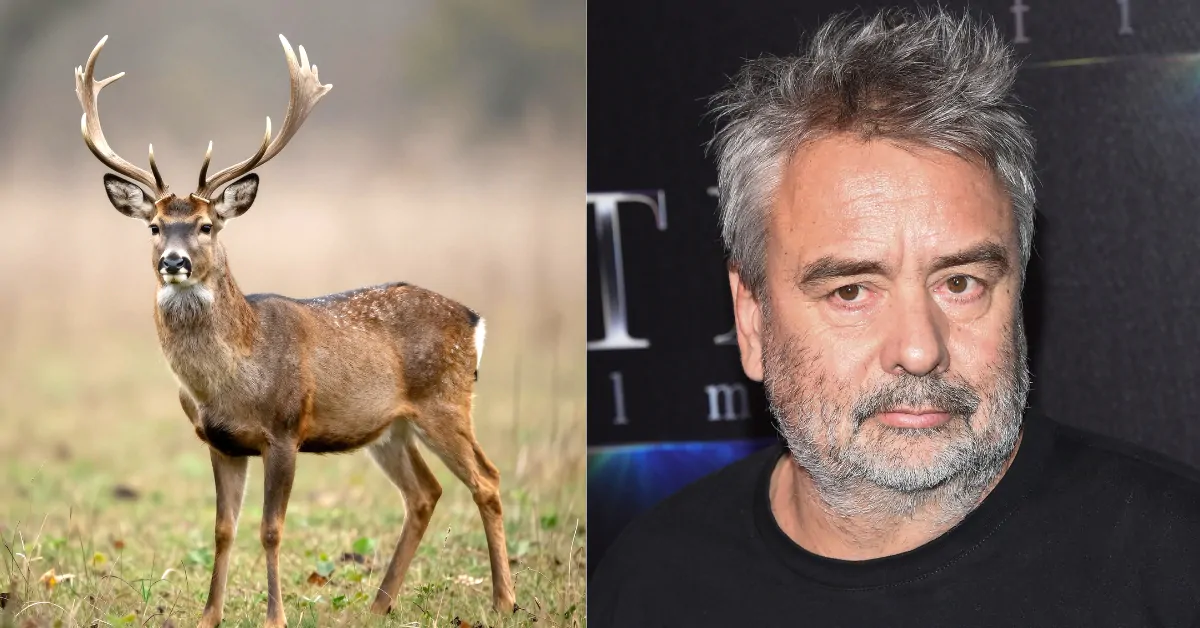
This latest incident comes 19 months after the killing of another deer on his terrace and eight months after two hunters were convicted.
Luc Besson and the Hunters: A New Alarm as Hunting Season Opens
On Sunday, September 20, 2026, Luc Besson once again took to the X social network to denounce a brutal act committed by hunters. The photograph shows a headless deer left against a fence near his property in the Orne region. The calendar underscores the significance of his post. According to the Orne prefecture’s order for the 2026-2027 hunting season, the general opening of shooting hunting was fixed precisely at 9 a.m. on September 20, while chase hunting with hounds and horns had been allowed since September 15. Besson thus made his discovery on the very day of the department-wide opening.
The filmmaker’s message directly recalls what happened in 2025. It begins with this line: “After having slaughtered a deer in front of my mother last year, hunting is open again!,” before explaining that deer would now be decapitated in front of his home and their bodies left to rot. He ends by accusing the “nobility of hunting.” As of the time of writing, France’s National Hunters Federation had not yet publicly responded.
Luc Besson is no stranger to conflict with hunters
Previously, a case was examined by the courts. On February 21, 2025, two hunters were pursuing a deer with a pack of dogs when the animal reached Luc Besson’s property in Orne. The two men entered the premises and the deer ended up on the homeowner’s terrace. One of the hunters then struck it with a dagger while the other held it by the antlers. The director’s mother, then 85, filmed the scene.
This video played a significant role in the proceedings. At the December 9, 2025 hearing, the defendants argued that they had intended to end an animal’s suffering. The court did not accept this account. In its reasoning, the court found that the deer had not been mortally wounded before their arrival on the terrace. It held that the hunters should have backed the dogs away, contacted the French Biodiversity Office, and ensured the safety of the property’s resident. Besson had used very harsh words during the case, describing the act as “revolting.” The filmmaker has long opposed hunting on his property and certain behaviors he deems unacceptable.
In this case, the verdict was delivered on January 20, 2026. The two men were found guilty of unauthorized hunting on someone else’s land and hunting with the aid of a prohibited device, instrument, or method. They were ordered to complete a wildlife-regulation and safety training course, organized with the French Biodiversity Office, and their hunting licenses were suspended for one year with immediate effect.
The financial penalties were also specified. A first hunter received a €600 fine. The amount was doubled for the hunter who had dealt the dagger blow. The two defendants were also ordered to pay €3,000 in damages to the Stéphane Lamart and ASPAS associations, as civil parties. Luc Besson and his mother requested and obtained a symbolic one euro.
After slaughtering a deer in front of my mother last year, hunting is open again! Now they decapitate deer in front of my home and let the bodies rot. And we dare speak of the “nobility” of hunting? pic.twitter.com/ekn1Xqha7f
— Luc Besson (@lucbesson) September 20, 2026
Luc Besson wants his property to be an “island of safety” for animals
The deer-killing incident on the terrace did not create the dispute; it brutally intensified it. Tensions between Luc Besson and hunters had been public for several years beforehand. In 2019, the departmental Hunters’ Federation filed a case against the filmmaker, accusing him of letting deer on his land escape regulation, with alleged consequences for neighboring crops. The federation was ultimately dismissed.
The point of friction is old and concrete: Luc Besson does not hunt on his estate and does not want others to hunt there. The property he has owned for roughly fifteen years covers about 160 hectares, about half of which is forest, at the edge of the Saint-Évroult massif. His stated position is that of a landowner who wishes to maintain a no-hunt zone. In previous remarks on the subject, the filmmaker explained that he wanted the animals to have a sanctuary: “I want the deer to have at least one island of safety,” he said in September 2026. At the trial, he also argued that around 8,000 hectares of woods surrounded his estate, to support the idea that a no-hunting space could exist within a much larger forested territory.
Yet this choice clashes with another logic: game-management and balancing animal populations, forests, and crops. Departmental regulations involve more than just hunting season openings and closures. The Orne prefecture also sets minimum and maximum harvest levels for certain large-game species based on their abundance, their impact on vegetation, and agricultural damage observed. It is at the heart of this tension between a private refuge, the movement of wildlife, and the goals of big-game management that the local dispute gradually took root.
Also read
In the family of ordinary biodiversity, let’s protect the deer