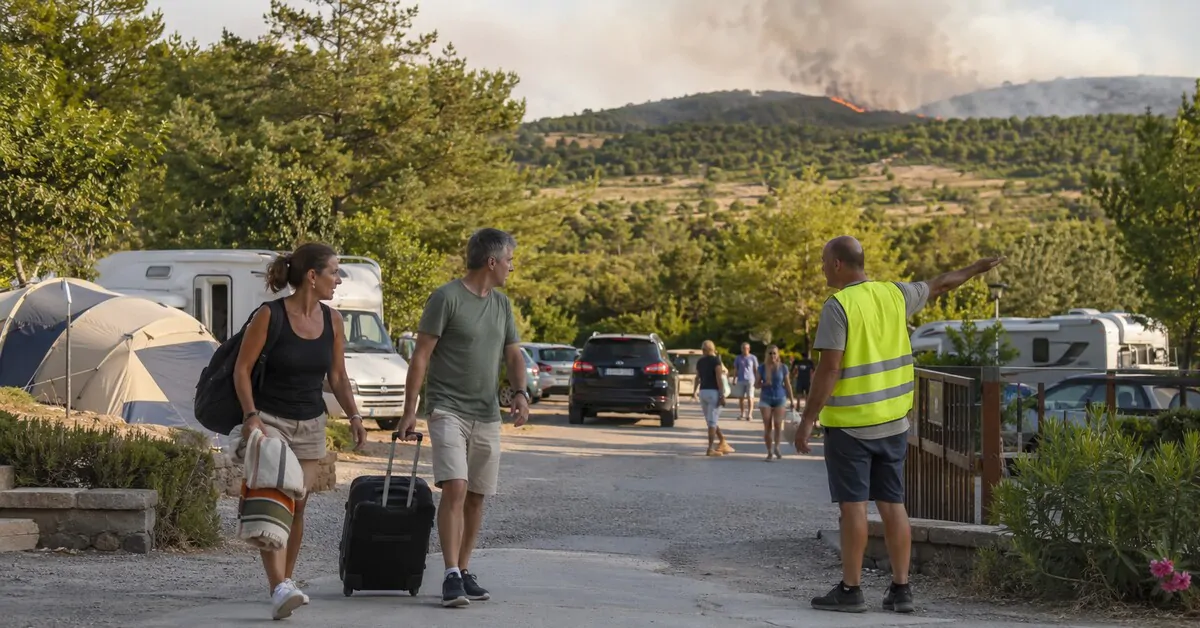
A warning message, a few belongings tossed into a bag, and orders to leave immediately. When a wildfire threatens a campground, a hotel, or a vacation rental, safety always comes first. Once the immediate danger passes, another question arises: who reimburses the nights lost, the new accommodation, or the damaged belongings?
In the United States, an evacuation does not trigger a single automatic indemnity. Your rights vary depending on the type of booking, whether the property actually closed, the services already consumed, and the insurance protections you purchased. Here’s what you can actually request and how to build a solid claim.
Evacuation: there is no automatic refund for everyone
The evacuation order is important evidence, but it does not by itself create an identical right for every traveler. First, identify who sold the stay and what could not be performed.
A direct booking at a hotel, campground, or vacation rental falls under the contract with that property or operator. A travel package, for example a flight and hotel bought together through a travel agency, falls under more protective rules.
You must also separate reimbursement of the stay from unforeseen expenses. The price of a night not provided can be recoverable, without the provider automatically covering fuel, meals, or the hotel reserved in an emergency.
In the immediate term, follow the directions of local authorities, the state or governor’s office, and emergency services. An evacuation center may be opened to shelter evacuees. This emergency aid does not constitute a general indemnification of all expenses caused by the evacuation.
Camping or hotel closed: unused nights must be refunded
If the establishment closes because of the fire, an administrative decision, or damage, it can no longer provide the promised service. If the stay has not begun, you can request a refund of the amounts paid.
If the evacuation occurs during the stay, request a refund pro rata for unused nights and non-provided services. Nights already used remain due. A temporary evacuation may therefore lead to a refund only for the period during which the site was inaccessible.
The provider may offer a postponement, a credit, or another accommodation. You may accept this solution if it suits you. However, ask for written confirmation of its value, its validity period, and its terms of use.
On the other hand, additional damages and compensation are not automatic. A wildfire may constitute a force majeure event excusing the provider from liability for consequences they could neither foresee nor avoid. That does not authorize them to keep the price of a service they did not deliver.
You leave while the campground or hotel remains open
The situation changes if no closure was decided, access remains possible, and the establishment can accommodate you as normal. A departure motivated by fear, smoke in the distance, or a precaution does not automatically entitle you to a refund.
Then check cancellation terms and request a goodwill gesture. Travel insurance may apply, but only if the evacuation, the site closure, or the inability to access the location is among the covered events.
Attention – Never return to an evacuated area to photograph a tent, a car, or belongings. Wait for authorization from the authorities. Your safety comes before assembling an insurance claim.
Vacation rental and platform: who should you ask for a refund?
For a cottage, a furnished rental, or a private-party rental, re-read the contract and the cancellation conditions. If the dwelling is closed, destroyed, or made inaccessible by an official decision, request a refund of the amounts corresponding to the period that could not be performed.
When the booking was made through a platform, quickly open a case from your account. Also write to the owner or property manager. Depending on the contract, the platform may be only an intermediary, even if it handles the refunds.
Keep the exchanges within the platform’s messaging tool. An agreement given only by phone becomes harder to prove. If the rental remains available and you cancel without an evacuation order or inaccessibility, the contractual terms are likely to apply.
Package travel: enhanced protection
Did you purchase at least two components of a trip from the same provider, such as transportation and lodging? The organizer must provide appropriate assistance to the traveler in difficulty.
If a substantial portion of the stay can no longer be provided, they must offer suitable replacement services at no extra charge. If these replacements are of lesser quality, a reduction in price may be requested. When the contract includes transportation and the stay cannot continue, an equivalent return must be arranged at no additional cost.
If exceptional circumstances prevent the planned return, the organizer normally covers the necessary accommodation, if possible, of equivalent category, up to three nights per traveler. Special rules protect certain vulnerable individuals.
Before departure, a fire at the destination or nearby may also allow cancellation at no cost when its consequences heavily affect the stay or the transport. The traveler then receives a full refund, but no additional compensation.
These protections apply to package travel. If the flight, rental, and hotel were booked separately, each contract is treated on its own. The hotel’s closure does not automatically trigger a refund of a flight.
Who pays for the emergency hotel after evacuation?
Outside a package trip, the campground, hotel, or rental company is not necessarily obligated to pay for alternative lodging. It may offer a solution, but the extra lodging costs often fall to insurance or assistance services.
Before booking, contact your home insurance, travel insurance, or your credit card’s assistance service if possible. Some policies require prior consent and may deny a charge incurred without approval.
Ask specifically whether the coverage includes:
- the interruption or cancellation of the stay;
- the emergency hotel nights booked in a hurry;
- transport to another accommodation or an early return;
- meals, essential clothing, or costs related to pets;
- damaged luggage and personal effects.
Credit card guarantees come with strict conditions. The stay typically must have been paid with the relevant card, and the event must be covered under the card’s terms.
Tents, luggage, car: which insurances can intervene?
Personal items damaged during a vacation may be covered by your homeowners or multi-risk policy if the policy extends fire coverage to belongings while you are away from home. Check the limits, deductibles, exclusions, and coverage for valuables.
A tent, camping equipment, or bicycles are not automatically covered outside the home. The insurer may require invoices, prior photos, or other proof of existence and value of the goods.
For a damaged or destroyed car, third-party liability is not enough. Automobile fire coverage is optional. It must appear in your contract for damages to your own vehicle to be reimbursed, subject to the policy terms.
Report the claim without delay. The deadline set by the contract cannot generally be shorter than five business days from the moment you learn of the damage. An evacuation-related inability can be reported to the insurer; keep proof of the situation.
Evidence to gather for a reimbursement
A precise file speeds up processing considerably. Save the emergency alert, local government advisories, the evacuation order, and the closure notice sent by the establishment.
Attach the booking contract or reservation confirmation, proof of payment, the terms and conditions, proof of payment, and the actual dates used. For additional costs, keep every hotel, transport, meals, or essential-purchase receipts.
When access is restored, photograph the damages before discarding or cleaning. Take the urgent measures necessary to prevent further damage, but do not start major repairs before the insurer’s approval or the inspector’s evaluation.
The right move –Request written confirmation of the evacuation date and time, the site closure, and the inability to return. This chronology helps calculate the unused benefits.
How to claim: a message template to send
Begin with a written request to the campground, hotel, rental, platform, or travel agency. Clearly state the amount requested and attach only copies of your receipts.
Subject: Refund request after evacuation of [name of establishment]
Dear Sir or Madam,
I booked a stay from [start date] to [end date], under reference [booking number]. On [date and time], the establishment was evacuated and rendered inaccessible due to the wildfire affecting [location].
The service could not be provided from [start date] to [end date]. I therefore request a refund of [amount] USD corresponding to unused nights and non-provided services.
You will find attached the reservation confirmation, proof of payment, the evacuation or closure confirmation, and, where applicable, receipts for guaranteed expenses.
Please process this refund within 14 days of receiving this message, via the original payment method or to the account indicated.
Sincerely,
[Name, contact details and customer reference]
For insurance, replace the refund request with a claim. Describe the circumstances, the items affected, and the expenses incurred. Also request immediate activation of the assistance coverage if you need lodging.
What to do if you’re refused or receive no response?
Follow up with the provider by a tracked letter with return receipt, reiterating your initial request. Set a reasonable deadline and keep copies of all communications.
If the dispute persists, file a complaint with the consumer protection mediator indicated in the terms or on the provider’s website. A written prior complaint is required. Mediation must be started within one year after this complaint.
You can also report the difficulty to consumer protection resources. If the provider is based outside your state, contact the appropriate cross-border consumer protection offices. And if the provider is overseas, consult federal and state consumer protection channels for guidance.
Ultimately, a resolution comes down to a simple rule: prove the evacuation, identify the services actually lost, and reclaim from each party what their contract covers. A quantified, well-documented claim has far better odds than a broad complaint about an entire vacation ruined.
- https://www.inc-conso.fr/content/incendies-sur-votre-lieu-de-vacances-comment-vous-faire-indemniser
- https://www.legifrance.gouv.fr/codes/article_lc/LEGIARTI000036242700
- https://www.legifrance.gouv.fr/codes/article_lc/LEGIARTI000038614158
- https://www.service-public.gouv.fr/particuliers/vosdroits/F21532
- https://www.legifrance.gouv.fr/codes/article_lc/LEGIARTI000035731302
- https://www.service-public.gouv.fr/particuliers/vosdroits/F10868