

Once reserved for treating certain venous disorders, their uses have become widely democratized, and you can now find them in over-the-counter form. But how to choose them properly and how to use them? All the answers are in this article!
Compression stockings or compression garments: what’s the difference?
Often known simply as “compression stockings,” there are actually two types of stockings with radically different indications. You’ll also find compression socks and compression tights as well as different lengths.
Compression stockings are made from materials that are very little elastic or non-elastic. They help prevent heaviness and swelling in the lower limbs by applying a strong, constant pressure on the muscles with every step, thus passively promoting venous return but only when the body is moving. That is why they are of no use at rest. They are primarily used in cases of arterial diseases.
Compression bands or stockings, on the other hand, are made of elastic fabric and exert active pressure on the muscles but also on the adipose tissue and the skin both during activity and at rest.
The pressure increases from the ankle up to the thigh and helps to promote venous return but also improves irrigation and oxygenation of the surrounding muscle and skin tissues. They also more effectively prevent edema by reducing capillary leakage into the tissues and thereby support lymphatic drainage.
Compression stockings are medical devices that are most often prescription-only because your doctor must choose the compression class most appropriate for your case.
What are the different compression classes?
There are four classes, corresponding to the level of pressure exerted by the stockings or bands on your legs.
- Class 1: between 10 and 15 mm Hg
- Class 2: between 15 to 20 mm Hg
- Class 3: between 20 to 36 mm Hg
- Class 4: greater than 36 mm Hg
Your prescribing physician will determine the compression strength that is right for you based on the condition to be treated.
For example, Class 1 or 2 stockings are better suited for mild edema or small varicose veins, while Class 4 stockings are used in cases of severe venous insufficiency or when treating stubborn venous ulcers that are healing.
Can compression stockings be dangerous?
Yes! There are absolute contraindications to wearing compression stockings:
- Peripheral artery disease of the lower limbs (PAD)
- Advanced diabetic microangiopathy
- Phlegmasia cerulea dolens (painful blue phlebitis with arterial compression)
- Septic thrombophlebitis
It is also necessary to regularly reassess with your doctor the benefit/risk ratio in cases of evolving peripheral neuropathy (in severe diabetes) and venous dermatitis. Not all edema can be resolved with compression stockings, especially when used for self-treatment.
You should absolutely see your physician to detect any possible heart failure or thyroid issues that may require medication and more extensive testing.
Be mindful of the tourniquet effect! When stockings or bandages are not positioned correctly, they can cause excessive constriction and thus hinder tissue irrigation and oxygenation, delaying the healing of venous ulcers. The application of compression bandages is, in fact, a paramedical procedure.
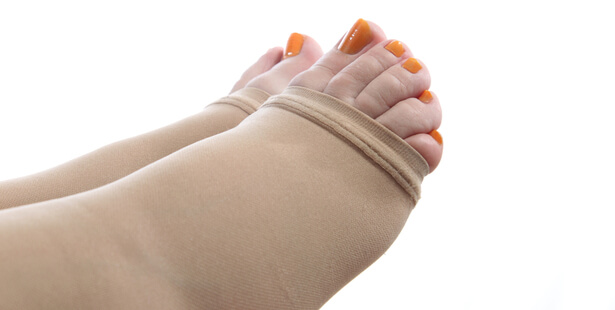
When should you use compression stockings or compression garments?
In cases of heaviness, swelling, or leg pain during prolonged standing, or in occupations that involve a lot of standing after a medical evaluation, compression stockings will provide quick relief from your symptoms.
On air travel, wearing compression stockings should be discussed case by case. Their main indication would be to prevent phlebitis and pulmonary embolism in those predisposed, with vein disease, or personal or family history. They are advised for long-haul flights in this context.
Tights, stockings, socks, knee-highs—which should you choose?
Simply what you can tolerate best! The most important factor is how regularly you wear them, so it should not feel like a burden. You’ll need to try different models and check with your pharmacist what works best for you.
When purchasing, to best tailor the device to your body, it will take numerous measurements:
- shoe size
- ankle circumference
- calf circumference
- height from the floor to the upper edge of the stocking
How to properly put on and care for your compression stockings?
To maximize their benefits, put the stockings on as soon as possible after waking up on clean, dry legs. Do not use creams or body lotions, and if you have a wound, protect it with a dressing or gauze.
To avoid snagging the stockings, watch for rings and long nails. For easy donning, turn the stocking inside out and gradually roll it up without pulling from the heel upward, avoiding creases.
For care, preferably hand wash in lukewarm water with soap, and do not use fabric softener. Wring gently, lay flat to dry in the air, and never tumble-dry.