
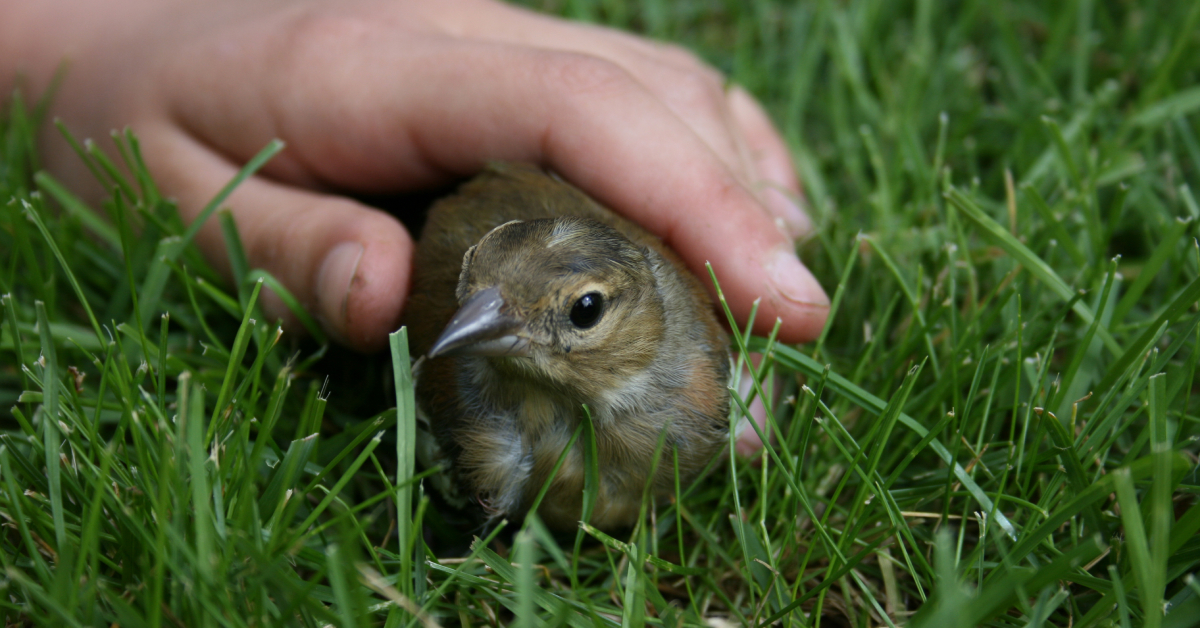
You found a bird on the ground in your yard and you don’t know what to do? Follow our guidance and the essential emergency steps to take care of your little patient without making a mistake.
Rescuing a wounded bird: how to take care of it
If you’ve found a bird in your yard, don’t rush to grab it. First, check whether it’s truly injured or if it’s a typical case of disorientation (for example after a collision with a window). Indeed, just because it’s on the ground doesn’t mean something is abnormal.
It might simply be a fledgling in the middle of learning whose parents aren’t far away. In that case, your first danger is you. In short, leave it alone if it hops, if it already has feathers, and it looks like it’s doing well. If predators (like a cat) are prowling, you can simply place it higher up on a sturdy branch.
Emergency steps to capture the bird safely
If the bird is visibly injured (wing hanging, bleeding, unable to right itself), you can help by taking these essential precautions:
- Protect yourself: Put on thick gloves before any handling. Be mindful of beak strikes from herons or the claws of defending raptors.
- Calm the animal: To capture it without panicking and to avoid aggravating its injuries, lay a cloth or towel over it. Darkness will instantly calm it.
- Handle it gently: Grasp it carefully with its wings pressed against its body.
- Isolate it: Place the bird in a perforated cardboard box for ventilation, with newspaper at the bottom. Do not use a cage with bars; it could injure it further.
- Keep it calm: Place the box in a cool, dark, and completely quiet room (out of reach of children and pets).
Fatal mistakes to avoid and the law
Once the bird is safe in its box, your role as a caregiver ends there. For its survival, strictly follow these guidelines:
- Do NOT give it ANY food: You risk giving it a food that isn’t appropriate for its diet (bread is a deadly poison for them) or causing it to choke if it’s in shock.
- Do NOT give it WATER: This is the most common mistake. Forcing a drink with a dropper or letting a bowl of water sit can cause water to be drawn into its airways (aspiration) and kill it quickly.
Finally, remember you cannot keep it at home. In the United States, laws vary by state, but private individuals generally cannot capture, hold, or care for wild birds at home; wildlife rehabilitation is regulated. Transportation is only permissible if you are taking the animal directly to a licensed facility.
Turn the injured bird over to a wildlife rescue center
The only legal and effective approach is to hand it over to wildlife professionals.
If you find a wounded bird, contact specialized networks immediately to learn the proper steps and locate the closest center to you:
- Your state wildlife agency: call the wildlife hotline or visit the agency’s website to find a licensed wildlife rehabilitator near you.
- National or regional wildlife rescue networks: these organizations maintain directories to help you locate a nearby center or rehabilitator (for example, a national directory maintained by wildlife rehabilitation associations).