
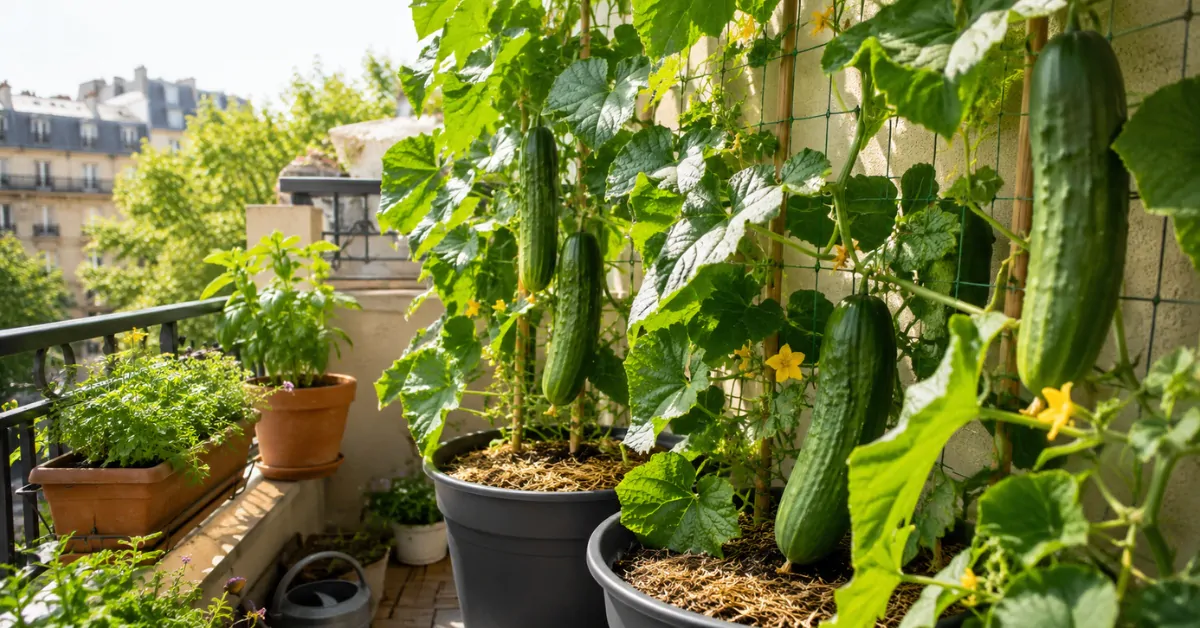
The challenge with cucumbers is their roaming temperament. This creeping plant loves to sprawl. In outdoor ground, it can quickly take up several square meters. On a balcony, it can quickly turn the path to the garden table into an obstacle course.
The good news? There is a simple, effective, and highly decorative solution: vertical culture. By training your plants to climb, you gain space, you create a true living wall, and you obtain cleaner fruits, better air circulation, and easier harvests. Yes, growing cucumbers on the balcony, even in generous formats, is within reach for all urban gardeners.
Why vertical gardening is ideal for growing cucumbers on the balcony
Cucumber belongs to the Cucurbitaceae family, like squash, melons, or zucchinis. In nature, it tends to creep along the ground. But on a balcony, it’s wiser to teach it some manners: climb, cling, and keep the ground free.
Spectacular space savings
In vertical cultivation, the cucumber plant occupies only the pot’s diameter at ground level. Everything else happens upward. This method makes it possible to install a small vertical garden even on a narrow balcony, an urban terrace, or a well-exposed windowsill.
Rather than letting the vine run everywhere, guide it onto a trellis, a net, or stakes. Result: you keep space to move around, add other pots, or simply enjoy your outdoor space without stepping on a runaway vine.
Fewer diseases and fewer damaged fruits
That’s one of the big advantages of vertical cultivation. When leaves and cucumbers stay suspended, they don’t touch the damp soil. This reduces the risk of rot, fruit yellowing, and diseases favored by stagnant humidity.
A plant with better air circulation also dries faster after rain or heavy dew. This reduces conditions favorable to fungi such as powdery mildew, recognizable by its white fuzzy growth on leaves, or downy mildew, which particularly likes humid environments.
Stronger, straighter cucumbers and easier harvesting
Gravity can work wonders. When grown suspended, cucumbers tend to form straighter fruits, not twisted by ground contact or hindered by leaves. They also receive light more evenly and are easier to spot at a glance.
Another non-trivial pleasure: harvest is at human height. No more digging under leaves as if you were searching for a missing sock in a vegetable-washing machine.
Did you know? Cucumbers typically produce male and female flowers. Female flowers are recognizable by their tiny swelling at the base: the future fruit. On a balcony high up, where bees and bumblebees visit less often, pollination can sometimes be more challenging. In that case, you can gently transfer pollen from a male flower to a female flower with a small brush.
Choosing the right pot and variety for growing cucumbers in pots
To get beautiful cucumbers, you must start them with good starting conditions. Cucumbers are generous, but also demanding. They need space for their roots, a rich substrate, and regular watering.
A large pot, the base for XXL cucumbers
The secret to a vigorous pot cucumber largely depends on the container size. A small pot dries out too quickly, heats up too much, and limits root development. For a real harvest, think big.
The golden rule: plan for a pot or trough at least 40 cm deep and 40 cm in diameter, about 30 liters per plant. The container must have drainage holes at the bottom to prevent water stagnation.
Add a drainage layer at the bottom if needed, especially if your balcony is exposed to rain. Clay balls, gravel, or pieces of pottery can help water drain properly.
Which varieties to choose for a balcony?
Not all cucumber varieties perform well in pots. On a balcony, prefer productive varieties that are compact or easy to train on a trellis.
- Marketmore : a classic, sturdy variety known for its elongated fruits.
- Gherkin : ideal for producing small cucumbers or crunchy pickles.
- Mini or snack varieties : perfect for small spaces and regular harvests.
- Cucamelon : playful and unique, it yields small fruits that look like tiny watermelons, with a fresh, tangy flavor.
For beginner gardeners, parthenocarpic varieties can also be interesting: they produce fruit without pollination. This is handy on a balcony where pollinator insects visit infrequently.
A rich growing medium for a hungry plant
Cucumber loves rich, cool, and lively soils. In pots, use a quality potting mix, ideally a vegetable-specific mix. Mix it with mature compost or worm castings to feed the plant gradually.
Avoid old, depleted potting mixes carried over from a previous season without enrichment. In pots, nutrients disappear quickly with repeated watering. A hungry plant will yield few fruits, even if it’s well exposed.

What varieties to choose for a balcony?
Not all cucumber varieties perform well in pots. On a balcony, it’s best to favor productive varieties that are fairly compact or easy to trellis.
- Marketmore: a classic, sturdy variety known for its elongated fruits.
- Gherkin: ideal for producing small cucumbers or crisp pickles.
- Mini or snack varieties: perfect for small spaces and regular harvests.
- Cucamelon: playful and original, it yields small fruits that look like tiny watermelons, with a fresh and tangy taste.
For beginner gardeners, parthenocarpic varieties can also be interesting: they produce fruit without pollination. This is handy on a balcony with few pollinating insects.
A rich growing medium for a hungry plant
The cucumber loves rich, cool, and lively soils. In pots, use a quality potting mix, ideally a vegetable-specific mix. Mix it with mature compost or worm castings to feed the plant gradually.
Avoid old, exhausted potting soils carried over from a previous season without enriching them. In pots, nutrients disappear quickly with repeated watering. A hungry plant will yield few fruits, even if well exposed.
Install a sturdy trellising to create a vertical garden
The support should be installed at planting time. It’s important, because adding a trellis or stakes later risks damaging roots already established. Cucumbers grow quickly: it’s better to give them a path before they decide to head for the railing.
Option 1: the wall trellis
The wall trellis is perfect for a narrow balcony. It can be fixed to a wall, a trellis, a privacy screen, or a balcony divider. The stems cling to it gradually and form a very decorative green screen.
Choose a sturdy support, as a well-developed plant, loaded with fruit and damp after rain, can weigh more than you expect.
Option 2: the bamboo teepee
The bamboo teepee is simple, aesthetically pleasing, and very practical. Plant three or four stakes in the pot, then tie them together at the top with natural string. This structure works well with large containers and stands up to wind if well anchored.
It also has the advantage of giving a nice look to the balcony, blending a nourishing garden with a little green shed.
Option 3: the climbing net
The wide-mesh climbing net is another effective solution. It can be stretched between the railing and a high point on the balcony, for example a beam, a ceiling, or an allowed wall mount.
However, be mindful of safety: nothing should risk falling on neighbors or into the street. On a windy balcony, always opt for sturdy fastenings and check them regularly.
Urban gardening tip
The cucumber has natural tendrils that grab on by themselves. But at the start, it appreciates a little helping hand. Guide the main stem toward the support and tie it gently with a loose tie, not tight. An old strip of cloth works very well.
The three golden rules for getting big cucumbers in pots
Once the plant is in place, success depends on regular care. Cucumbers aren’t difficult, but they don’t like water stress, cold snaps, or repeated neglect. To harvest good fruits, three actions make all the difference.
1. Provide plenty of sun
Cucumbers need light to grow well and fruit. Plan for at least 5 to 6 hours of direct sun per day. A balcony facing south, southeast, or southwest is ideal, provided you watch for extreme heat.
On a north-facing balcony, growing becomes more challenging. The plant may grow, but produce few fruits. In that case, it’s best to favor early or mini varieties, which are less demanding.
2. Water regularly, without wetting the foliage
Cucumbers are largely water, so they need a cool, not soggy, soil. In pots, watering should be regular, especially in summer, because the substrate dries out much faster than in the ground.
Water at the base, preferably in the morning or late afternoon, without splashing the leaves. Wetting the foliage promotes fungal diseases, especially when air circulation is poor. To keep moisture longer, add mulch on the surface of the pot: straw, dry clippings, fallen leaves, hemp, or untreated wood chips.
3. Feed the plant during production
In pots, nutrients are quickly depleted. From the appearance of the first flowers, apply an organic fertilizer suited for fruiting vegetables, such as tomato fertilizer, about every two weeks. Always respect the indicated doses: too much fertilizer can encourage leaf growth at the expense of fruits.
Compost or vermicompost on the surface can also be added in small amounts throughout the season. It’s a gentle way to support the plant without disturbing the substrate.
What to remember
- To grow cucumbers in pots, plan for at least 30 liters of substrate per plant.
- Vertical gardening saves space and helps limit diseases.
- A sunny balcony is essential for a good harvest.
- Water at the base, without wetting the leaves, and mulch to keep things cool.
- Organic fertilization helps produce more and larger cucumbers.
Harvesting cucumbers on the balcony: the little summer pleasure
Harvest is best when cucumbers are well formed, firm, and still glossy. Don’t wait too long: a cucumber that’s too large can turn bitter and contain more seeds. It’s better to harvest regularly to encourage the plant to produce new fruits.
Just a few meters between the plant and your kitchen: hard to get any closer. Sliced in a salad, cut into sticks for appetizers, in flavored water, or with a yogurt dipping sauce, homemade cucumbers have that little victory taste that makes summer even better.