
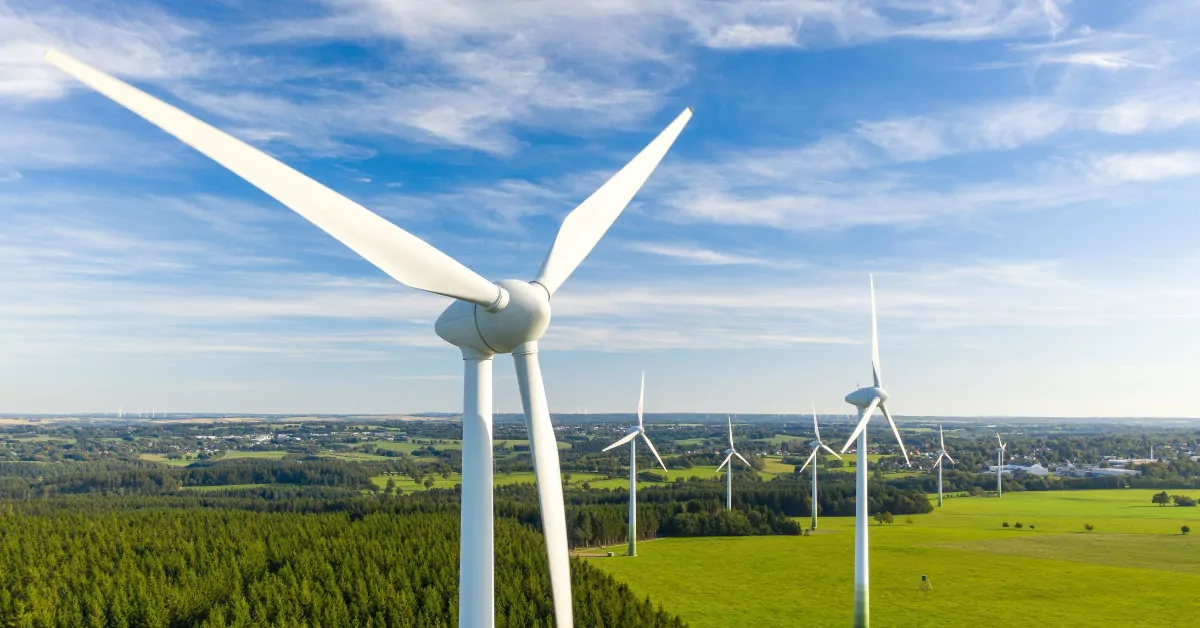
Météo-France and Ifpen announced on June 11, 2026, the signing of a five-year framework agreement dedicated to studying the interactions between wind turbines and local weather conditions. This new step marks the continuation of a scientific collaboration that began in 2015. As wind-energy development accelerates in France and across Europe, researchers now seek to better understand how these infrastructures influence their immediate environment.
Wind Turbines and Local Weather at the Heart of an Unprecedented Program
For several years, scientists have observed that wind turbines do more than simply generate electricity. Indeed, their blades modify air movement and create turbulence. Yet, the full extent of these phenomena remains poorly understood. That is why the new partnership between Météo-France and the Ifpen aims to study the interaction between the atmospheric boundary layer and wind turbines, according to the joint statement circulated by AFP.
Concretely, the researchers will seek to determine to what extent wind turbines can locally modify the wind, temperature, humidity, or even cloud formation. According to information published by Ifpen on June 5, 2026, the work will focus notably on dynamic effects, such as wind speed and turbulence, but also on thermodynamic effects, such as near-surface temperature and humidity. These observations should enable a better understanding of the interactions between wind farms and their meteorological environment.
How wind turbines are already influencing the atmosphere
The question is not entirely new. Several scientific studies had already highlighted measurable effects around large wind farms. For instance, French research published in Nature Communications showed that large installations could locally modify temperature and precipitation. According to CNRS, cited by AFP at the time, “a significant increase in temperatures, especially at night” had been observed near certain wind parks.
The Turbines and the Challenges of Climate Change
The research program will not be limited to the effects of wind turbines on weather. The researchers will also analyze the impact of climate change on wind energy production. This third axis of work is among the priorities defined by the two public institutions. According to the AFP-relayed press release of June 11, 2026, the teams will specifically study the future evolution of wind resources.
This issue is becoming essential for the energy sector. According to Ifpen, the work should help better forecast the production potential of wind farms in a changing climate. The researchers will also examine the wake effects between turbines within the same park or between neighboring installations. In addition, the two organizations already have advanced tools. Ifpen notes that three theses have been co-supervised since the start of the collaboration and that an atmospheric model named Meso-NH/EOL now reproduces the interactions between wind farms, temperature, and humidity under various weather conditions.
Research could also benefit from the OWWAAW project, officially launched on January 26, 2026 with funding from the National Research Agency. This four-year program aims to study the effects of offshore wind farms on local weather, acoustics, and aerial biodiversity through field measurements and high-resolution numerical simulations. Scientists now have a suite of tools that could provide more precise answers to a long-debated question: just how much do wind turbines actually influence the weather around them?