

Waxing to feel clean and beautiful, yes! But it’s not easy to navigate between a manual razor or an electric shaver, depilatory cream, laser hair removal, cold wax or hot wax… A closer look at Oriental sugar waxing.
And what if sugar could replace traditional wax strips in your bathroom? Practiced for centuries in the Middle East, sugaring seduces with its simple recipe, low cost, and a more natural approach.
This golden paste, also called sugar wax or sugaring, is prepared with a few simple ingredients: sugar, lemon, water and sometimes honey. When used properly, it removes hair at the root and leaves the skin smooth longer than a shave. However, it requires real practice and a few precautions.
What you should know
- The Oriental wax is made with sugar, water, lemon and sometimes honey.
- It rinses easily with warm water, unlike some greasy waxes.
- The results typically last two to three weeks, depending on the rate of regrowth for each person.
- It should not be used on irritated skin, sunburned skin, or skin that is compromised.
- Essential oils after waxing should remain optional and highly diluted.
Oriental sugar wax: a natural hair removal method from the Middle East
As a true beauty ritual in the Middle East, the sugar wax is a sugared wax. It looks like a soft caramel ball, with a rich amber color.
Unlike a traditional depilatory wax, it contains few ingredients. Its base is simple: sugar, water, and lemon. Some recipes also add a small amount of honey.
Another advantage: this paste comes off with water. It’s as simple as rinsing the skin or fingers with warm water to remove sticky residues.
What are the advantages of Oriental sugar wax?
First, it appeals for its economical and minimalist nature. It’s prepared with pantry ingredients and reduces waste from disposable strips.
It can also be appealing for people who want to cut back on conventional cosmetic products. Its short ingredient list avoids synthetic fragrances, resins, and additives found in some store-bought waxes.
Its main benefits are:
- A budget-friendly homemade recipe, with ingredients easy to find;
- A texture that rinses off easily with warm water;
- A hair-removal method that pulls the hair from the root;
- Results that last longer than shaving;
- A more eco-conscious move, especially if you reuse fabric strips;
- A smooth skin effect, since the paste also removes some dead skin cells.
In practice, the result often lasts two to three weeks. This, of course, depends on the treated area, hair growth rate, and individual habits.
A gentler method, but not magical
Sugaring is often presented as a gentler method. That’s true when it’s well prepared, used at the right temperature, and removed with the correct technique.
That said, no hair removal that pulls the hair out is completely painless. Redness, small blemishes, ingrown hairs, or pulling sensations can appear, especially on sensitive skin.
It’s also best to avoid this method in certain cases:
- on irritated, damaged, or sunburned skin;
- on a treated area with a cut, eczema, or inflammation;
- just after an overly abrasive scrub;
- during dermatological treatments that sensitize the skin, particularly some acne therapies;
- on the bikini area, if you’ve never tried this technique.
If in doubt, it’s better to ask a health professional. This is especially important for reactive skin or when undergoing medical treatment.
Homemade Oriental Sugar Wax Recipe
The recipe is simple, but it requires vigilance. Sugar heats quickly and can burn the skin if applied too hot.
The ingredients
- 1/4 cup granulated sugar;
- 2 tablespoons water;
- juice of half a lemon;
- 1 tablespoon honey, optional.
The preparation
- Pour the sugar and water into a small saucepan.
- Heat over low heat, not leaving the saucepan unattended.
- When the mixture turns golden blond, add the lemon juice.
- Stir in the honey, if you want a softer texture.
- Remove from heat after a few moments.
- Pour the paste onto a clean surface that can withstand heat.
- Let it cool to a pliable, moldable consistency.
The wax should be warm, never hot. Before applying, test a small amount on the inside of your wrist. If it’s too hot, wait a little longer.
How to use Oriental sugar wax without injuring the skin?
For the wax to grip well, the hairs should be long enough. A length of about 5 mm typically makes waxing easier.
The skin should also be clean, dry, and free of greasy creams. An oil or body lotion applied right before can prevent the paste from adhering properly.
The right technique
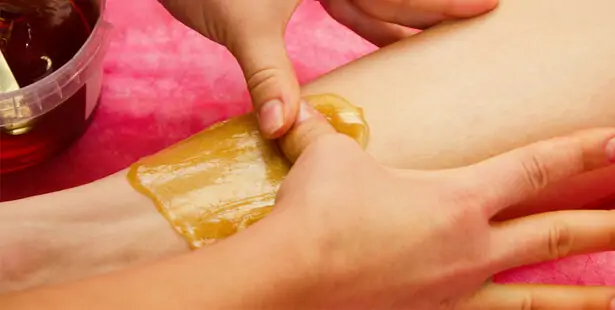
- Take a small ball of warm wax.
- Work it for a few seconds between the fingers.
- Spread it over a small area, in the direction of hair growth.
- Stretch the skin with one hand.
- Remove with a decisive motion, against the direction of hair growth.
- Rinse any residues with warm water.
Always work in small zones. It’s more precise, less painful, and easier for beginners.
After waxing: how to calm the skin naturally?
After waxing, the skin needs some calm. Avoid hot baths, intense exercise, saunas, and sun exposure for 24 hours.
Opt for loose clothing, especially after waxing the legs, underarms or bikini area. Friction can exacerbate redness.
Simple aftercare to prioritize
- a bit of organic aloe vera gel;
- a cold compress if there’s any stinging;
- a gentle plant oil, such as sweet almond oil;
- a neutral and fragrance-free cream for sensitive skin.
You can also apply a few drops of sweet almond oil on clean skin. Massage gently, without rubbing.
And essential oils after waxing?
Tea tree or lavender essential oils are often mentioned after waxing. However, they aren’t suitable for everyone.
Never apply them neat to freshly waxed skin. They can irritate, especially on the face, underarms, or bikini area.
They’re also not recommended for pregnant or nursing women and children. If you use them, heavily dilute them in a carrier oil. Always test the mixture in the inside of the elbow 24 hours beforehand.
Cire orientale: les erreurs à éviter
Pour réussir son épilation au sucre, la recette ne suffit pas. Quelques erreurs peuvent transformer ce soin maison en un mauvais moment.
- Appliquer la cire trop chaude : c’est le risque numéro un de brûlure.
- Épiler une peau humide : la pâte accroche mal et tire davantage.
- Repasser plusieurs fois au même endroit : cela augmente l’irritation.
- S’épiler juste avant la plage : soleil, sel et sable peuvent sensibiliser la peau.
- Faire un gommage juste après : attendez plutôt deux à trois jours.
Enfin, ne cherchez pas la perfection dès la première tentative. La cire orientale demande un peu de pratique. Commencez par les jambes avant d’essayer une zone plus délicate.
Une option beauté plus écologique et économique
La cire orientale coche plusieurs cases chères à consoGlobe. Elle réduit les emballages, évite les aérosols dépilatoires et limite les accessoires à usage unique.
Pour aller plus loin, utilisez des bandes de coton lavables. Vous pouvez les découper dans un vieux drap propre. Après usage, laissez-les tremper dans l’eau chaude, puis lavez-les normalement.
Cette méthode n’est pas parfaite pour tout le monde. Mais pour celles et ceux qui cherchent une épilation maison, naturelle et peu coûteuse, elle mérite d’être testée avec prudence.