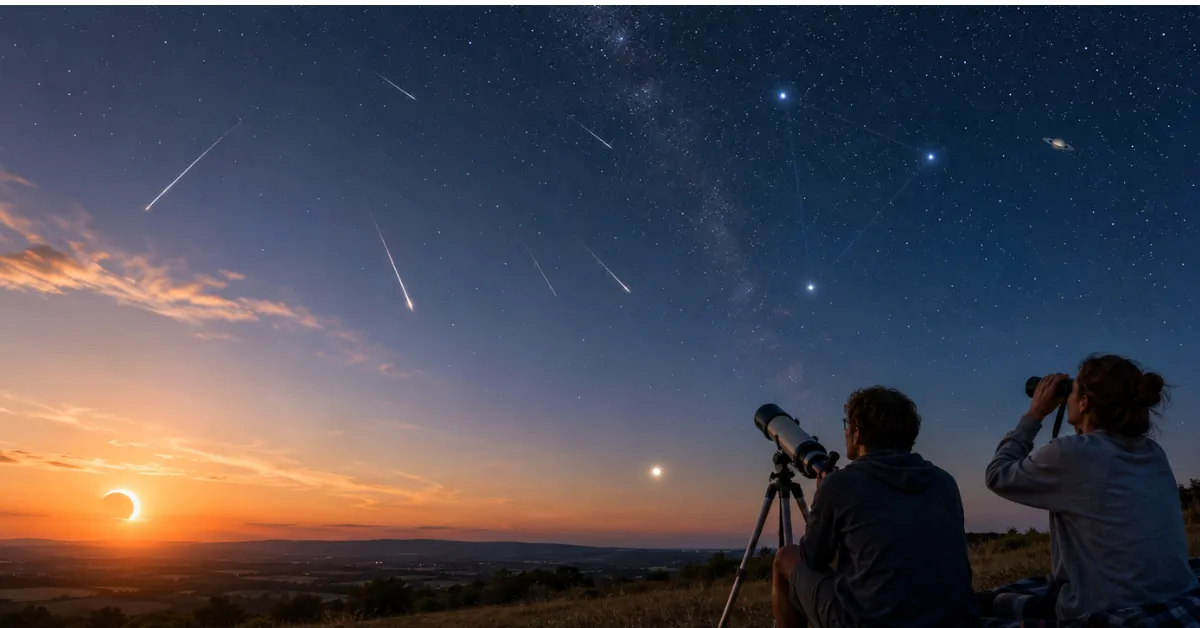
Between a solar eclipse and a meteor shower, the summer sky is poised to deliver some wonderful surprises. Grab your binoculars or telescope and get ready to look up.
A Spectacular Solar Eclipse on August 12, 2026
The summer’s grand astronomical event will take place on August 12, 2026, in the late afternoon. The solar eclipse will be total in parts of northern Spain. From France, it will appear as a partial eclipse.
The phenomenon will reach its maximum around 8:30 PM, with times varying slightly by region. To enjoy the show, choose a location that offers a clear view toward the west.
Be sure never to look directly at the Sun. Certified eclipse viewing glasses are essential, even when the Sun appears largely masked.
This precaution is especially important for children. Without proper protection, several seconds of exposure can cause serious, irreversible damage to the retina.
The Perseids Will Illuminate the Following Night
The spectacle will continue a few hours later. During the night of August 12–13, the Perseids will reach their peak activity.
This famous meteor shower can produce up to around a hundred meteors per hour when conditions are ideal. In practice, numbers depend on weather, ambient light, and the observing site.
To maximize your chances:
- steer away from city lights;
- choose a spot with a broad view of the sky;
- switch off screens and smartphones;
- let your eyes adapt to the darkness for about twenty minutes;
- settle in comfortably on a blanket or lounge chair.
No telescope is required to watch the Perseids. The naked eye can enjoy a much larger swath of sky.
These bright trails are produced by dust left behind by comet 109P/Swift-Tuttle. As they streak into Earth’s atmosphere at high speed, these tiny particles heat up and burn up.
How to Spot the Summer Triangle?
Even before August, you can practice recognizing the Summer Triangle. This vast celestial landmark is formed by three bright stars: Vega, Altair, and Deneb.
Vega is often the easiest to identify. Its white-blue light remains visible despite moderate light pollution.
Once you’ve spotted these three stars, the Summer Triangle serves as a guide to exploring the sky. Under a dark enough sky, it helps you locate the Milky Way.
This long pale band corresponds to the densest part of our galaxy as seen from Earth. Binoculars reveal a multitude of stars that are invisible to the naked eye.
With a small telescope, more experienced observers can also search for the Ring Nebula, also known as M57. Located in the Lyra constellation, it resembles a tiny glowing ring.
Venus and Saturn Complete the Show
The planets will also be part of the summer evenings. Unlike stars, they are typically recognized by their steadier light, which flickers far less.
Venus, known as the “Evening Star,” will draw the eye toward the west after sunset. Very bright, it is often one of the first celestial objects visible after nightfall.
Later in the season, Saturn will also become an appealing target. A telescope will reveal its famous rings, a sight that impresses both adults and children alike.
Between a partial eclipse, the Perseids, the Milky Way, and the planets, the summer of 2026 offers many opportunities to discover the sky. All that remains is clear weather.