
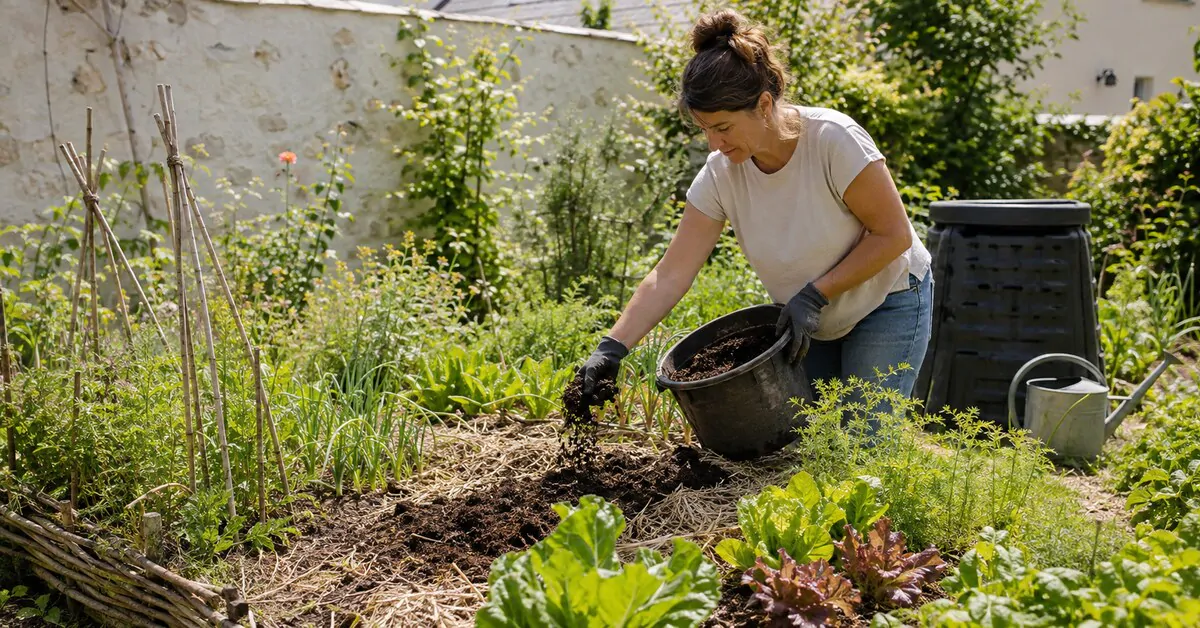
Turning over the vegetable garden in spring or fall used to be a rite of passage. For generations, a plowed bed signaled well-kept soil. The no-dig approach turns that habit on its head. Popularized notably by British market gardener Charles Dowding, this method aims to nourish the soil without turning it over.
No-dig, what is it exactly?
No-dig literally means “no digging.” The gardener no longer turns the soil or deeply loosens it. They lay down compost, leaves, or mulch on the surface. Earthworms and other soil creatures then gradually incorporate this material.
This method should not be confused with permaculture, a global approach that covers water management, biodiversity, and garden design. No-dig remains a cultivation technique. It does not require building raised beds either. The essence of this method: disturb the soil as little as possible and feed its life from the surface.
Why avoid turning the soil?
A fertile soil hosts bacteria, fungi, earthworms, and a multitude of tiny organisms. Their tunnels facilitate the flow of air and water. Mycorrhizal fungi also link some roots to soil resources.
A deep, repeated disturbance disrupts this organization. It fragments fungal networks and blends soil layers with different conditions. Effects vary with soil type, climate, and the intensity of digging. However, research often links no-till with greater microbial biomass and more mycorrhizal fungi.
Tilling also exposes soil to wind, pounding rain, and drying out. The FAO thus recommends limiting mechanical disturbances and maintaining organic cover. These practices reduce erosion and feed the soil with organic matter. (2)
Finally, stirring the soil redistributes buried seeds (weeds, for example). Some rise into a zone favorable for their germination. No-dig thus does not eliminate all spontaneous weeds. It avoids reactivating a new seed bank with every tilling.
How to start a no-dig vegetable garden?
1. Cover the beds rather than uprooting
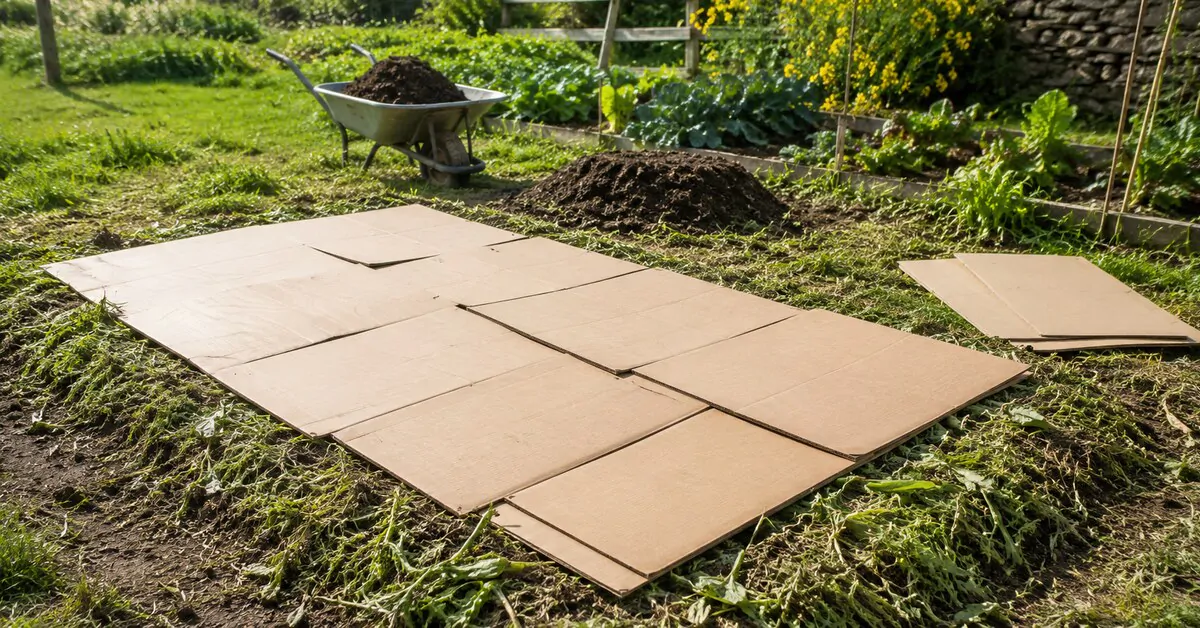
Cut down tall vegetation, then lay down unplasticized brown cardboard. Remove any tape and overlap the pieces. The cardboard shades the weeds and then decomposes. Avoid it on waterlogged ground or ground with lots of slugs.
2. Add a layer of compost
Spread about 3 to 6 inches of well-matured compost on a new plot. Fully decomposed manure also works. On an already cultivated bed, a thinner annual layer usually suffices. To obtain this amendment at lower cost, you can make your own compost.
3. Plant directly
Plant the transplants into the compost, without tilling. For fine seedlings, level the surface. Water at the outset, then monitor moisture under the cover.
What if the soil is very compacted or clayey?
No-dig doesn’t prohibit every tool. On a very compacted soil, a broadfork can aerate it temporarily without turning over its horizons.
Deep-rooted plants, such as fava beans, alfalfa, or certain forage radishes, also help restructure the soil. You can sow appropriate cover crops. A degraded site won’t become loose in a few weeks. Expect several seasons, sometimes one to three years, before you see a clear improvement.
The tangible benefits of no-dig
The first benefit is felt in the back. The vegetable garden becomes more accessible to beginners, seniors, and people with limited equipment.
The cover also reduces evaporation and cushions heavy rainfall. A soil rich in organic matter generally holds water better. Watering needs can decrease, though they won’t disappear during droughts. That’s why it’s best never to leave bare soil.
In the long term, regular inputs nourish soil organisms and support fertility. The use of fertilizers can then decrease. The carbon balance warrants nuance.
Reducing soil disturbance limits some carbon losses and favors its accumulation on the surface. But total storage depends on inputs, crops, climate, and the depth studied. No-tilling alone is therefore not a guaranteed climate solution.
An effective method, but not “magic”
The main obstacle remains access to compost. Covering a new area requires a substantial volume, sometimes costly and difficult to transport. Producing your own compost or sharing a delivery lowers the bill.
Tough perennials, such as bindweed or quackgrass, also require patience. They can push through the mulch and may require repeated removals. Finally, some very degraded soils may need an initial, measured intervention.
Adopting no-dig is thus less about “doing nothing” and more about changing your approach. The gardener stops imposing a fixed structure on the soil every year. They cover it, feed it, and let life do part of the work. A form of restraint that aligns well with an ecological garden.
Read also
- Gardening is good for health, physically and mentally
- Organic gardening: the 10 golden rules for healthy gardening
- https://www.sciencedirect.com/science/article/abs/pii/S092913931000199X
- https://www.fao.org/conservation-agriculture/in-practice/soil-organic-cover/en/