
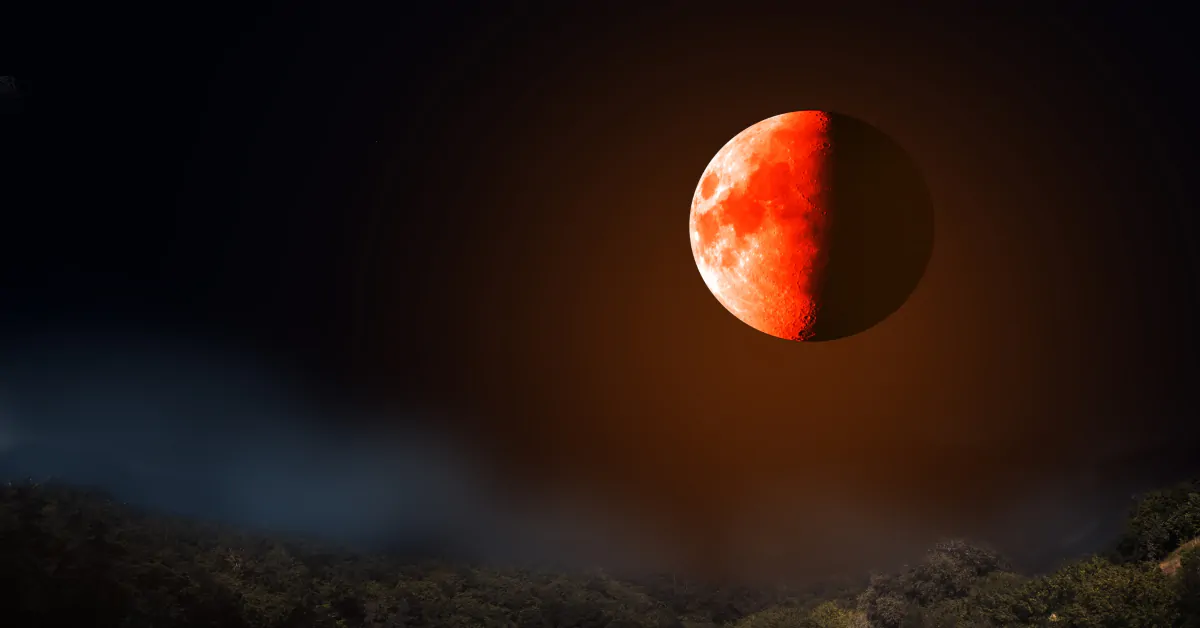
The spectacle will be brief at its peak for observers in France, as the Moon will already be skimming the horizon.
Lunar Eclipse of August 28, 2026: What the Sky Will Show in France
August 2026 isn’t finished turning eyes toward the sky. After the total solar eclipse of August 12, 2026, visible as a partial eclipse from much of France, a new alignment will bring the Sun, Earth, and Moon into view sixteen days later. This time, our planet will occupy the central position: its shadow will cover almost the entire disk of the full Moon.
This lunar eclipse will take place on Friday, August 28, 2026, in metropolitan France. It will not be total, but its depth will place it at the edge of the most spectacular phenomenon: at maximum, only a thin fragment of the Moon will remain directly illuminated by the Sun.
The event will begin long before the change is obvious. The Moon will enter the Earth’s penumbra around 3:23, then into the central umbra at 4:33, before reaching its maximum around 6:12. On a global scale, the partial phase will continue until 7:52 and the penumbral phase until 9:01. From France, the latter stages will not be observable because our satellite will have already slipped below the horizon.
The heart of the show will last long by astronomical standards. The partial phase will extend for about 3 hours and 18 minutes, and the entire event for nearly 5 hours and 38 minutes when counting the passage through the penumbra. The best compromise for French observers will be roughly between 4:30 a.m. and 5:45 a.m.: the shadow will have moved well across the Moon, while it won’t yet be as close to the horizon as at maximum.
A precision is essential, because two numbers are circulating. The shade magnitude will be about 0.93, which means that about 93% of the Moon’s diameter will be immersed in Earth’s shadow. But if you measure the apparent surface area of the disk actually darkened, the obscuration will be about 96.2%. There is therefore no contradiction between the two values: one is linear, the other measures a surface area.
Why the Moon Turns Red When the Earth Blocks the Sun
A lunar eclipse can occur only at full Moon, when the Sun, Earth, and our satellite align closely enough. Earth then blocks part of the sunlight that would otherwise reach the lunar surface. It casts behind it two light zones: a relatively pale penumbra and a much darker central umbra. This cone of darkness extends about 1.4 million kilometers into space.
Yet the Moon does not become instantly black. A fraction of sunlight passes through the Earth’s atmosphere, where blue colors are scattered more widely. Red and orange wavelengths are more readily refracted toward the shadow and can reach the lunar surface. This is the same mechanism that lends the warm hues to sunrise and sunset. It’s as if all the world’s sunrises and sunsets were projected onto the Moon!
However, the effect will not be uniform. Near maximum, the majority of the Moon’s disk may show deep red, brown, orange, or copper tones, while a thin crescent remains directly lit by the Sun. In France, dawn will be breaking as the Moon sits very low: fog, humidity, low clouds, and twilight will reduce contrast and soften the red’s intensity.
Lunar Eclipse: Timings, Show, and the Best-Placed Regions
All of metropolitan France will be able to see the start of the partial phase and its maximum, but geography will play a major role. The west will be clearly advantaged. At maximum, the Moon will reach a meridian altitude of about 11.9 degrees in Brest, 11.2 degrees in Bordeaux, 10.7 degrees in Nantes, and 10.5 degrees in Toulouse. It will be lower in Marseille at 8 degrees, in Paris at 7.7 degrees, in Lyon at 7.4 degrees, and especially in Strasbourg at only 4.6 degrees.
This low altitude changes a lot. The Moon will set between 6:47 and 7:39, while the partial phase will still be visible worldwide. In Paris, its setting is expected around 7:09, while in Brest it will remain visible until about 7:39.
Therefore, you should favor a completely unobstructed view toward the west or west-southwest. In Paris, the Moon will be only around 8 degrees above the horizon near maximum, underscoring the need to avoid buildings, trees, or terrain in that direction. This setup explains why Brittany, the Pays de la Loire, Nouvelle-Aquitaine, and the western part of Occitanie have a slight geometric advantage.
However, there is no need to break out the sunglasses used for the Solar Eclipse. A lunar eclipse can be watched with the naked eye safely. Binoculars can intensify the contrasts between the still-lit portion and the regions already plunged into shadow, while a small telescope will let you see the boundary progress across craters and lunar seas. Weather remains the big unknown: a perfectly clear horizon is pointless if a layer of clouds or fog hides the Moon at dawn.
An Almost Total Sky Show, But Not a Blood Moon
The term “Blood Moon” is often used as soon as a Moon disk takes on a red tint. Astronomically, it is mainly associated with total eclipses, when the entire Moon falls under the central shadow of the Earth. On August 28, about 96.2% of the apparent surface will be in that shadow at maximum: there will still be enough Moon directly illuminated by the Sun for the event to be officially classified as a partial eclipse.
This lack of totality should not, however, make the phenomenon discreet. With roughly 96% of the surface obscured, the visual eclipse will come very close to a total, while preserving a distinctive contrast between a narrow bright rim and the rest of the darkened disk. The curved edge of the Earth’s shadow can also be traced on the Moon: a simple visual demonstration of our planet’s spherical shape.
The event will also have a global reach. About 3.3 billion people will fall within its general visibility, spanning the Americas and parts of Europe and Africa. In Western Europe, the main challenge will be the time: the show will coincide with the end of the night and the Moon’s setting.
For the French who miss this rendezvous, the next lunar eclipse visible in mainland France will be a much more modest penumbral eclipse on February 20–21, 2027. To see a true total lunar eclipse from metropolitan France, you’ll have to wait until December 31, 2028.
The Moon and Its Effects…
Gardening with the Moon: everything beginners should know!
Full Moon: people are more sensitive to sleep disturbances than women
The Moon’s effects on animals