
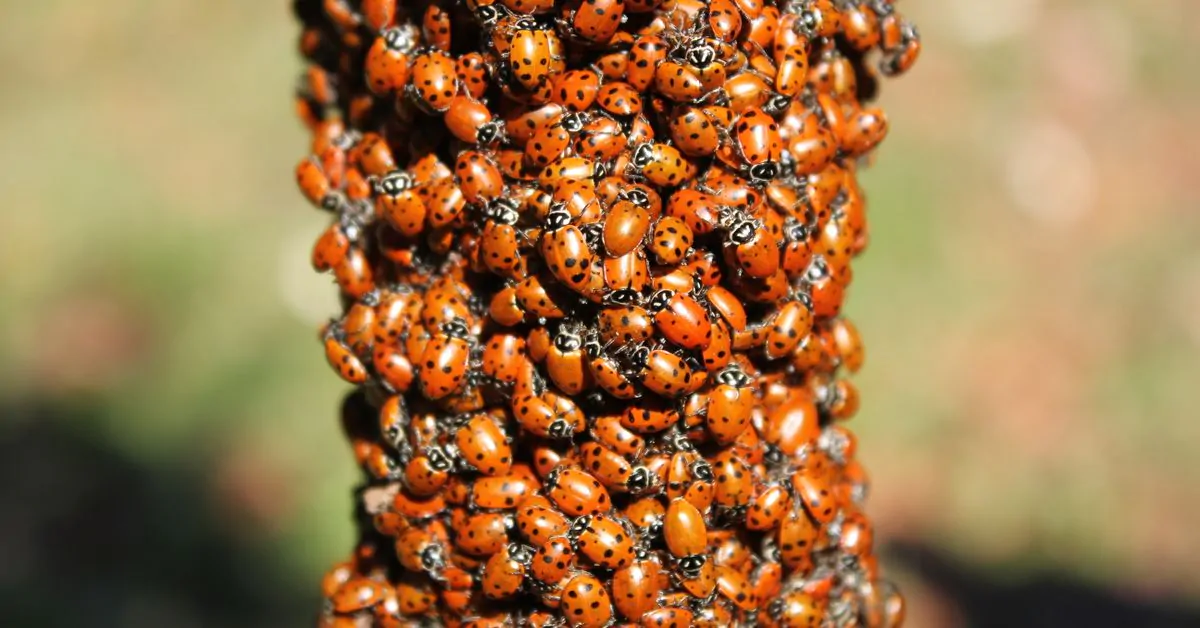
Clusters of lady beetles that form in mid‑November in the corners of windows, under the casings of roller shutters, or on the ceiling of a bedroom are almost always Harmonia axyridis. The Asian lady beetle, also known as the harlequin ladybird, seeks a dry shelter to overwinter.
The National Inventory of Natural Heritage (INPN), run by the National Museum of Natural History, classifies it among “introduced established invasive species.” It can cluster by hundreds or even thousands of individuals in homes to pass the winter (harmless to people). It does not transmit disease, but it soils, smells bad, and returns from year to year.
A black ‘M’ on a white background distinguishes the Asian lady beetle
You can’t rely on color alone to identify it. The color of the elytra ranges from yellow-orange to red, and some specimens are black. Individuals can have from one to nine spots.
There are many color morphs (about 120) described, according to INRAE’s aphid encyclopedia. The elytra are the hardened wings that cover the back.
The reliable criterion is found on the pronotum, the plate located between the head and the elytra. In the most common form, it is white and bears a black “M” shape, which reads as a “W” when viewed from the opposite side.
The pronotum can also bear a “cat’s paw” pattern, meaning a central spot with four other spots arranged in a semicircle around it, or be black with two broad pale bands. INPN notes that this can be confused with Coccinella septempunctata and other large lady beetle species. Viewed in profile, the elytra—colorful and variable—also show a small bump (an irregularity) at their tip.
| Criterion | Asian lady beetle (Harmonia axyridis) | Seven-spotted lady beetle (Coccinella septempunctata) |
|---|---|---|
| Size | 5 to 8 mm | Comparable: size alone isn’t enough |
| Color of elytra | Orange-yellow, red, or black | Red |
| Number of spots | From 1 to 9 per INRAE, sometimes none | Always 7 |
| Pronotum | Most often white with a black “M” | Black with two white spots at the front |
| Hibernation | In groups, often inside buildings | Outside, in vegetation |
Introduced to control aphids, it also preys on larvae of native species
According to INRAE, the Asian lady beetle was imported into Europe and the United States for biological pest control in the early part of the century, but was especially introduced on a larger scale toward the end of the 1980s.
It was chosen because of its high fertility and ease of rearing in artificial environments, making its production cheaper than that of the two-spotted lady beetle. Its behavior, prolificacy, and voracious appetite made it an invasive species as soon as it established itself in natural habitats.
Adults and larvae feed on aphids, but they can also attack larvae of other lady beetle species. They also compete with native species for food and space.
The species appears on the list of the 100 most problematic invasive species in Europe, and there are currently no regulations or protections in place for this species. Destroying individuals that have invaded a dwelling is therefore not prohibited. It also troubles vintners, because crushed beetles with grapes during harvest release isopropyl-methoxypyrazine, a compound that gives the wine an off flavor.
A yellow staining liquid and a venom-free pinch
When disturbed, the Asian lady beetle performs a “reflex bleed.” It allows droplets of hemolymph to ooze from the leg joints—the liquid that plays the role of blood in insects.
To defend themselves, they eject a yellow, foul-smelling liquid containing alkaloids. This liquid smells like decaying leaves and leaves stubborn stains on plaster, raw wood, curtains, or upholstery. A crushed beetle releases all of its liquid at once.
They can also pinch the skin with their small mandibles, especially in autumn. They probably do this to grab a little salt or moisture. The pinch is brief and contains no venom.
Simply wash your hands after handling beetles to avoid carrying this bitter liquid to your eyes. Also remove dead insects found in attics, because dead beetles left in a attic attract other insects, such as anobiids and dermestids, small beetles that damage textiles.
A vacuum cleaner fitted with a nylon stocking catches them without crushing them
Brooms and cloths crush the beetles. In a room where people live, a researcher from the Gembloux Agro-Bio Tech entomology unit in Belgium advises against using insecticide bombs, which are dangerous to human health. A vacuum works better if you slide a nylon stocking over the tube and secure it with a rubber band.
The air passes through the nylon, which traps the insects. Without this filter, the beetles end up in the bag, where they can escape, and those that are crushed make the vacuum’s motor stink.
Once captured, tie the stocking. There are then two options. You can release the beetles far from the house, preferably on a milder day, because those released near the façade tend to return.
You can also destroy them by freezing the closed stocking and then discarding it. You’ll likely need to repeat during the winter. The beetles stay still for weeks, then wake up on warm days or when the heating comes on.
After the insects are gone, wash the areas where they gathered with soapy water. The traces they leave on window frames attract beetles again the following autumn, which explains why they often return to the same window.
Joints, roller shutter boxes, and screens keep them from entering
The beetles first land on light-colored, sunny façades, then take advantage of the slightest crack. Check cracks around window and door frames, crushed or cracked joints, and cable passages. Also inspect roller shutter boxes, which are often poorly insulated on the inside.
Acrylic or silicone sealants close the gaps. A brush seal or a new gasket can seal the passage of the strap and the hatch of the box.
For openings that must remain open, Pierrette Nyssen, an entomologist with Natagora in Belgium, recommends window screens and fine mesh in front of ventilation openings. Do not seal air intakes of the carpentry or the heat recovery ventilation (VMC), which are used to refresh indoor air. A fine grid is enough to protect them.
The best time to seal is September, before the first flights toward the façades. Doing this work in November is still useful, because new beetles perch on walls every sunny afternoon until the first real frosts.
Sources: ncbi.nlm.nih.gov | encyclopedie-pucerons.hub.inrae.fr