
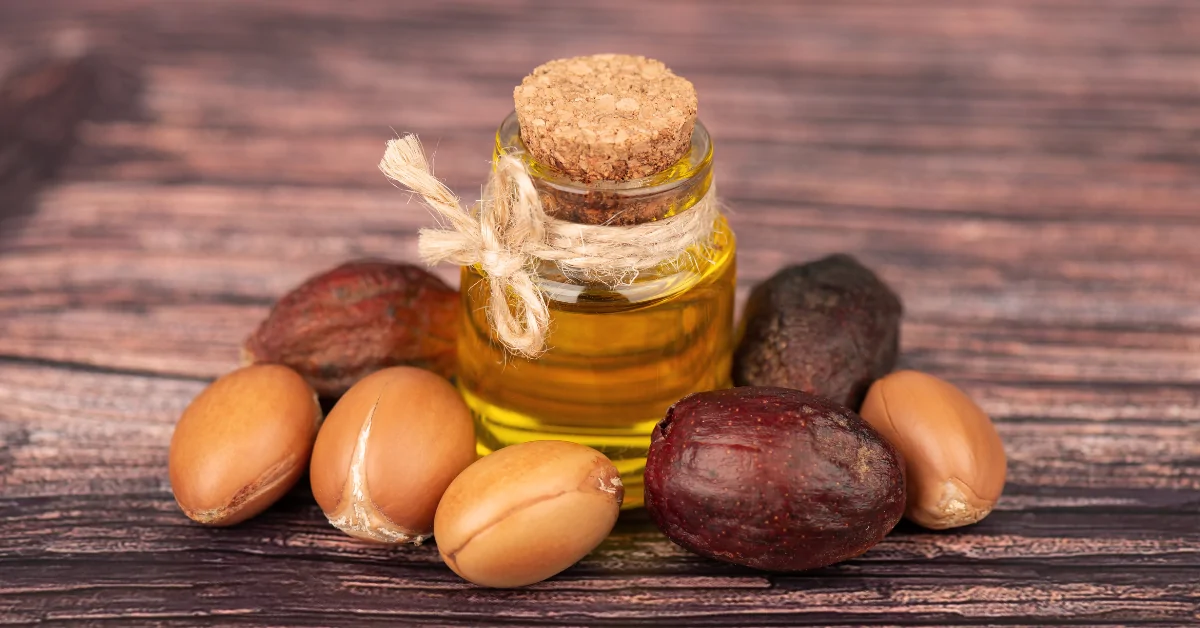
Argan oil has become a staple of natural skincare. Yet this precious golden liquid comes from a very particular tree, adapted to the arid lands of southwestern Morocco. Nourishing for skin and hair.
That little word, « argan », doesn’t particularly evoke a tree, and for good reason. The argan tree, also known by its botanical name Argania spinosa, grows mainly in the southwest of Morocco. Natural populations also exist in the western part of Algeria, notably in the Tindouf region.
What is argan oil?
The Amazigh populations, formerly referred to as Berbers, know this tree well. For centuries, women have produced an oil from the oleaginous kernel contained in the fruit’s stone.
The foliage, the pulp, and the processing residues can also feed livestock. As for the wood, it has long served as fuel or as a material for making tools and utensils.
These multiple uses attest to the economic and cultural importance of the argan tree. However, overexploitation, overgrazing, soil erosion, and prolonged droughts are weakening its natural habitat.
The argan grove of southwestern Morocco has been recognized as a UNESCO biosphere reserve since 1998. The practices and know-how related to the argan tree have also been inscribed on the intangible cultural heritage of humanity since 2014.
The composition of argan oil
Traditionally, argan oil has been used for skin and hair care in Morocco. It also has numerous culinary uses.
Its composition varies depending on the origin of the fruits, their maturity, and the extraction method. It mainly includes:
- about 43 to 49% oleic acid, a mono-unsaturated fatty acid;
- about 29 to 36% linoleic acid, belonging to the omega-6 family;
- nearly 20% saturated fatty acids;
- tocopherols, compounds related to vitamin E;
- small amounts of polyphenols, carotenoids and phytosterols.
This richness in lipids explains mainly its emollient action. In other words, the oil helps soften the skin and limit its drying.
Argan oil for cosmetics
Argan oil contains essential fatty acids, vitamin E and antioxidant compounds.
It is therefore an interesting care option for dry or uncomfortable skin. Like all plant oils, it does not directly provide water to the skin. Instead, it forms a protective film that reduces water loss and supports the skin barrier.
Cosmetic uses of argan oil
Suitable for the face as well as the body, argan oil has several simple uses.
A nourishing treatment for dry skin
If you have dry or very dry skin, a few drops of argan oil can bring more suppleness and comfort.
Apply two or three drops to clean and still slightly damp skin. Massage gently until absorbed. A larger amount is not necessarily more effective and may leave an oily film.
To protect the skin in winter, you can pair it with jojoba oil or shea butter. Their richer textures are especially good for very dry areas.
Argan oil can also be used after a gentle scrub. However, avoid applying it to irritated, damaged, or recently sunburned skin.

Is argan oil truly anti-aging?
Its fatty acids help keep the skin supple, while its tocopherols have antioxidant activity. Small clinical studies suggest improvements in elasticity and skin barrier function.
These results remain limited. Argan oil does not erase wrinkles and does not replace daily sunscreen.
Its main benefits include:
- reducing the sensation of tightness;
- softening dry areas;
- helping to preserve the skin’s protective barrier;
- temporarily improving the appearance of dehydrated skin.
Fortify your hair with argan oil
Apply a small amount of argan oil to the lengths and ends. Leave on for 20 to 30 minutes, then wash and rinse as usual.
This oil treatment does not permanently repair already damaged fibers. It can, however, add gloss to the hair, limit frizz and reduce breakage caused by dryness.
If your hair is weakened by sun, sea, or pool exposure, rub one or two drops between your hands. Then run them through the ends, avoiding the roots.
For hands and brittle nails
A single drop is enough to massage the cuticles and the nail contour. This treatment softens dry skin around the nails and protects nails from repeated exposure.
You can also mix a few drops into your hand cream. The oil then improves the comfort of hands exposed to cold or frequent washing.
How to use argan oil safely?
Even natural, a plant oil can trigger a reaction in some people. Before first use, place a small amount in the crook of the elbow and wait 24–48 hours.
Discontinue if redness, itching, or a burning sensation occurs. Avoid direct contact with the eyes.
For the face, oily or acne-prone skin should start with a very small amount. Reactions vary by individual skin.
Argan oil, culinary virtues
Food-grade argan oil has a more pronounced flavor than the cosmetic version. Its roasted hazelnut-like taste accompanies salads, vegetables, soups, fish, or couscous dishes.
Like olive oil, it is predominantly composed of unsaturated fats.
It includes notably:
- monounsaturated fatty acids, primarily oleic acid;
- linoleic acid, an essential omega-6 provided by the diet;
- tocopherols;
- polyphenols;
- phytosterols;
- aromatic compounds from roasting.
Small studies have observed a favorable evolution in certain lipid parameters among regular consumers. However, these studies do not allow presenting argan oil as a treatment for cholesterol or cardiovascular disease.
Its interest depends largely on overall dietary balance. Replacing part of saturated fats with an oil rich in unsaturated fats is a more meaningful choice than simply adding oil to meals.
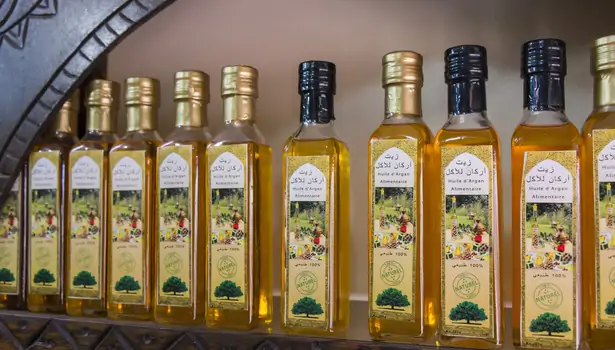
How to use argan oil in cooking?
Its price, aroma, and aromatic richness invite careful use. It is particularly suited for cold preparations or added after cooking.
You can drizzle a finet:
- into a vinaigrette;
- over roasted or steamed vegetables;
- into soup just before serving;
- over couscous or a legume dish;
- into amlou, a Moroccan almond-and-honey specialty.
It can withstand gentle cooking, but its delicate flavor is best preserved when used raw. Avoid smoking it or using it for repeated frying.
Never use an argan oil sold exclusively for cosmetics in food. Only a product explicitly labeled for culinary use guarantees that it is fit for consumption.
How to choose your argan oil properly?
Given the oil’s popularity, quality can vary considerably. Some products are refined, deodorized, or mixed with cheaper oils.
For a pure cosmetic oil, the ingredient list should ideally be limited to the mention “Argania Spinosa Kernel Oil”. The presence of other ingredients indicates a blend or a formulated care product.
Also favor:
- clearly indicated geographic origin;
- cold-pressed or mechanical pressing;
- an opaque bottle or tinted glass;
- precise traceability of the producer;
- a cooperative or supply chain ensuring fair compensation;
- organic certification if that criterion matters to you.
A pure cosmetic oil usually has a golden-yellow color and a subtle plant-based aroma. A complete absence of odor can indicate deodorization, without automatically meaning the product is of poor quality.
Properly store argan oil
Close the bottle tightly after each use. Keep it away from light, heat, and humidity. A rancid smell or unusual texture changes should prompt you to stop using the oil.
A precious oil, tied to a fragile ecosystem
The argan tree protects soils from erosion and helps curb desertification. It also supports the economic activity of many families in southwestern Morocco.
The global rise of argan oil can promote employment and the preservation of traditional know-how. It can also increase pressure on the trees if demand drives overexploitation.
Choosing a traceable oil produced in a responsible supply chain thus helps support both producers and the conservation of the argan grove.