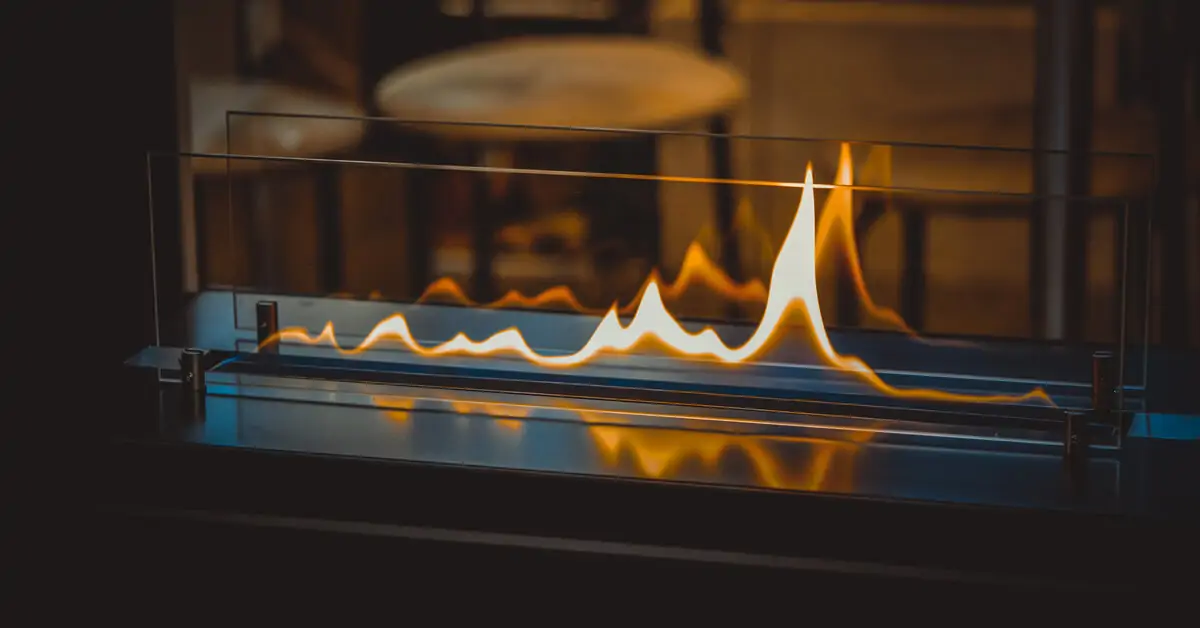
Practical and stylish, the bioethanol fireplace promises flame enjoyment without logs, ashes, or a smokestack. It’s especially appealing for decor enthusiasts and apartment dwellers. Yet this apparent ease shouldn’t make you forget about combustion, fuel costs, and burn hazards.
Is it a wood-burning replacement or a piece of salon ambience equipment? Here are the advantages, the limits, and the precautions worth knowing before investing.
Overview
- How does an ethanol fireplace work?
- What are its advantages?
- Heating and consumption: what are the limits?
- What safety and indoor-air risks exist?
- How to choose and use your unit?
- Is it truly eco-friendly?
- Frequently asked questions
How does an ethanol fireplace work?
An ethanol fireplace burns ethanol, also called ethyl alcohol, in a burner fed by a reservoir. Ethanol is derived from biomass, including sugar beet, grains, or sugarcane, produced through fermentation and distillation.
The prefix “bio” here signifies a biomass origin. It does not mean the fuel comes from organic farming.
Unlike a wood stove, a ventless decorative fire does not expel combustion byproducts outside. Those emissions remain in the room, which is a crucial point to understand its limitations.
Manual models require lighting and extinguishing according to the manufacturer’s instructions. Some units are automatic and offer electronic controls or a remote.
Autonomy depends on the reservoir, the burner, and the allowed settings. Check the technical specification rather than assuming a universal duration for all devices. Likewise, automatic shutoff after three hours is not a universal feature.
Ethanol fireplace: the advantages of a decorative hearth
The main appeal remains the visual show of fire. The flames are real, unlike the visual effect of an electric flame heater. They help create a warm ambiance without storing logs or dealing with ash.
Another advantage: a ventless model doesn’t require an exhaust installation. There’s no chimney to sweep, so no dedicated venting or flue is needed for this appliance. That said, it doesn’t excuse neglecting burner cleaning or the maintenance checks outlined in the manual.
From a decorative standpoint, options are plentiful: wall-mounted units, freestanding models, or built-in inserts. Sizes, materials, and finishes vary as well.
However, installation is not without constraints. A built-in unit demands appropriate materials and adherence to safety clearances. And a mobile model should never be moved while operating or while it’s still hot.
Does an ethanol fireplace actually heat, and at what cost?
A real warmth, but primarily decorative use
Claiming that an ethanol fireplace “barely heats” would oversimplify things. It does emit heat. The output varies by model, and a few kilowatts can meaningfully raise a room’s temperature.
However, this heat is not enough to serve as a primary heating source. The fire consumes oxygen and releases combustion byproducts into the living space. Adequate air exchange must be considered as well.
When choosing, look at the combination of power, hourly consumption, and usage limits. A stunning flame or long runtime does not by itself prove the device is an economical heating option.
How to calculate your ethanol consumption?
The purchase price depends on format, materials, and features. A small manual hearth and a large automatic model do not fit the same budget. Compare devices intended for the same use, along with their accessories and installation requirements.
For operation, use this formula:
Example: If a model consumes 0.3 liter per hour and you pay $4 per liter for the fuel, one hour costs $1.20.
With three hours of use per day for 21 days, the consumption would reach 18.9 liters, or about $75.60 in this scenario. This calculation illustrates a budget, not a recommended usage duration. Always follow the limits in the manual.
Before purchasing, replace these values with those of the model you’re considering and the compatible fuel. Avoid comparing to wood solely on price per liter or bag.
Ethanol fireplace: safety and indoor-air risks
Smoke-free combustion can still emit pollutants
Complete combustion of ethanol yields carbon dioxide and water vapor, while consuming oxygen. Since there is no exterior vent, these emissions stay in the room until they are diluted by ventilation.
Actual combustion can also release other substances. A 2026 study in the Journal of Hazardous Materials tested two fuels and two burner designs under low ventilation.
Researchers recorded increases in several pollutants, including particulates and volatile organic compounds. Formaldehyde frequently exceeded WHO guideline values in the studied conditions. Emissions varied by fuel and burner design.
These results do not describe every device or every home. They do remind us that the absence of visible smoke does not guarantee pollution-free combustion. Indoor air quality deserves as much attention as aesthetics.
Carbon monoxide and humidity: two safety concerns
Incomplete combustion can produce carbon monoxide. This colorless, odorless gas disrupts oxygen transport in the blood and can cause serious poisoning.
To recognize danger signals, consult our tips for staying safe from carbon monoxide.
Water vapor can also promote condensation when air exchange is insufficient. A damp or poorly ventilated room is therefore not ideal for this use.
A poisoning event should be considered, especially if several occupants report the same symptoms. Ventilate and shut off the appliance if it’s safe to do so. Evacuate immediately and call 911. Do not re-enter until responders give the all-clear.
Refilling while hot is an especially dangerous mistake
Ethanol is highly flammable. Pouring fuel into a burning or hot burner can trigger a flash fire and severe burns.
A flame can be hard to see in bright light. Never assume the stove is extinguished. Follow the extinguishing procedure, then wait for cooling and the manufacturer’s recommended time before refilling.
How to choose and use an ethanol fireplace?
Check standards and the manual before buying
The French standard NF D35-386, issued in 2009, remains current in AFNOR catalogs. Another standard, NF EN 16647-1, was released in December 2025. It covers ventless decorative fireplaces with manual operation for home use.
Ask the seller for the applicable standard for the model and the corresponding documentation. A simple “compliant” claim should be accompanied by documents identifying the specific device.
Also examine stability, flame-contact protections, the extinguishing mechanism, and refilling procedures. The French-language manual should outline installation, ventilation, and maintenance requirements.
Respect the room’s volume and air exchange
There isn’t a one-size-fits-all surface for every model. The generic guideline of “40 m² minimum” does not replace the product’s own requirements. The room’s volume, the unit’s power, and the ventilation must be considered together.
Never block air openings. Daily ventilation remains necessary, but it does not by itself guarantee proper conditions during combustion. Follow the device’s specific requirements.
For day-to-day living, see our tips for ventilating a home in winter. If the required conditions cannot be met, do not use the fireplace in that room.
Essential precautions during use
- Use only the fuel specified by the manufacturer: never gasoline, E85, or improvised mixtures.
- Do not refill a burning or hot burner. Respect the cooldown time and the maximum level indicated.
- Use the prescribed refilling accessories. If fuel spills, do not relight until cleaning and drying are complete per the manual.
- Maintain safe distances from curtains, furniture, and other flammable materials. Keep children and pets away.
- Monitor the flame and extinguish the unit before leaving the room or going to sleep.
- Store fuel in its proper container, closed, out of reach of children, and away from any heat source.
Is an ethanol fireplace really eco-friendly?
The biomass origin of the fuel alone does not guarantee a good environmental balance. It depends on the feedstocks, agricultural practices, processing energy, and transport.
Land-use changes can dramatically alter the climate impact of biofuels. It would be overstated to claim that all bioethanols are carbon-neutral. Conversely, attributing the same effects to all bioethanols in terms of deforestation would be too broad a generalization.
Moreover, the fuel’s climate balance and the indoor air pollution in the room are two separate questions. A biomass-derived product can still emit pollutants when burned in your home.
If your priority is simply the visual ambiance, an electric fireplace with a flame effect avoids combustion in the room. It does consume electricity, so compare that cost with the chosen mode of operation.
To reduce heating costs, start with the home’s needs, its insulation, and temperature regulation. A decorative fireplace does not replace this essential planning.
Ethanol fireplace: frequently asked questions
Can you install an ethanol fireplace in an apartment?
It can be feasible for a model sized to the space if the room’s volume, ventilation, and safety requirements are met. The lack of a vent does not guarantee compatibility with every apartment.
Can you use automotive ethanol (E85) in an ethanol fireplace?
No. E85 also contains gasoline and is not a suitable fuel for residential fireplaces. Use only the fuel specified in the manual.
Is an ethanol fireplace odorless and safe?
Those claims are too absolute. Odors can occur depending on the fuel or operation. An absence of odor does not guarantee air quality or rule out danger.