
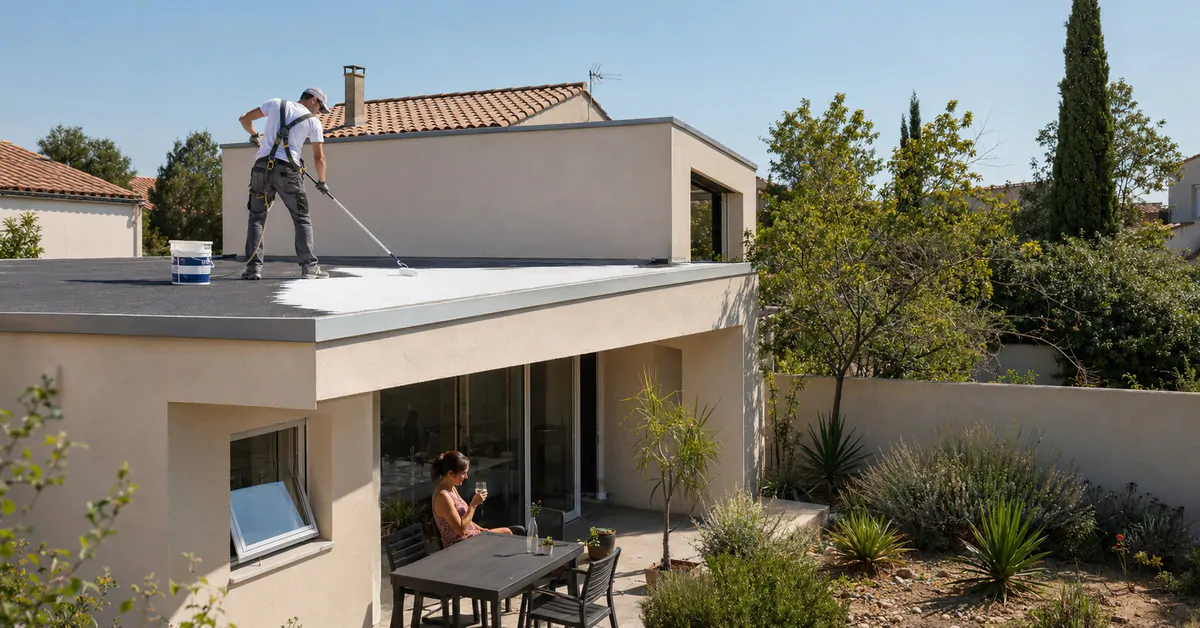
It’s a technique of striking simplicity: applying a white or reflective coating to roofs to bounce sunlight back instead of absorbing it. Initially confined to a niche market, this approach has now emerged as a major, affordable, and immediate solution to adapt the built environment and urban infrastructure to the challenges of climate change.
A Demand That’s Exploding
The cool-roof sector is recording an unprecedented acceleration in activity, directly tied to the frequency of heat waves. Specialized companies, such as start-ups Enercool, Alfacool, or the pioneer Cool Roof France, are seeing order volumes and revenues double or triple from one year to the next. The nature of projects is also evolving dramatically, with professionals now handling industrial and commercial surfaces on a massive scale, up to 50,000 square meters per project.
The effectiveness of this technology rests simply on the albedo effect, the ability of a light surface to reflect light and heat. By replacing traditional black bituminous coatings with a white finish, buildings drastically limit their internal heating. This solution can reduce indoor temperatures by 1°C to 7°C during heat waves (roughly 2°F to 13°F), offering a substantial summer comfort gain for employees and occupants without requiring heavy installations.
A Simple, Concrete Solution
Beyond thermal comfort, cool roofing fully fits within current environmental regulations that require a gradual and drastic reduction of energy consumption. By limiting overheating of infrastructure, these reflective coatings dramatically cut the need for artificial cooling. Industry professionals estimate that this reduction in cooling demand yields annual energy savings of roughly 15% to 20%.
Compared with costly thermal retrofit projects that often run into tens of thousands of dollars, the cool roof stands out for its financial accessibility. With an attractive average cost around $2 per square foot, the approach appeals to a wide range of economic actors. Grocery stores, distribution warehouses, data centers, and public service facilities like the U.S. Postal Service find it a highly cost-effective way to optimize their spending and future-proof their infrastructure.
A Global Cooling Strategy
To maximize the fight against extreme heat, many companies choose to pair the white roof with other passive or innovative solutions. At the city scale, widespread adoption of cool roofs is a powerful weapon to mitigate the urban heat island phenomenon, caused by the heat buildup of concrete and asphalt.
According to a 2024 university study conducted in London, mass white-roofing would outperform all other adaptation methods (such as greenspace or solar panels) by managing to lower the outdoor air temperature of a major city by an average of about 1.2°C (roughly 2°F) on extremely hot summer days.
Also worth reading
Paint Against Heat: The DIY Guide to Lower Your Roof Temperature.