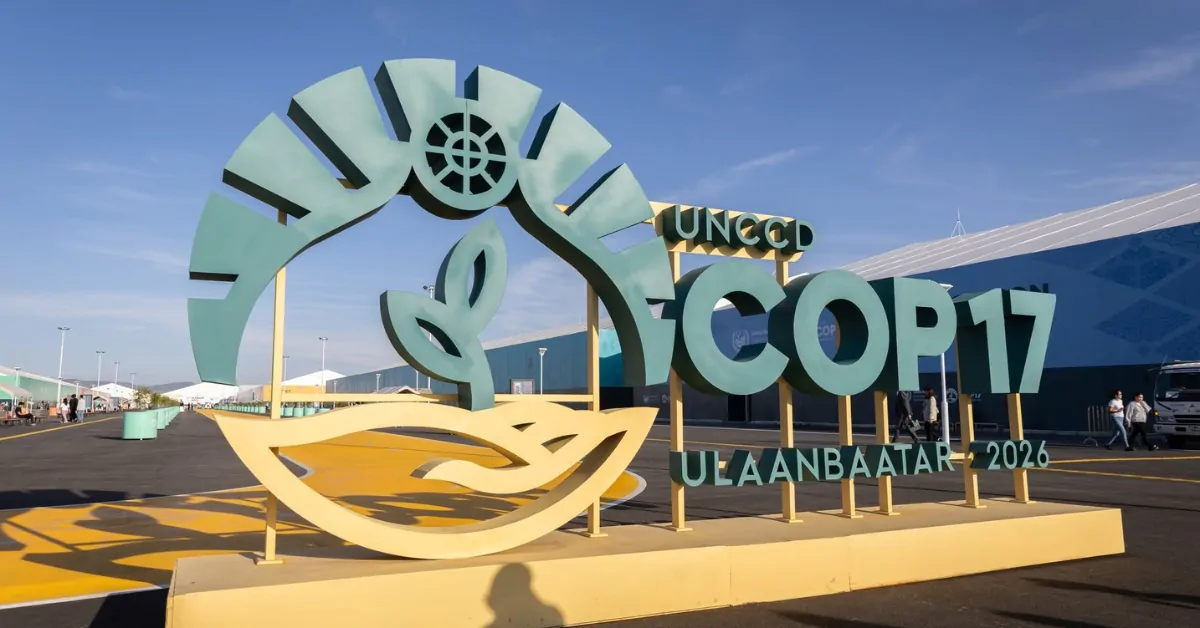
In Ulaanbaatar, countries are no longer merely expected to promise restoration; they must spell out how they will protect soils, water, pastures, and the people who depend on them.
A COP Specifically Dedicated to Desertification
The 17th Conference of the Parties to the United Nations Convention to Combat Desertification (UNCCD) began on August 17, 2026, in the Mongolian capital and is set to run through August 28. An army of 12,000 delegates from 197 countries is expected. After the COP16 held in Riyadh, Saudi Arabia officially handed the presidency of the process to Mongolia at the opening of the conference.
Long regarded as less visible than climate or biodiversity COPs, this conference nonetheless addresses a common foundation shared by all three crises: land. Desertification does not merely mean the dramatic advance of dunes. In the convention’s language, it denotes land degradation in arid, semi-arid, and dry sub-humid areas, driven by the combined effects of climate variations and human activities. Overgrazing, erosion, deforestation, poorly managed irrigation, unsustainable farming practices, and prolonged droughts can cause soils to lose productivity and their capacity to store water or carbon.
COP17 in Mongolia: a global land crisis
The scale of the problem explains why this COP17 extends far beyond the sole issue of deserts. Up to 40% of the planet’s lands are degraded today, while 75% of the Earth’s surface has been significantly transformed by human activities. Yasmine Fouad, Executive Secretary of the UNCCD, sums up the challenge with a maxim: The land is our most vital infrastructure.
Exposed populations now number in the billions. About 1.3 billion people are directly facing land degradation and 1.84 billion facing persistent drought. Since 2000, the frequency of droughts has risen by nearly a third. Meanwhile, arid lands cover about 46.2% of the land surface and house almost 3 billion people. The phenomenon is thus no longer marginal, geographically contained or limited to the poorest regions: it affects agricultural systems, water resources, and, gradually, the economic stability of many countries.
Pressure on soils directly feeds into food security. “At the heart of our discussions is food security,” said Yasmine Fouad. The equation is mechanical: less fertile soil holds water less effectively, produces less, increases crop vulnerability, and sometimes forces the expansion of cultivated areas, which can, in turn, accelerate degradation. Restoring land becomes a policy that is both agricultural and climate-oriented.
Governments have pledged to restore roughly one billion hectares by 2030, while the globally degraded area is estimated at 1.5 to 2 billion hectares. The gap between ambition and reality explains the shift in tone seen in Ulaanbaatar. “COP17 must not be a conference where decisions and declarations are merely repeated, but one where their implementation is accelerated,” said Mongolian Prime Minister Nyam-Osoryn Uchral.
Mongolia: An Extreme Desertification Laboratory
Choosing Mongolia as host country puts negotiators in direct contact with accelerated degradation. It had long been stated that 77% of Mongolian territory is degraded. Even more alarming, the new National Desertification Atlas, presented on August 12, 2026, raises the share of degraded land to 81.9%, to varying degrees, due to desertification or land degradation. The two figures should not be mechanically opposed: they may reflect different methodologies, timeframes, or categories. The new national assessment nonetheless measures the environmental pressure the country endures.
The indicators in this atlas are particularly stark. Between 1941 and 2025, Mongolia’s average annual temperature rose by 2.5°C. The intensity of droughts is increasing over 53.5% of the territory, while a trend of decreasing soil moisture is observed over 93.3% of Mongolia. Additionally, erosion risks are high: 54.8% of the land would be exposed to water erosion and 34.3% to wind erosion. Vegetation productivity would also be declining across 22.3% of the territory.
This vulnerability isn’t just about climate. In a country where extensive herding and grazing still shape a large portion of the rural economy, the quality of pasture directly determines income, mobility, and family security. Pastures cover roughly 70% of Mongolian territory and sustain nearly a third of the population. A less productive land means herds concentrated in smaller spaces, heightened water competition, and additional risks of overgrazing.
Mongolia aims to leverage the summit to push three initiatives: an international pasture initiative, a land-and-water integrated management program, and a nature-based solutions initiative applied to sustainable infrastructure. The country had also announced its intention to devote at least 1% of its GDP annually to addressing climate change and desertification. Hosting the summit allows it to turn a very concrete national vulnerability into a global diplomatic dossier.
COP17: Nations Face the Financing and Drought Wall
This is probably where the gap between commitments and implementation shows up most starkly. The global annual needs for restoring land and building drought resilience are estimated at about €306.8 billion, versus only €66.6 billion currently mobilized. The shortfall would thus run to nearly €240.3 billion per year. The private sector would contribute only about 6% of these global funds.
Still, substantial sums have already been pledged. More than €10.37 billion in commitments, after conversion, are linked to a fund and related initiatives for 74 drought-affected countries over seven years. More than 70 countries have also submitted national drought plans. Yet the journal notes that UNCCD estimates the needs through the end of the decade at roughly €2,247 billion. This disparity explains why COP17 is now trying to attract more private capital and secure financial mechanisms that are truly mobilizable.
Money, however, is only part of the negotiation. At Riyadh, during COP16, countries failed to agree on the form of an international instrument dedicated to drought. Several African nations backed the idea of a legally binding protocol; other Parties preferred less prescriptive provisions. The issue was thus deferred to Ulaanbaatar and represents one of the major political tests of COP17.
For the European Union, the priority is to move away from disaster-response logic once damage is already done. “We must stop managing drought as an emergency and instead bolster resilience before crises strike,” European Commissioner Jessika Roswall said on August 14, 2026. Brussels backs early-warning systems, risk reduction, and more sustainable soil and water management. Thirteen EU member states are themselves listed as affected by desertification under the UNCCD, signaling that the issue cannot be limited to the desert regions of the Global South.
Editorial – The Truth: A Climate That Disrupts
Grazing Lands and Vulnerable Countries: The Battle Over Land Use
Pastures should be one of the defining markers of this conference. Globally, they cover roughly 54% of the land surface, support livelihoods for about 2 billion people, and supply nearly 70% of the world’s livestock feed. Up to half of these spaces may already be degraded. UNRIC notes that they directly sustain the livelihoods of about 500 million people, a more conservative estimate focusing on populations directly dependent on these ecosystems.
This year, 2026, was proclaimed the International Year of Pastoralists and Pastures; the summit must address the role of mobile herders in restoring lands. For these communities, protecting soils does not necessarily mean rigidly fixing land-use rules. On the contrary, the ability to move herds allows avoiding sustained pressure on the same pasture and to track the seasonal availability of water and vegetation.
The issue underlines a central challenge in desertification fights: restoring one hectare is ineffective if land tenure rules, water access, or agricultural policies recreate the conditions that led to its degradation. The decisions negotiated in Ulaanbaatar must align ecological goals with user rights. This is especially crucial in countries where a large portion of the population depends directly on common lands, seasonal pastures, or fragile water resources.
National experiments are already highlighted as demonstrations. In its official COP17 space, China says it has rehabilitated approximately 15.33 million hectares of degraded grasslands since the start of its 14th Five-Year Plan. Programs for land defense and restoration covering much larger areas are underway. These figures, drawn from Chinese authorities and reported by the public agency, illustrate the scale that restoration policies can take; they do not by themselves address ecological quality, permanence of outcomes, or local governance.
That gap—from announced hectare to actually restored hectare—precisely what negotiators must make credible. Global indicators already show degradation advancing faster than the mechanisms designed to combat it. In Mongolia, where the drop in soil moisture now affects almost the entire country according to the new national atlas, discussions about pastures, water, financing, and drought prevention are not abstract: they determine the conditions under which a country can continue to produce, raise, move, and inhabit its lands.
Read also
Do you think COPs are useful for addressing global climate challenges?