ATMs, transit turnstiles, door-opening buttons, watches, spiral notebooks, scissors… Left-handers know it well: daily life is often designed for right-handed users. From childhood, they sometimes have to adapt to writing, cutting, tying their laces, or using everyday objects.
But why do we become left-handed or right-handed? This preference isn’t a simple choice. It depends on a complex mix of genetics, embryonic development and biological chance. A study published in Nature Communications in 2024 offers a new clue, without solving the full mystery.
Why are we born left-handed or right-handed?
Left-handers are a minority, but far from rare. A large meta-analysis published in 2020 estimates the proportion of left-handers at about 10.6%. This figure varies depending on the methods used to measure manual preference.
Laterality refers to the fact that certain functions are more readily handled by one side of the body or the brain. It concerns the dominant hand, but also the eye, the foot, or certain brain functions.
In daily life, this preference seems obvious. Yet its origin remains difficult to explain. Science today shows that it develops very early, probably during the first weeks of pregnancy.
The mysteries of lateralization
For a long time, it was thought that the right-hand preference dominated by default. The reality is more nuanced. The majority of humans are right-handed, but the persistent presence of left-handers in all populations intrigues researchers.
Lateralization depends in part on our genes. However, there is no single “left-handed gene” that fully explains why someone writes with their left hand. It is rather a suite of very fine mechanisms.
A 2024 study in Nature Communications allowed exploring this path with greater precision. Researchers analyzed the genetic data of more than 351,000 people from the UK Biobank.
A rare mutation more common in left-handers
Scientists did not focus on the most common genetic variations. They studied rare variants capable of directly altering the structure of certain proteins.
Result: a rare variant of the gene TUBB4B appears about 2.7 times more often in left-handers than in right-handers. This gene is involved in the production of microtubules, essential structures for the architecture of cells.
These microtubules play a role in organizing cells during development. They could therefore indirectly contribute to establishing brain asymmetry.
However, this discovery does not mean that TUBB4B “manufactures” left-handers. The researchers describe it as an additional clue. It sheds light on a small part of a much larger mechanism.
A large part of biological chance
Genetics does not explain everything. According to the researchers, chance also plays a significant role in lateralization.
During embryonic brain development, tiny fluctuations can influence how cells organize. The concentration of certain molecules at a precise moment could tilt the balance.
In other words, DNA would not decide our dominant hand on its own. It could mainly create a biological bias, stronger or weaker, toward right or left.
This also explains why two identical twins may not share the same dominant hand. Even with identical genetic heritage, their development may follow slightly different paths.
Left-handedness: a difference, not an anomaly
For a long time, left-handed people were thwarted at school or at home. Some children were even forced to write with the right hand. This practice is now considered inappropriate.
Being left-handed is not a disorder. It does not mean being clumsier, more creative, or more intelligent. These ideas, whether positive or negative, are often stereotypes.
However, left-handers still have to deal with objects designed for the right-handed majority. This can make certain actions more tiring, less fluid, or less comfortable.
So the real issue is not to “correct” left-handed people. It is to adapt the environment to avoid strain, poor posture, and frustration.
How to help a left-handed child daily?
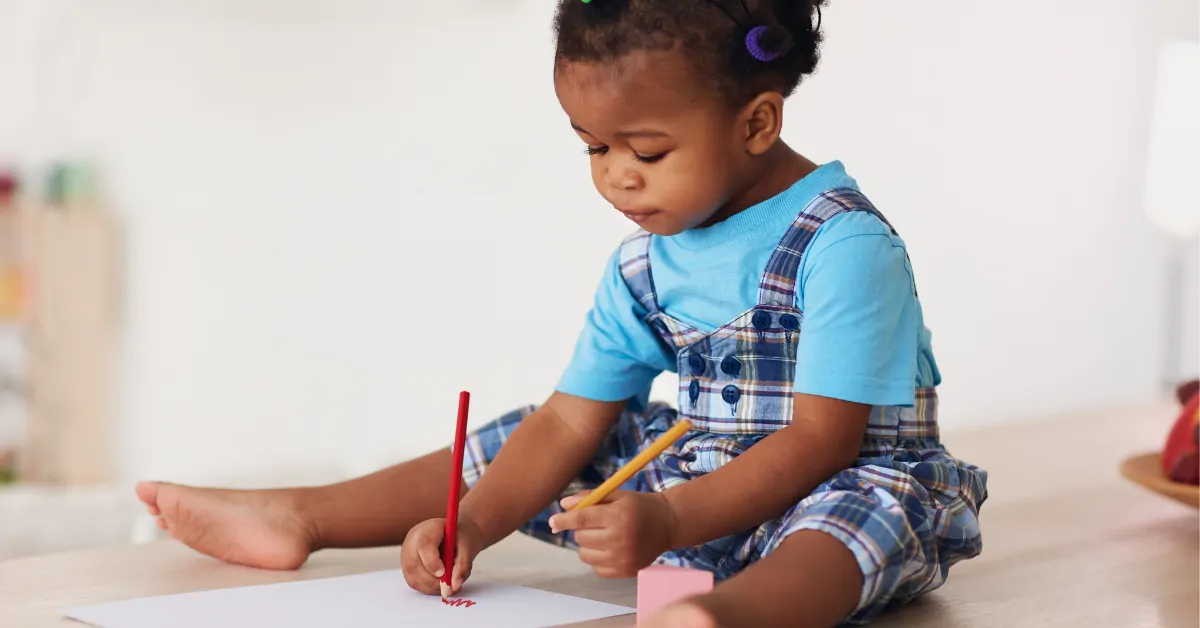
In children, hand preference can take time to establish. It is therefore useless to cut it off too early. The best approach is to observe their spontaneous gestures, without pressure.
For writing, several simple adjustments can be very helpful:
- Never force the right hand if the child naturally uses the left;
- place the left-handed child to the left of a right-handed child to avoid elbow bumps;
- shift the notebook slightly to the left;
- tilt the page to keep the hand in line with the forearm;
- choose a pen that dries quickly, to avoid ink smudges;
- prefer left-handed scissors if cutting becomes difficult;
- avoid the “bent” wrist posture over the writing line.
These tips may seem modest. Yet they can reduce fatigue, improve comfort and prevent unnecessary tension.
A small home test to observe handedness
Without turning this into an exam, you can watch the child in several situations. Which hand does he use to brush his teeth, throw a ball, draw or open a jar?
It’s possible that he uses one hand for writing and another for certain tasks. This is common, and it usually poses no problem.
In case of pain, significant slowness, or persistent difficulty writing, it’s best to seek advice. A teacher, an occupational therapist or a psychomotor therapist can help adjust posture and equipment.
Everyday objects: should you buy everything in left-handed versions?
Not necessarily. In a more restrained approach, it’s better to avoid blanket purchases. Some objects are truly useful in left-handed versions, such as scissors or some can openers.
Others can simply be adjusted. This is the case with the computer mouse, some smartwatches, or how a desk is organized.
Before buying, ask yourself three questions:
- Does the current object cause real discomfort?
- Is there a configurable or reversible solution?
- Can one find the right version second-hand?
This approach avoids overconsumption while respecting the comfort of the left-handed child or adult.
The International Left-Handers Day, a useful reminder
Every August 13, International Left-Handers Day highlights a simple reality. About one in ten people live in a world designed for the other hand.
This day also invites us to question our automatisms. A tool, a desk, a classroom, or a kitchen can be more inclusive without much effort.
Ultimately, left-handers are neither a mystery to be solved nor a curiosity to be idealized. They remind us that the majority norm isn’t always the most practical for everyone.