
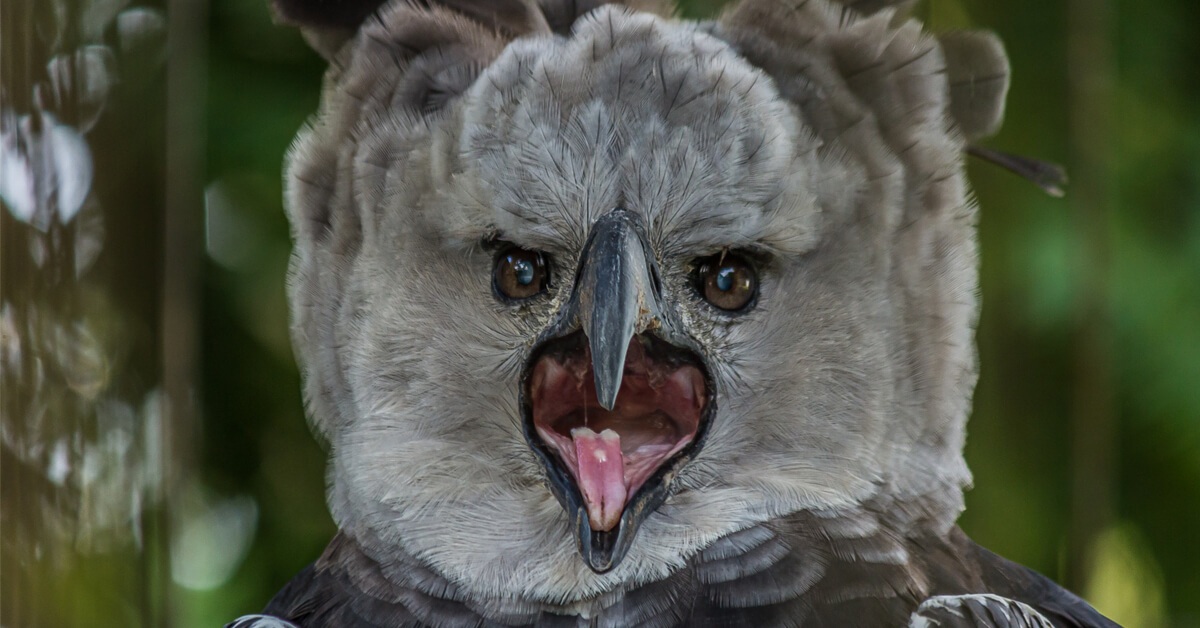
The Harpy Eagle (Harpia harpyja) is a raptor that lives on French soil… And yes, it is also found in French Guiana, which is worth noting, because France has responsibility for many exotic species as well! A bird of superlatives, the Harpy Eagle is well worth seeking out.
Biology of the Harpy Eagle
Always chasing sensationalism, many sites claim that the Harpy Eagle is the largest bird in the world, which is simply false.
The Ostrich stands much taller at the shoulder, about 1.5 m, compared to roughly 1 m for the Harpy Eagle. The same goes for its wingspan, 2.2 m, which the Albatross’s wingspan exceeds by about 1.3 m, totaling 3.5 m.
Nevertheless, the Harpy Eagle has utterly astonishing dimensions!
The Harpy Eagle is, indeed, an eagle, which is why it is also known as the Harpy Eagle, and it inhabits a large stretch of Central America—from Mexico down to Brazil, including Argentina, Venezuela, and even French Guiana. It frequents tropical rainforests where it moves through the canopy to hunt, reproduce, and rest.
Diet of the Harpy Eagle
With incredibly long talons measuring about 12.5 cm… Its average weight ranges from 7 to 9 kg (15–20 lb) for females and 5 to 8 kg (11–18 lb) for males. In short, it needs to eat a substantial amount of food to survive, but the Harpy Eagle is equipped to do so.
Certainly the largest diurnal raptor in the world, the Harpy Eagle is capable of hunting particularly large animals to feed on. Monkeys, for example, are often brought down by its talons (about 30% of its diet depending on the region), as well as dogs, sloths, agoutis, macaws, and even iguanas.
Snatching its prey with its talons, the Harpy Eagle can surprisingly maneuver through the trees before landing to tear them apart with a beak whose power exceeds that of a wolf.

Reproduction of the Harpy Eagle
Building their nests at vertigo-inducing heights that can exceed 40 m, Harpy Eagles are faithful raptors. A pair once formed stays together for life… A touch of poetry that could have inspired its name as well, far from the notion of ferocity.
The Harpy Eagle reaches its sexual maturity at 4 years, the age at which it begins to pair up, but at a relatively slow pace, producing one egg every 2 or 3 years.
After a 30-day incubation, the chick hatches and will be raised by the parents for six months.
An Important Role in Ecosystems
Like any top predator, the Harpy Eagle plays a crucial role in regulating its prey populations, especially capuchin monkeys. Indeed, these primates are known to particularly prey on bird eggs of all kinds, including many protected species.
By regulating the populations of these animals, the Harpy Eagle therefore helps many other species continue on their path!