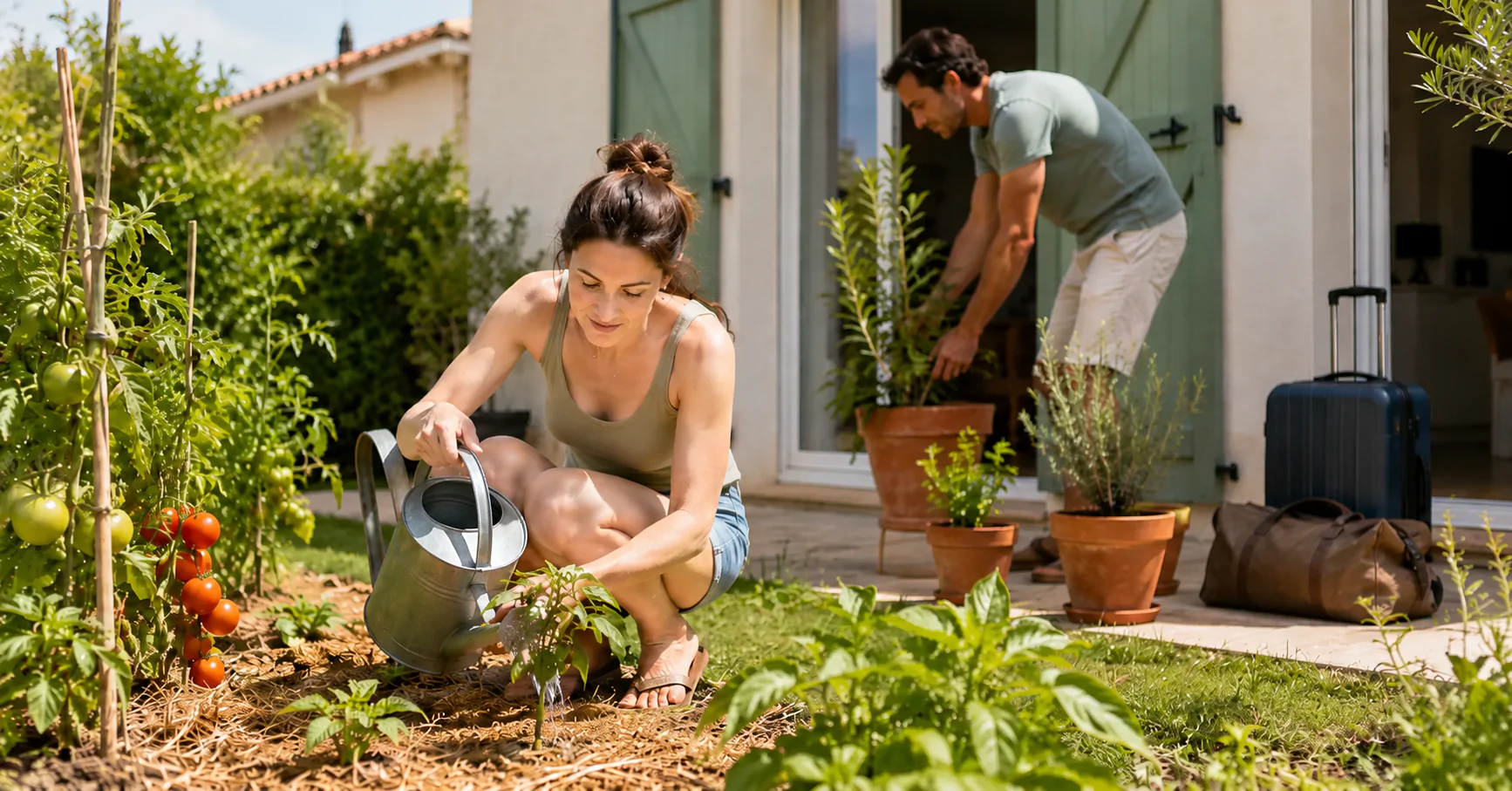
Summer is here, and with it comes vacation time—the long-awaited escape. Yet a question remains: how can you protect your garden while you’re away?
Between the heat, water shortages, and vegetables ripening quickly, a few precautions are essential. Fortunately, good planning lets you leave with peace of mind, without turning a friend into a full-time gardener.
What to Remember
– Test your irrigation system several days before departure.
– Water the soil deeply, then lay down a thick mulch.
– Gather pots in a bright area, but shield them from the scorching sun.
– Harvest ripe vegetables and remove spent flowers.
– Check local water restrictions before scheduling irrigation.
Preparing Your Garden Before Vacation
Careful preparation helps preserve plants without multiplying interventions during your absence. The idea is simple: anticipate essential needs without aiming for perfection.
If a neighbor or friend agrees to check in, prepare very clear instructions. The goal is to protect priority plants, not to tend every inch of the garden.
You can leave a sheet that includes:
– the plants to water first
– the approximate frequency of visits
– where the watering cans and hose are kept
– vegetables to harvest
– how the timer works
– a contact number in case of a leak
Place watering cans near the water source. You may also label fragile pots with a ribbon so they’re quickly identifiable.
Advice: run a trial with the person who will guard the garden. A few minutes are enough to avoid watering errors.
Cleaning the Garden Without Over-T pruning
A few days before departure, pull out the most invasive weeds. They compete with crops by stealing a portion of the available water.
Also remove wilted flowers. This allows plants to channel energy into new shoots and flower buds.
However, avoid heavy pruning right before vacation. It can weaken plants in hot weather and encourage tender shoots that suffer in dry conditions.
Harvesting ripe fruits and vegetables
Tomatoes, zucchinis, beans, and cucumbers can swell quickly in summer. Pick them before you leave, even if they still look a touch green.
This precaution reduces waste and sometimes encourages new fruit production. You can give the surplus away, freeze it, or can it.
Don’t forget to collect fruit that has fallen to the ground. It can attract wasps, flies, or some unwanted animals.
Mowing the Lawn: Don’t Cut It Too Short
A very short lawn tolerates heat less well. Direct sun on bare soil speeds up drying.
In summer, maintain a height of about 2.5 to 3 inches. You can also leave some taller patches to protect biodiversity.
Watering Effectively Before You Leave
The day before or the morning of departure, perform a slow, deep watering. Water should reach the roots, not just moisten the surface.
Water early in the morning or in the evening. During the hottest hours, water can evaporate before soaking into the soil.
Also avoid wetting the foliage unnecessarily. Direct the water to the base of the plants, especially tomatoes, zucchinis, and roses.
Mulching to Keep Moisture
After watering, cover the soil with about 2 to 3 inches of mulch. Use fallen leaves, straw, wood chips, or dry clippings.
Mulch slows evaporation, protects soil life, and limits weed growth. Keep it slightly away from the plant crown to prevent excessive moisture around the stem.
Choosing a Watering Method to Suit Your Vacation Length
Duration of absence | Possible solution
Two or three days | Deep watering, mulching, and moving pots into the shade
One week | Spaghetti irrigation (wick irrigation), ollas, drip irrigation, or a friend’s occasional visits
More than ten days | A tested programmable system and regular monitoring recommended
Whichever system you choose, test it at least three days before you leave. A poorly drilled bottle can empty in a few hours or fail to deliver water at all.
Also check fittings, timer batteries, and the flow of each emitter. A faulty automatic system can waste a lot of water.
Installing a Wick Watering System
The wick method works best for potted plants. It involves connecting the potting soil to a water-filled container.
1) Place a water container slightly above the pot.
2) Use a thick string or cotton strip.
3) Ensure the wick is fully moistened before installation.
4) Push one end into the potting mix.
5) Submerge the other end into the bottom of the container.
Water will rise gradually by capillarity. Again, a trial beforehand is essential to adjust the container size.
Protecting Container Plants From Heat
Potted plants heat up faster than soil-planted ones. Their water reserves are limited, especially in small or dark containers.
Group plants in a spot with clear shade. Grouping creates a microclimate that’s more humid and reduces wind exposure.
However, avoid a completely dark room. Plants still need natural light during your absence.
Are saucers a good idea?
A saucer can act as a small reservoir for certain water-hungry plants. It’s not suitable for species sensitive to stagnant moisture.
Don’t leave several inches of water standing for long. Roots can rot, and stagnant water can attract mosquitoes.
Health authorities advise removing or covering standing water around homes to limit mosquito breeding.
For large, immovable pots, install a light translucent shade cloth. A loose old curtain can also filter the sun without blocking airflow.
Using ollas for gradual irrigation
Ollas are porous clay pots buried in the soil. They steadily release water to the roots once filled and covered.
Choose olla size based on the plant bed and the length of your absence. Fill them before you go and always replace their lid.
The lid minimizes evaporation and also keeps insects, leaves, and small animals out of the vessel.
Rainwater Harvesting Without Creating a Mosquito Trap
A rain barrel can feed gravity irrigation. It must be fitted with a sealed lid and proper mosquito protection.
Check filters, the faucet, and fittings before you depart. A small leak can drain the entire reserve in a few hours.
Rainwater can be used to water the garden, but it should not be consumed or used for food preparation.
Inside the home, its uses are strictly regulated. It can power toilets or help clean floors under certain conditions.
Mistakes to Avoid Before Vacation
Some well-meaning actions can weaken the garden. Before you pack your bags, avoid:
– fertilizing plants heavily right before leaving
– pruning severely in hot weather
– leaving a pressurized hose without checking fittings
– installing an irrigation device that has never been tested
– drowning pots to create a water reserve
– mowing the lawn too short
– leaving ripe or damaged fruit on the ground
When You Return, Don’t Rush
A wilted plant isn’t necessarily dead. Start by checking soil moisture before giving it more water.
If the root ball is very dry, rehydrate gradually. For a pot, you can submerge the root ball for a few minutes and then let the water drain.
Then remove leaves that have dried out permanently. Wait a few days before adding fertilizer to let the plant recover.
With these precautions, your garden can weather your absence without wasting water. You’ll be able to enjoy your vacation to the fullest.
References:
– https://agirpourlatransition.ademe.fr/particuliers/economiser/eau/solutions-consommer-moins-eau-jardin
– https://www.anses.fr/fr/content/moustique-tigre
– https://www.ecologie.gouv.fr/politiques-publiques/secheresse
– https://vigieau.gouv.fr/
– https://www.service-public.fr/particuliers/actualites/A18382
– https://www.service-public.fr/particuliers/vosdroits/F31481
– https://agirpourlatransition.ademe.fr/particuliers/economiser/eau/solutions-consommer-moins-eau-jardin