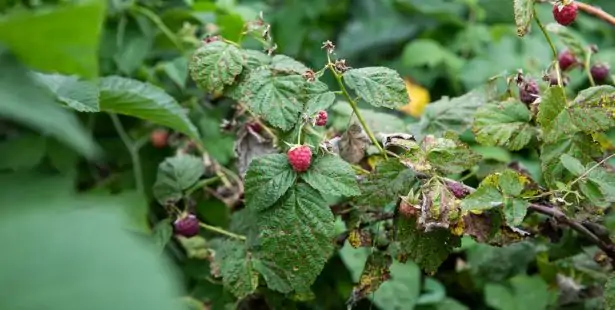
It’s in the summer, during the peak raspberry season—from June through August—that the first symptoms of a disease causing yellowing of the foliage appear. These symptoms stem from the development of anthracnose.
Why is my raspberry plant turning yellow and not producing berries?
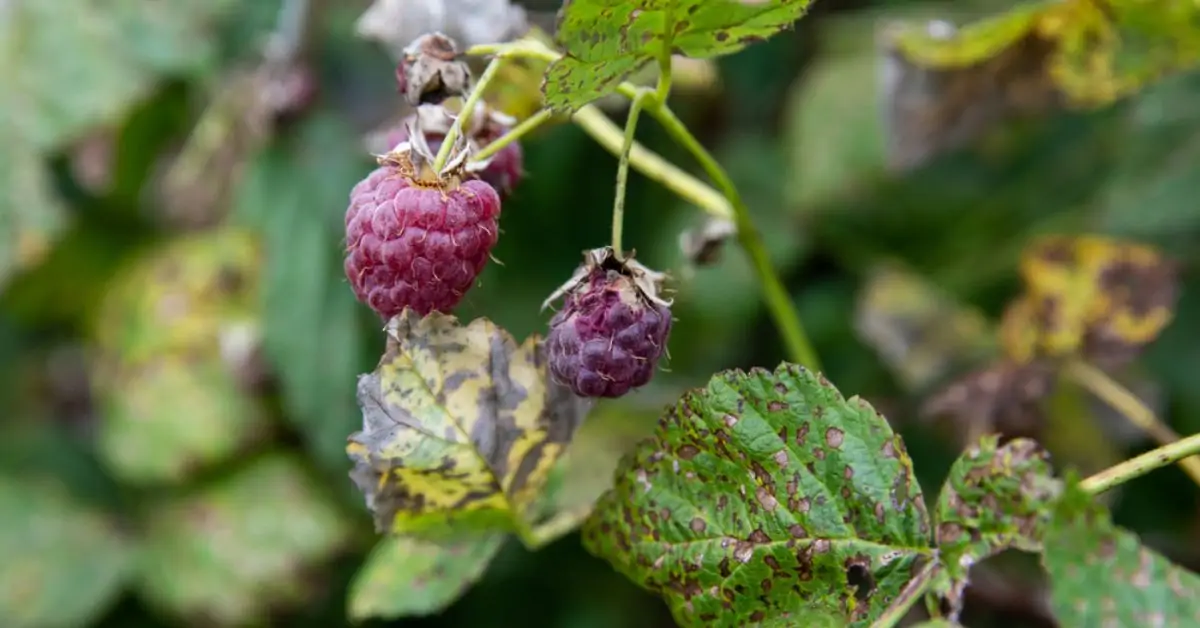
If your raspberry plant develops yellow leaves, a yellow tint that most often appears along the leaf veins, it’s due to a disease called anthracnose. It is, along with cane scorch, one of the most significant diseases of the raspberry plant. This pathology is usually severe when it appears and it also reduces the yield of the fruiting shrub, which then produces noticeably fewer raspberries.
In addition, anthracnose attacks the canes as well, which then develop small brown spots, and occasionally also the raspberries themselves, which become gray and inedible. Thus weakened, the plants are far less resistant to heat as well as to cold. The damaged parts may dry up and fall off. The lifespan of raspberry plants is shortened, and it’s high time to take action.
Be careful not to confuse anthracnose with another raspberry disease: Septoria leaf spot, which causes round spots with black specks in the center. By contrast, anthracnose produces roundish spots as well (2–3 mm in diameter) but with a pale center and a dark margin, symptoms caused by the presence of a fungus: Elsinoe veneta.
As for infected raspberries, anthracnose can also be confused with dull-spotted aphid feeding punctures, or other damage caused by rain or wind. To diagnose the presence of the fungus Elsinoe veneta on your raspberries, it’s best to rely on the appearance of the foliage and stems. How to treat a raspberry plant affected by anthracnose, a disease that can also affect cherry trees, but also tomatoes, vines, or currants?
Treating a Raspberry Plant for Anthracnose: Natural Treatments and Tips
You must act early to treat a raspberry plant afflicted with anthracnose, because the treatments are more preventive than curative. To prevent the fungus Elsinoe veneta from wreaking havoc on your raspberry, remove the leaves that start to yellow immediately and do not reuse them for mulching the raspberry bed or any other plant, since they are contaminated. It’s best to dispose of them entirely by burning them.
If the fungus Elsinoe veneta has had time to affect the entire raspberry plant, remove all damaged parts in the same way. Once the plant is rid of infected parts, spray with a Bordeaux mixture.
Another possible treatment: a 10% dilution of horsetail extract applied as a spray. Treat your raspberries about every 10 days in spring, through the end of August. At the early onset of infection, horsetail extract can even serve as a curative treatment as well as a preventive one. Garlic in an oil macerate or infusion can also act as a fungicide for raspberries.
Mind your watering of raspberries
Also keep in mind that anthracnose is a disease fostered by excessive humidity, which, combined with high heat, can cause damage. Summer storms provide ideal conditions for this pathogen. The fungus Elsinoe veneta also spreads through the irrigation water, which can splash other plant parts, but also via cultivation and pruning tools. Garden helpers (insects, birds, etc.) also contribute to its spread. Therefore, adopt good raspberry maintenance habits, including proper watering practices.
Tips to limit the spread of anthracnose: water at the base of your raspberry plants, avoiding splashing onto other parts. Likewise, don’t walk between the rows after watering or after a rainstorm, so as not to spread the fungus Elsinoe veneta to other plants. Thoroughly disinfect the tools you used for pruning or loosening soil.
Finally, note that the fungus can stay active for nearly two years in plant debris or soil. That’s why you should not rake up and reuse leaves or soil around infected plants, and do not use seeds from plants infected with anthracnose. In the garden, crop rotation and adequately spacing the rows helps limit the spread of this type of disease.